

Part 1: Recognising Acmella oleracea in the Field
Table of Contents
- Introduction: Why Correct Identification Matters
- Botanical Classification and Taxonomy
- Overall Plant Growth Habit
- Identifying the Leaves
- Conclusion to Part 1
Introduction: Why Correct Identification Matters
Correctly identifying Acmella oleracea is the first step towards successful cultivation, harvesting, botanical research, and commercial use. Although the plant is widely known by common names such as Buzz Button, Paracress, Electric Daisy, and Toothache Plant, these names are not always used consistently. In different countries, the same common name may refer to related species or even entirely different plants, making scientific identification essential.
For growers, accurate identification helps prevent unwanted species from entering cultivation. Researchers rely on authenticated plant material to produce reliable scientific data, while cosmetic manufacturers and food producers need confidence that the raw botanical material is genuinely Acmella oleracea. Even gardeners growing the plant for culinary or ornamental purposes benefit from recognising its characteristic features throughout each stage of development.
Unlike many plants that can be recognised from a single distinctive characteristic, Acmella oleracea is best identified by examining several botanical features together. Professional botanists study the plant's overall growth habit, leaves, stems, flowers, and seeds before confirming an identification.
This guide explains each of these characteristics in detail, beginning with the vegetative features that are visible long before the plant begins to flower.
Botanical Classification and Taxonomy
Understanding the botanical classification of Acmella oleracea provides useful context for recognising its physical characteristics and distinguishing it from related species.
Scientific Classification
| Rank | Classification |
|---|---|
| Kingdom | Plantae |
| Clade | Angiosperms |
| Clade | Eudicots |
| Clade | Asterids |
| Order | Asterales |
| Family | Asteraceae |
| Genus | Acmella |
| Species | Acmella oleracea (L.) R.K.Jansen |
Acmella oleracea belongs to the Asteraceae, commonly known as the daisy or sunflower family. This is one of the largest families of flowering plants, containing more than 30,000 species worldwide.
Members of the Asteraceae family share one defining characteristic: what appears to be a single flower is actually a composite flower head, made up of many tiny individual florets clustered together.
Although Acmella oleracea belongs to the same family as sunflowers, daisies, chamomile, calendula, and echinacea, it has a distinctive appearance that makes it relatively easy to recognise once its key characteristics are understood.

Scientific Name Versus Common Names
One reason botanists rely on scientific names is that common names vary greatly between regions and languages.
Some of the most widely used names include:
- Buzz Button
- Buzz Buttons
- Paracress
- Electric Daisy
- Toothache Plant
- Eyeball Plant
- Jambu (Brazil)
- Cresson de Pará
- Acmella
Using the scientific name, Acmella oleracea, ensures that growers, researchers, manufacturers, and consumers are all referring to the same botanical species.
Closely Related Species
Several members of the genus Acmella resemble Acmella oleracea, especially before flowering.
Other species may share:
- similar leaf shapes;
- branching stems;
- yellow flower heads;
- comparable growth habits.
For this reason, professional identification always considers multiple characteristics rather than relying on a single visual feature.
Overall Plant Growth Habit
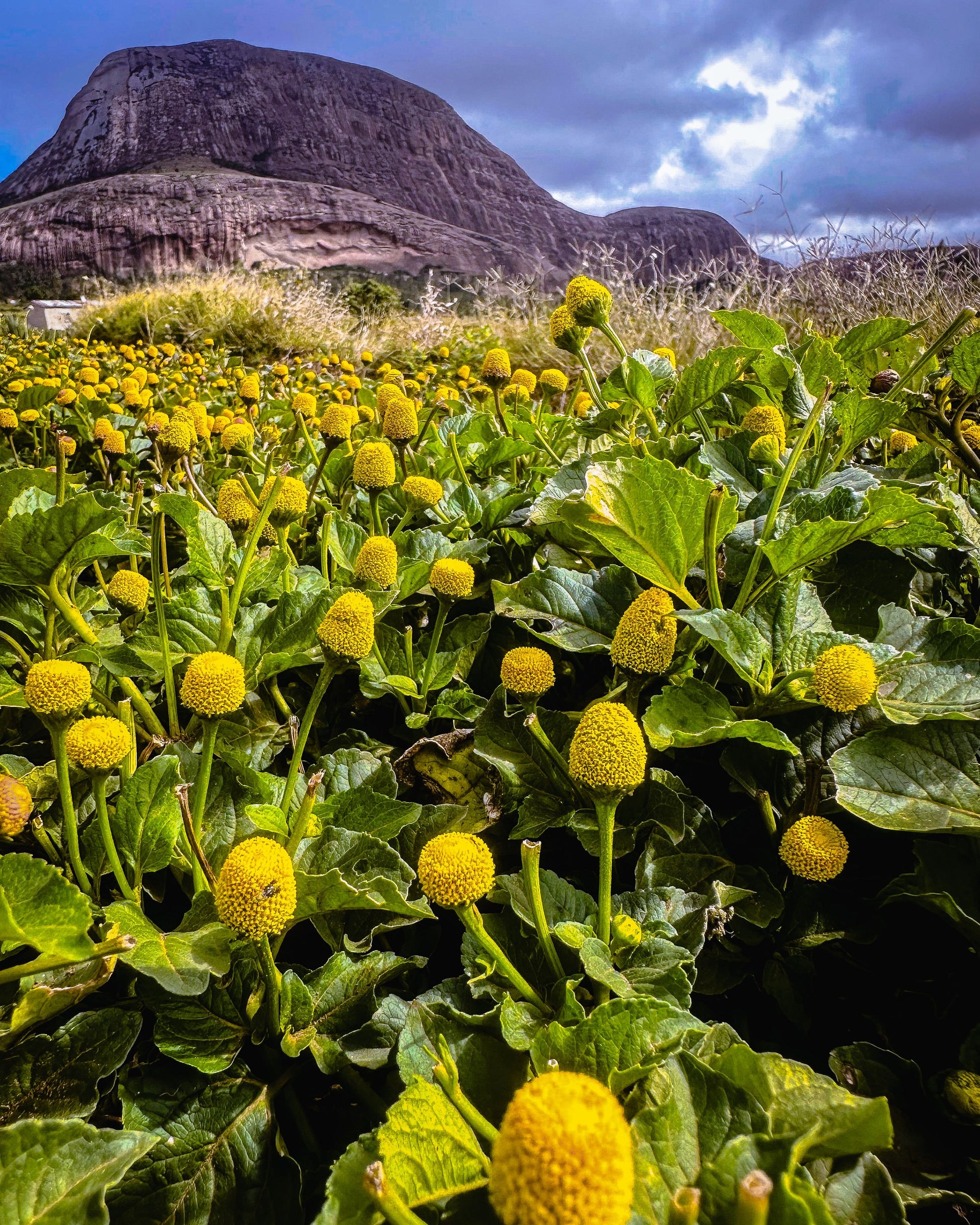
One of the easiest ways to recognise Acmella oleracea is by observing the entire plant before focusing on individual structures.
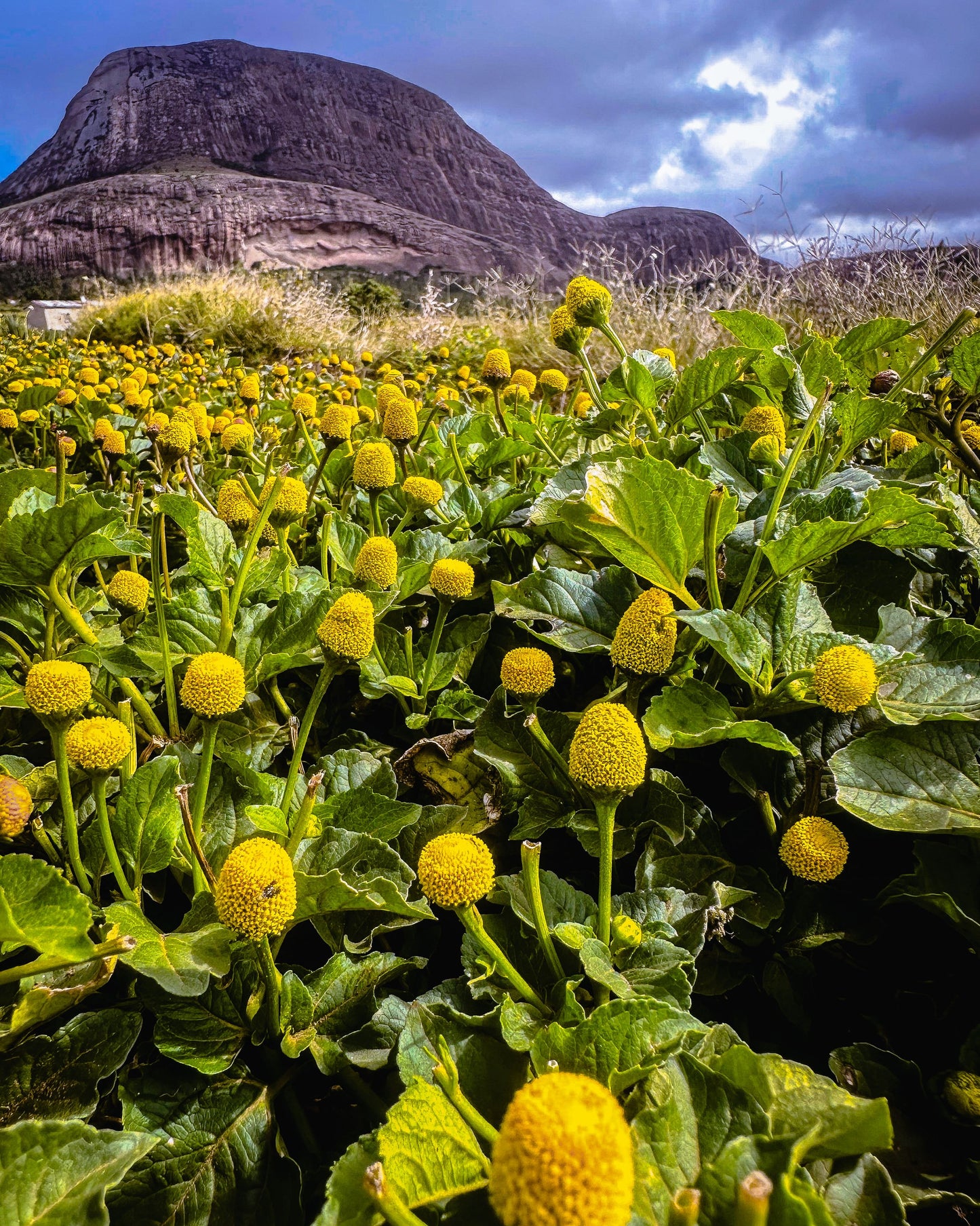
The species typically develops into a compact, freely branching herbaceous annual with a rounded or spreading appearance. Under favourable growing conditions, mature plants generally reach 20–50 cm (8–20 inches) in height, although exceptional plants may grow slightly larger in tropical climates.
Instead of producing one dominant upright stem, the plant branches repeatedly from the lower nodes, creating a dense canopy of foliage and numerous flowering stems.
Healthy plants often appear:
- compact;
- vigorous;
- highly branched;
- bright green;
- densely covered with leaves.
This bushy growth habit distinguishes Acmella oleracea from many upright culinary herbs.
Growth During the Life Cycle
The appearance of Acmella oleracea changes considerably as it matures.
Understanding these developmental stages helps improve field identification.
Seedling Stage
After germination, young seedlings produce:
- two smooth cotyledons;
- a short green stem;
- the first pair of true leaves.
At this stage, many members of the daisy family appear similar, making positive identification more difficult.
Vegetative Stage
As growth accelerates, the plant develops:
- opposite leaves;
- multiple side branches;
- thicker stems;
- increasingly vigorous foliage.
The plant begins to take on its characteristic rounded appearance during this phase.
Flowering Stage
As maturity approaches, flower stalks emerge from the growing shoots.
Flowering occurs continuously over an extended period, allowing several developmental stages to be present simultaneously, including:
- unopened buds;
- newly opened flower heads;
- mature flowers;
- developing seed heads.
This continuous flowering is one of the reasons Acmella oleracea is valued in both horticulture and commercial cultivation.
Identifying the Leaves
Before flowers appear, the leaves provide some of the most useful clues for recognising Acmella oleracea. Although leaf characteristics alone are not sufficient for definitive identification, they offer valuable diagnostic features when considered together with the plant's overall growth habit.
Opposite Leaf Arrangement
One of the easiest characteristics to observe is the opposite arrangement of the leaves.
Each node produces:
- one leaf on one side of the stem;
- another directly opposite.
This pattern continues along much of the stem and immediately distinguishes the plant from many species with alternate leaves.
Leaf Shape
The leaves are typically:
- ovate;
- broadly lanceolate;
- slightly elongated.
They gradually taper towards the tip while remaining wider through the middle of the blade.
Typical mature leaves measure approximately:
- 3–7 cm long
- 2–5 cm wide
although environmental conditions can influence size.
Leaf Margins
The leaf edges are distinctly serrated.
Rather than having smooth margins, the leaves display numerous small, evenly spaced teeth around their edges.
The serrations are clearly visible but are not deeply cut like those of some other Asteraceae species.
Leaf Surface
Healthy leaves are usually:
- smooth;
- soft to the touch;
- bright green;
- slightly glossy.
The upper surface generally appears darker than the underside.
Prominent veins radiate from the central midrib, creating a clearly visible vein network across the leaf blade.
Leaf Texture
The leaves are relatively thin but remain firm and flexible.
Unlike some members of the daisy family, they are not heavily hairy or rough.
This smooth texture contributes to the plant's fresh appearance and makes the foliage attractive for culinary use.
Petiole
Each leaf attaches to the stem by a short petiole.
The petiole allows the leaf blade to move freely with wind and sunlight while maintaining efficient light exposure for photosynthesis.
Young Versus Mature Leaves
Leaf appearance changes as the plant develops.
Young leaves are generally:
- smaller;
- lighter green;
- thinner;
- more delicate.
Older leaves become:
- broader;
- darker green;
- thicker;
- more strongly veined.
Recognising these normal developmental differences helps prevent confusion with nutrient deficiencies or disease.
Why Leaves Alone Are Not Enough
Although the leaves provide several important identification clues, they should never be used as the sole basis for identifying Acmella oleracea.
Many related species possess similar:
- leaf shapes;
- serrated margins;
- branching growth habits.
Professional botanists therefore examine multiple plant structures before confirming species identity.
The flower heads, stem characteristics, and seed morphology provide additional evidence that significantly improves identification accuracy.
Conclusion to Part 1
Correct identification of Acmella oleracea begins with understanding the plant as a whole rather than focusing on a single feature. As a member of the Asteraceae family, it develops into a compact, branching annual with opposite, serrated leaves, smooth green foliage, and a vigorous growth habit that becomes increasingly distinctive as the plant matures. These vegetative characteristics provide valuable clues during cultivation, especially before flowering begins.
However, reliable botanical identification requires more than leaf shape alone. Closely related species may share similar foliage, making it important to examine the complete plant. In Part 2, we will explore the structures that make Acmella oleracea unmistakable: its branching stems, unique cone-shaped flower heads, composite florets, flowering pattern, and the reproductive features that distinguish it from other members of the daisy family.
Part 2: Identifying the Stems and Flowers
Table of Contents
- Stem Characteristics
- Understanding the Flower Head
- Flower Development and Blooming
- Distinguishing Acmella oleracea from Similar Species
- Conclusion to Part 2
Stem Characteristics
Although the bright yellow flower heads usually attract the most attention, the stems of Acmella oleracea provide several reliable identification features throughout the growing season. When combined with the leaves and flowers, these characteristics help distinguish the species from other members of the Asteraceae family.
Healthy stems are typically:
- bright green;
- smooth;
- succulent when young;
- increasingly firm with age;
- highly branched.
Unlike woody shrubs, Acmella oleracea remains an herbaceous plant throughout its life cycle.
Young Stems
Shortly after germination, the stem is soft and flexible.
Young stems typically display:
- a light green colour;
- smooth epidermis;
- rapid elongation;
- short internodes;
- opposite leaf pairs.
At this stage, the plant invests most of its energy in vegetative growth before flowering begins.
Mature Stems
As the plant develops, stems become:
- thicker;
- stronger;
- darker green;
- extensively branched.
Numerous lateral branches emerge from the leaf nodes, allowing a single plant to produce dozens of flower heads during the flowering season.
This branching habit contributes significantly to the plant's compact, bushy appearance.
Stem Texture
Unlike many ornamental daisies, the stems of Acmella oleracea are generally:
- smooth;
- slightly glossy;
- only sparsely hairy, if at all.
They often retain a degree of succulence, especially when grown under warm, humid tropical conditions.
Internodes
The internodes—the sections of stem between successive leaf nodes—are relatively short.
Short internodes produce:
- dense foliage;
- compact growth;
- closely spaced branches.
Plants grown in low light may develop slightly longer internodes as they stretch toward available sunlight.
Branching Pattern
One of the most recognisable characteristics of mature plants is their extensive branching.
Every branch has the potential to produce:
- additional leaves;
- new side shoots;
- flower stalks;
- mature flower heads.
This repeated branching enables healthy plants to remain productive over an extended flowering period.
Understanding the Flower Head
The flower head is the defining feature of Acmella oleracea and is usually the easiest way to identify the species once flowering begins.
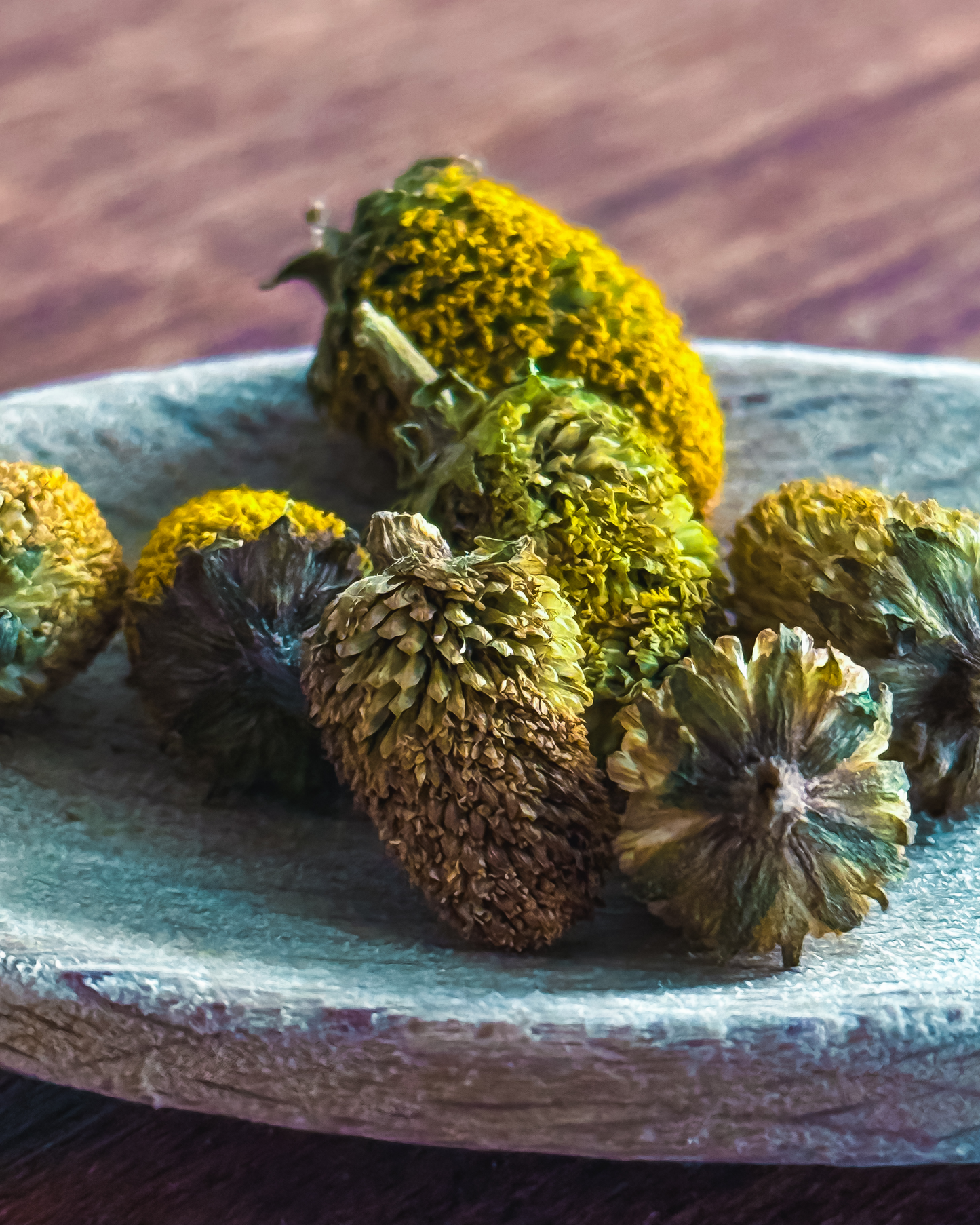
Although commonly described as a flower, the yellow structure is actually a composite flower head, or capitulum, made up of many tiny individual florets grouped together.
This composite arrangement is characteristic of the Asteraceae family.
Overall Shape
Perhaps the most distinctive feature is the flower head's unique shape.
Rather than producing flat daisy-like flowers with obvious petals, Acmella oleracea develops:
- cone-shaped;
- oval;
- button-like;
- slightly elongated flower heads.
The mature flower resembles a small yellow cone standing upright above the foliage.
This characteristic appearance explains the popular name Buzz Button.
Size
Individual flower heads are relatively small.
Most mature flowers measure approximately:
- 1–2 cm in height
- 0.8–1.5 cm in diameter
although growing conditions and plant health influence final size.
Colour
Flower colour changes slightly during development.
Young flower heads appear:
- pale green;
- yellow-green.
As maturity progresses, they become:
- bright yellow;
- golden yellow;
- occasionally slightly deeper yellow at full maturity.
The colour remains remarkably uniform across healthy plants.
Surface Appearance
Looking closely, the flower head is not smooth.
Instead, it consists of hundreds of tiny tubular florets packed tightly together.
This creates a finely textured surface with a honeycomb-like appearance under magnification.
Each visible segment represents an individual flower within the composite head.
Do Buzz Buttons Have Petals?
One question often asked is whether Acmella oleracea has petals.
The answer is:
Usually not.
Unlike ornamental daisies, Acmella oleracea typically lacks the large white ray florets that people associate with traditional daisy flowers.
Instead, almost the entire flower head consists of small yellow disc florets.
Occasionally, some cultivated varieties may produce a few inconspicuous ray florets, but these are usually absent or extremely reduced.
Flower Development and Blooming
Observing flower development helps growers determine plant maturity and optimal harvest timing.
Flower heads undergo several clearly recognisable stages before producing seeds.
Stage 1: Flower Bud
The earliest flower buds appear as:
- small green spheres;
- tightly closed structures;
- short upright stalks.
At this stage, the flower is protected by overlapping green bracts.
Stage 2: Early Flowering
As flowering begins:
- the bud enlarges;
- yellow colour becomes visible;
- the cone shape develops.
Individual florets gradually begin opening from the outer regions toward the centre.
Stage 3: Full Bloom
At maturity, the flower reaches its characteristic appearance.
Healthy flower heads are:
- bright yellow;
- upright;
- firm;
- fully developed.
This stage is generally the easiest for field identification.
Stage 4: Seed Development
Following flowering:
- florets complete pollination;
- seeds begin forming;
- the flower gradually dries.
The bright yellow colour slowly fades as the seed head matures.
Flowering Period
One of the advantages of Acmella oleracea is its extended flowering season.
Rather than flowering only once, healthy plants continuously produce new flower heads.
A mature plant often carries:
- unopened buds;
- developing flowers;
- mature flowers;
- seed heads.
This continuous flowering greatly increases harvest opportunities for growers.
Distinguishing Acmella oleracea from Similar Species
Several plants resemble Acmella oleracea at first glance, particularly before flowering.
Careful observation helps avoid misidentification.
Compared with Ornamental Daisies
Traditional daisies usually have:
- white petals;
- broad flower heads;
- flat floral discs.
Acmella oleracea differs by producing:
- yellow button-like flower heads;
- little or no visible petals;
- elongated cone-shaped capitula.
Compared with Chamomile
Chamomile develops:
- feathery leaves;
- white ray florets;
- aromatic flowers.
Acmella oleracea has:
- broader leaves;
- smooth stems;
- yellow cone-shaped flower heads.
The differences become immediately obvious once both species flower.
Compared with Other Acmella Species
Closely related species within the genus may resemble Acmella oleracea.
Professional botanists therefore evaluate:
- leaf arrangement;
- flower structure;
- seed characteristics;
- growth habit;
- botanical measurements.
Using several characteristics together produces the most reliable identification.
Why the Flower Is the Best Identification Feature
Although leaves and stems provide useful clues, the mature flower head is generally considered the most reliable field characteristic.
Its unique combination of:
- cone-shaped structure;
- bright yellow colour;
- absence of large petals;
- upright growth;
- compact size
makes Acmella oleracea relatively easy to recognise during the flowering season.
For growers, the appearance of mature flower heads also signals that harvest planning can begin, depending on the intended use of the plant.
Conclusion to Part 2
The stems and flowers provide the most distinctive visual characteristics of Acmella oleracea. Smooth, highly branched green stems support a succession of upright flower stalks, while the plant's unmistakable cone-shaped yellow flower heads distinguish it from most other members of the daisy family. Unlike ornamental daisies with prominent white petals, Acmella oleracea produces compact composite flower heads made almost entirely of tiny yellow disc florets, giving rise to the familiar names Buzz Button and Electric Daisy.
Understanding how the flower develops—from the first green bud through full bloom and eventual seed formation—also helps growers identify the ideal stage for cultivation, harvesting, or seed production. When combined with the vegetative characteristics discussed in Part 1, these reproductive features allow accurate identification in the field.
In Part 3, we will complete the botanical guide by examining the seeds, root system, and complete life cycle of Acmella oleracea. We will also provide a practical field identification checklist, discuss common identification mistakes, and explain how botanists distinguish genuine Acmella oleracea from similar species with confidence.
Part 3: Seeds, Root System and Complete Field Identification
Table of Contents
- Identifying the Seeds
- Understanding the Root System
- Seasonal Growth and Life Cycle
- Common Identification Mistakes
- Field Identification Checklist
- Final Scientific Perspective
- Key Takeaways
Identifying the Seeds
Although the flower heads attract most attention, the seeds of Acmella oleracea play an equally important role in species identification, propagation, and cultivation. Understanding how seeds develop and what they look like helps growers produce healthy future crops while allowing botanists to confirm plant identity after flowering has finished.
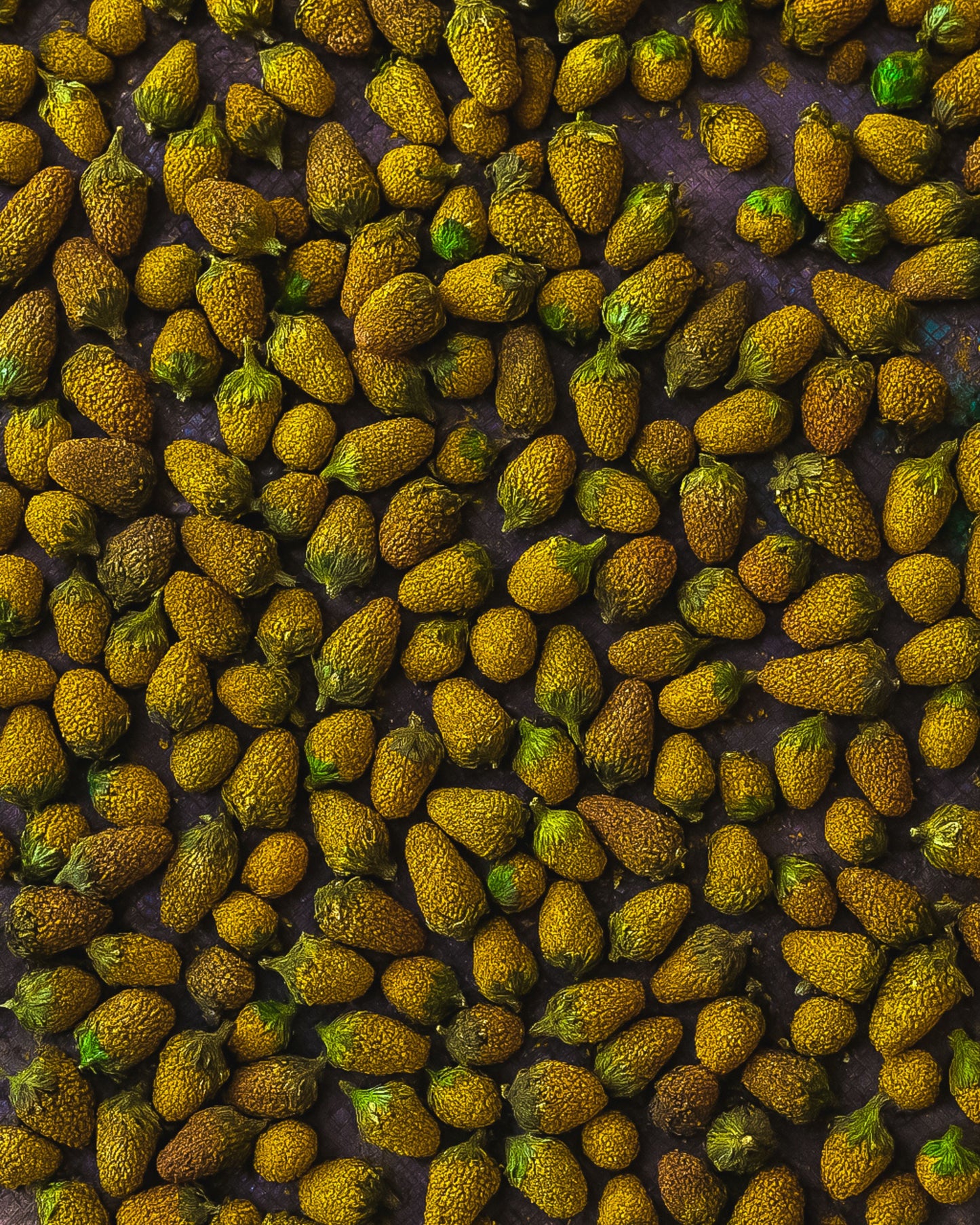
Like other members of the Asteraceae, Acmella oleracea produces dry, single-seeded fruits known as achenes. Each achene develops from an individual floret within the composite flower head.
How Seeds Develop
After successful pollination, each tiny floret inside the flower head begins forming its own seed.
As the flower matures:
- the bright yellow florets gradually dry;
- the flower head becomes firmer;
- individual achenes complete development;
- moisture content decreases.
Eventually, the mature seed head turns brown and releases seeds naturally if left on the plant.
Seed Appearance
Mature seeds are very small and lightweight.
Typical characteristics include:
- dark brown to black colour;
- elongated shape;
- slightly flattened profile;
- smooth outer surface.
Individual seeds generally measure only a few millimetres in length, making careful handling important during collection and sowing.
Seed Viability
Seed quality depends on several factors, including:
- flower maturity;
- growing conditions;
- drying practices;
- storage conditions.
Fresh, well-developed seeds generally exhibit higher germination rates than immature or poorly stored material.
To maintain viability, seeds should be stored in:
- cool conditions;
- dry environments;
- airtight containers;
- protection from direct sunlight.
Collecting Seeds
Seed collection begins only after flower heads have fully matured.
Growers typically wait until:
- flower heads become dry;
- seeds darken;
- moisture has largely disappeared.
Harvesting too early may reduce seed viability because embryos have not completed development.
Understanding the Root System
While the aerial parts of Acmella oleracea are most familiar, the underground root system also contributes to successful identification and cultivation.
The species develops a relatively shallow but highly branched fibrous root system that efficiently absorbs water and nutrients from fertile soils.
Fibrous Roots
Unlike plants with a dominant taproot, Acmella oleracea develops numerous fine roots extending outward from the base of the stem.
This fibrous system provides:
- excellent soil contact;
- efficient nutrient uptake;
- rapid establishment;
- good anchorage.
The branching root network also supports the plant's vigorous vegetative growth.
Root Colour
Healthy roots are typically:
- white;
- cream-coloured;
- pale tan as they mature.
Dark, soft, or foul-smelling roots may indicate disease or excessive soil moisture rather than normal development.
Root Growth
Most roots occupy the upper layers of the soil where moisture, oxygen, and nutrients are readily available.
Well-drained soils encourage:
- healthy branching;
- vigorous plant growth;
- continuous flowering.
Waterlogged conditions, however, may reduce oxygen availability and negatively affect root health.
Seasonal Growth and Life Cycle
Recognising Acmella oleracea becomes easier when its complete life cycle is understood.
Although growth rate varies according to climate, the plant generally follows a predictable sequence from germination to seed production.
Stage 1: Germination
Under favourable conditions, seeds absorb moisture and begin germinating.
The emerging seedling produces:
- a primary root;
- two cotyledons;
- the first true leaves.
Warm temperatures and consistent soil moisture promote successful establishment.
Stage 2: Vegetative Growth
Rapid vegetative growth follows germination.
During this phase the plant develops:
- multiple branches;
- opposite leaves;
- expanding root systems;
- vigorous foliage.
Most of the plant's energy is directed toward producing biomass before flowering begins.
Stage 3: Flower Initiation
As environmental conditions become favourable, flower buds begin forming at the growing tips.
The first flower heads gradually emerge above the foliage.
Healthy plants continue producing new flowering shoots throughout the season.
Stage 4: Peak Flowering
Mature plants may carry dozens of flower heads simultaneously.
At any given time, a single plant often contains:
- unopened buds;
- developing flowers;
- fully open flower heads;
- maturing seed heads.
This continuous flowering pattern makes Acmella oleracea especially productive.
Stage 5: Seed Production
As flowering concludes, energy shifts toward seed development.
Mature flower heads dry naturally before releasing viable seeds.
These seeds complete the annual life cycle and allow future generations to establish.
Common Identification Mistakes
Despite its distinctive flowers, Acmella oleracea is occasionally confused with other species, particularly during early growth.
Understanding these common mistakes improves identification accuracy.
Mistake 1: Relying Only on Common Names
Names such as:
- Buzz Button;
- Electric Daisy;
- Toothache Plant;
- Paracress
may be applied inconsistently depending on the country or region.
Always confirm identification using the scientific name:
Acmella oleracea
Mistake 2: Identifying Plants Before Flowering
Young seedlings often resemble other members of the Asteraceae family.
Before flowering, identification should consider:
- opposite leaves;
- branching pattern;
- growth habit.
Flower characteristics remain the most reliable distinguishing feature.
Mistake 3: Looking Only at the Leaves
Although leaf shape provides useful information, many related species possess similar foliage.
Accurate identification should include:
- stems;
- flower heads;
- seed structure;
- overall plant architecture.
Mistake 4: Confusing Immature Flowers with Mature Flowers
Early flower buds differ considerably from mature cone-shaped flower heads.
Waiting until flowering is well established significantly improves identification confidence.
Mistake 5: Ignoring Plant Development
Plants naturally change throughout the growing season.
Seedlings, vegetative plants, flowering plants, and mature seed heads all appear different.
Understanding these developmental stages prevents normal growth from being mistaken for abnormal variation.
Field Identification Checklist
When identifying Acmella oleracea in the field, professional botanists evaluate multiple characteristics simultaneously.
A healthy mature plant should display most of the following features:
✅ Opposite leaf arrangement
✅ Bright green serrated leaves
✅ Smooth herbaceous stems
✅ Extensive branching
✅ Upright flowering stalks
✅ Small yellow cone-shaped flower heads
✅ Little or no visible ray petals
✅ Composite flower heads composed of numerous tiny florets
✅ Fibrous root system
✅ Small dark achenes after flowering
No single characteristic confirms identification on its own. Instead, confidence increases as multiple diagnostic features are observed together.
Why Multiple Characteristics Matter
Botanical identification relies on recognising the complete combination of plant characteristics rather than searching for one defining feature.
Professional botanists compare:
- vegetative structures;
- reproductive structures;
- developmental stages;
- habitat;
- taxonomic characteristics.
This integrated approach provides much greater reliability than evaluating leaves or flowers in isolation.
Final Scientific Perspective
Correct identification of Acmella oleracea requires a holistic understanding of the plant throughout its entire life cycle. While the species is best known for its distinctive yellow Buzz Button flower heads, reliable identification begins much earlier with its opposite serrated leaves, smooth branching stems, compact growth habit, and fibrous root system. As the plant matures, its cone-shaped composite flower heads, followed by the formation of small dark achenes, provide increasingly reliable diagnostic characteristics that distinguish it from closely related members of the Asteraceae family.
No single feature should be used in isolation. Professional botanists examine multiple vegetative and reproductive traits together, recognising that plant appearance changes naturally from germination through flowering and seed production. Understanding these developmental stages not only improves identification accuracy but also helps growers determine the best timing for cultivation, harvesting, seed collection, and quality assessment.
For researchers, farmers, cosmetic manufacturers, chefs, and gardeners alike, accurate species identification forms the foundation of every subsequent activity involving Acmella oleracea. Whether the goal is scientific research, botanical extraction, culinary innovation, or sustainable cultivation, recognising the authentic plant ensures consistency, traceability, and confidence throughout the entire supply chain.
Key Takeaways
- Acmella oleracea is best identified by examining the entire plant rather than relying on a single characteristic.
- Opposite serrated leaves, smooth branching stems, and compact herbaceous growth are key vegetative features.
- Mature plants produce distinctive yellow cone-shaped composite flower heads with little or no visible ray petals.
- The species develops small dark achenes and a shallow fibrous root system typical of many members of the Asteraceae family.
- Accurate identification improves cultivation, harvesting, scientific research, botanical extraction, and quality control, making it an essential first step for anyone working with Acmella oleracea.