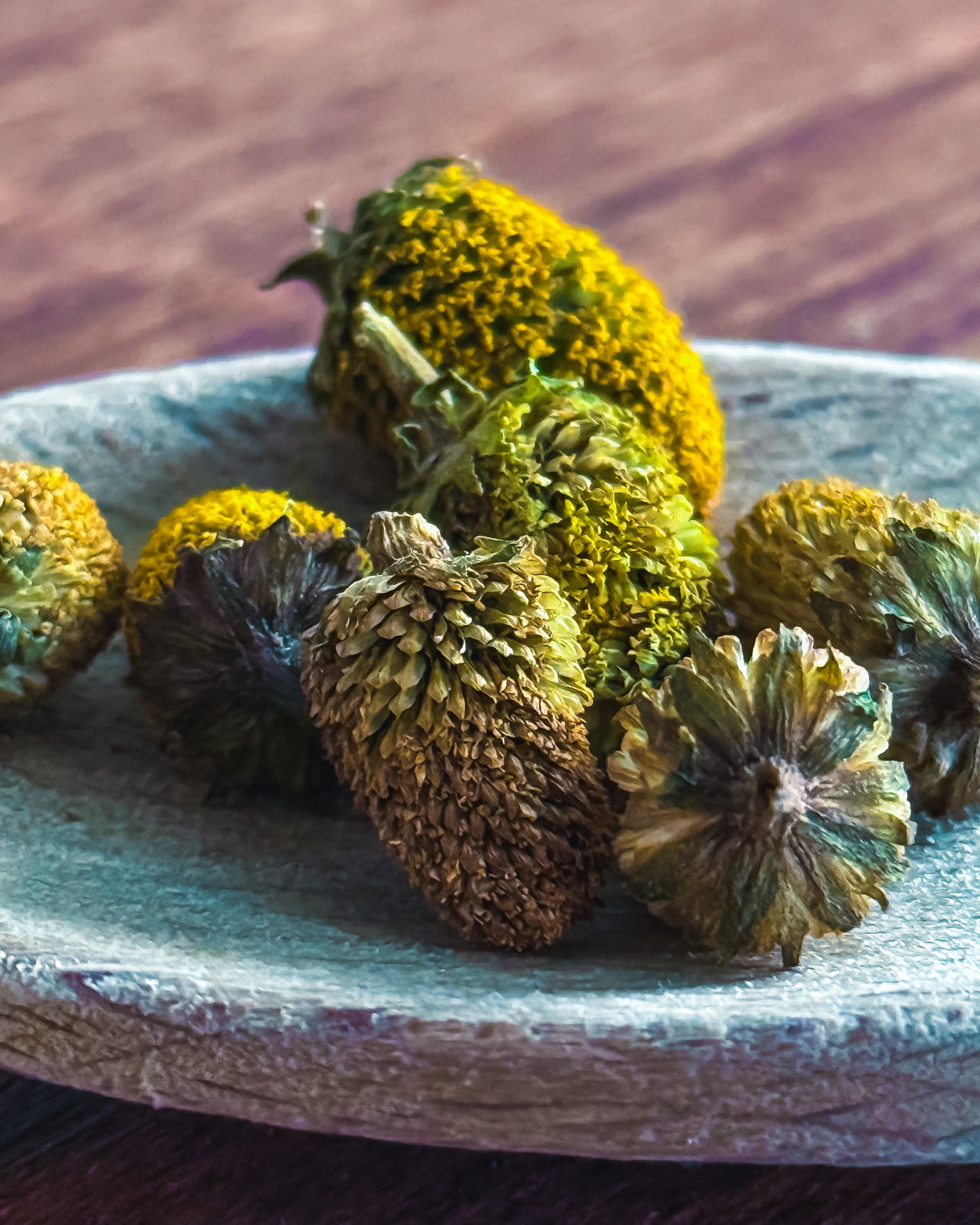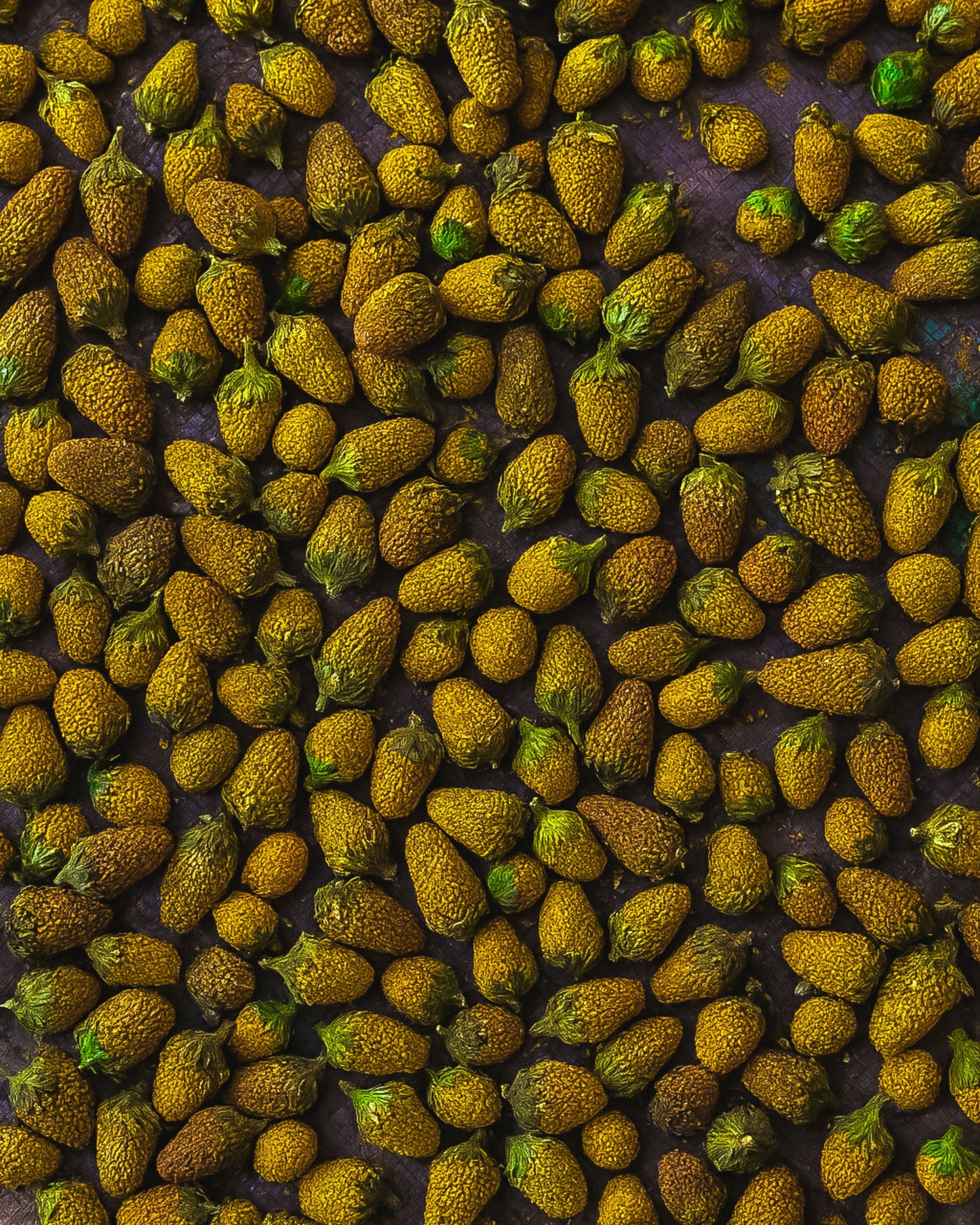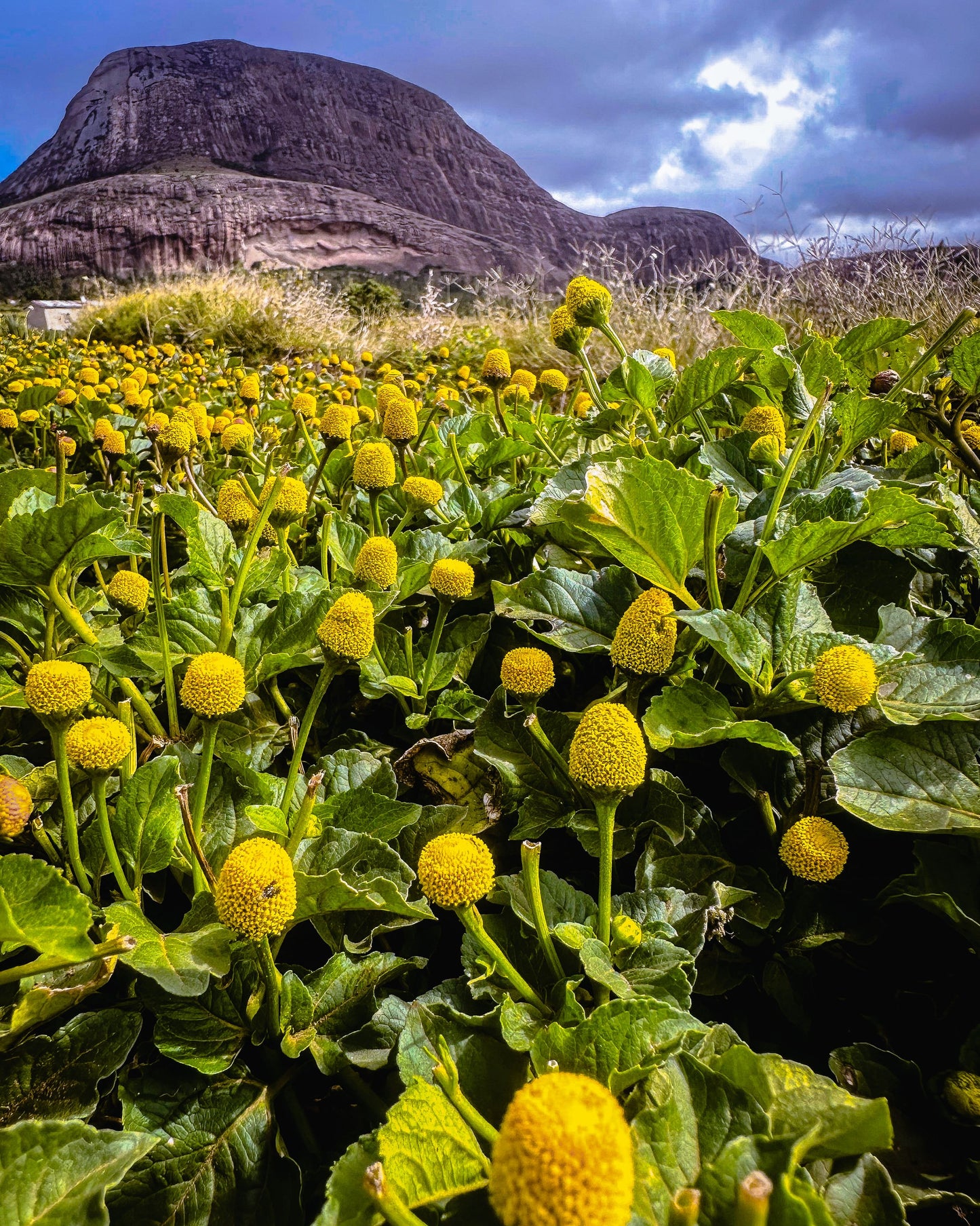


Part 1: How Acmella Seeds Develop and When to Harvest Them
Acmella oleracea is usually grown for its distinctive golden-yellow flower heads, the part best known as Buzz Buttons.
But every successful crop begins somewhere much smaller:
the seed.
Saving your own Acmella oleracea seeds can help maintain planting material from one growing season to the next. Yet collecting good seed involves more than waiting for flowers to turn brown and shaking them into a container.
Seed quality begins while the seed is still developing on the plant.
The complete process is better understood as:
Healthy plant → Flowering → Pollination and seed development → Maturation → Harvest → Drying → Cleaning → Storage → Germination testing → Next crop
A mistake early in this chain cannot always be corrected later.
The central principle is simple:
Good seed storage can preserve existing seed quality, but it cannot make an immature or non-viable seed viable.
This first part explains how Acmella oleracea progresses from flowering to mature seed, how to recognise when seed heads are approaching harvest, and why careful collection matters.
1. Start with the Correct Plant
Before saving seed, establish the identity of the plant from which it is being collected.
The accepted botanical name is:
Acmella oleracea (L.) R.K.Jansen
The older name Spilanthes oleracea L. is encountered frequently in horticultural, commercial and historical literature.
Common names include:
- Buzz Buttons
- Electric Daisy
- Paracress
- Toothache Plant
- Eyeball Plant
Common names are useful, but they are not reliable botanical identification by themselves.
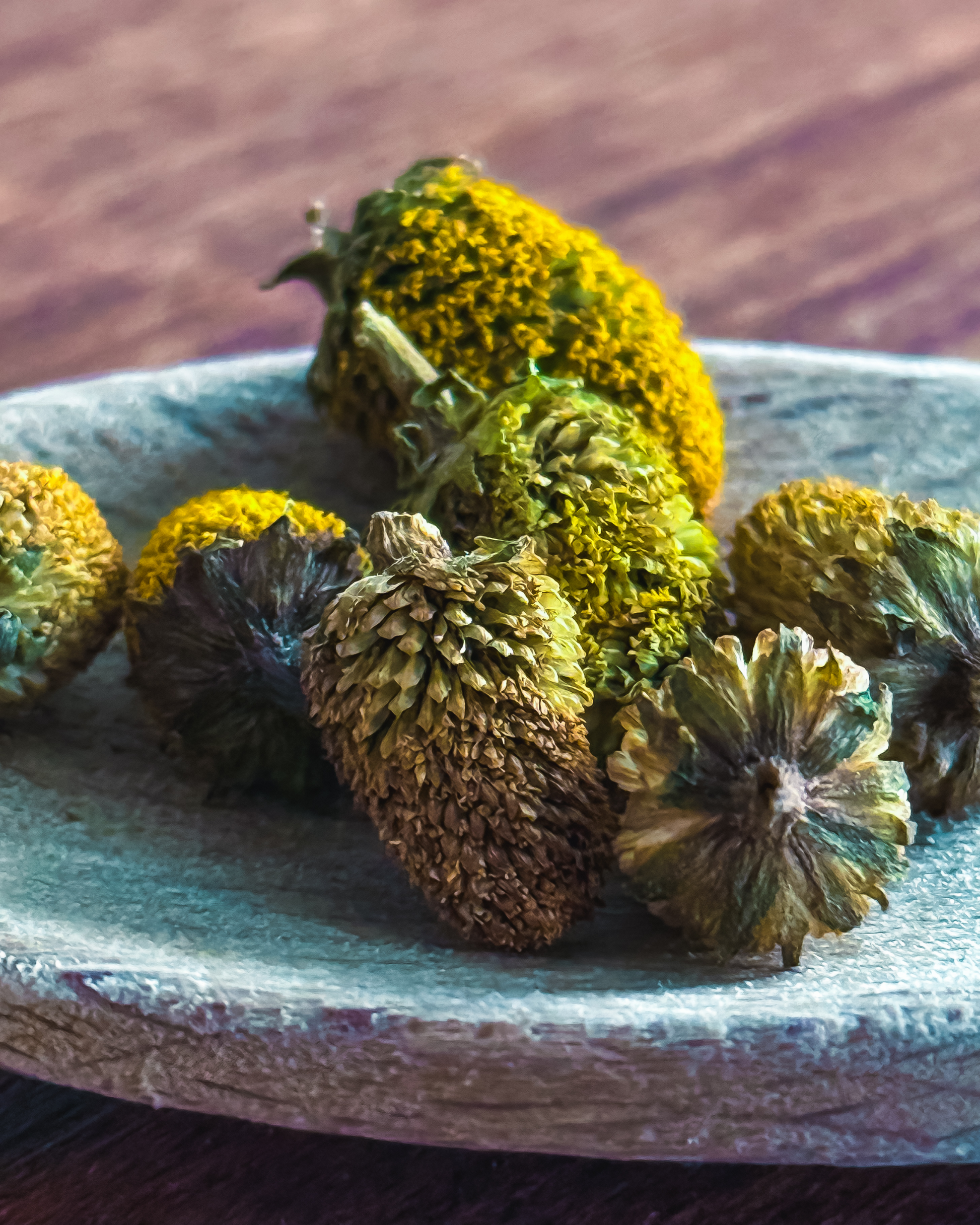
2. Why Botanical Identity Matters for Seed Saving
If seeds are collected from a misidentified plant, careful drying and storage will not correct that mistake.
The problem simply moves into the next generation.
For anyone maintaining traceable Acmella planting material, seed identity should therefore begin with the parent crop.
3. Seed Quality Begins Before Harvest
It is tempting to think of seed quality as a storage problem.
It is not.
Seed quality can be influenced much earlier by:
- parent-plant health
- environmental conditions
- flowering
- pollination
- seed development
- maturity at harvest
- disease or pest pressure
- post-harvest handling
Storage is only one stage.
4. From Flower to Seed
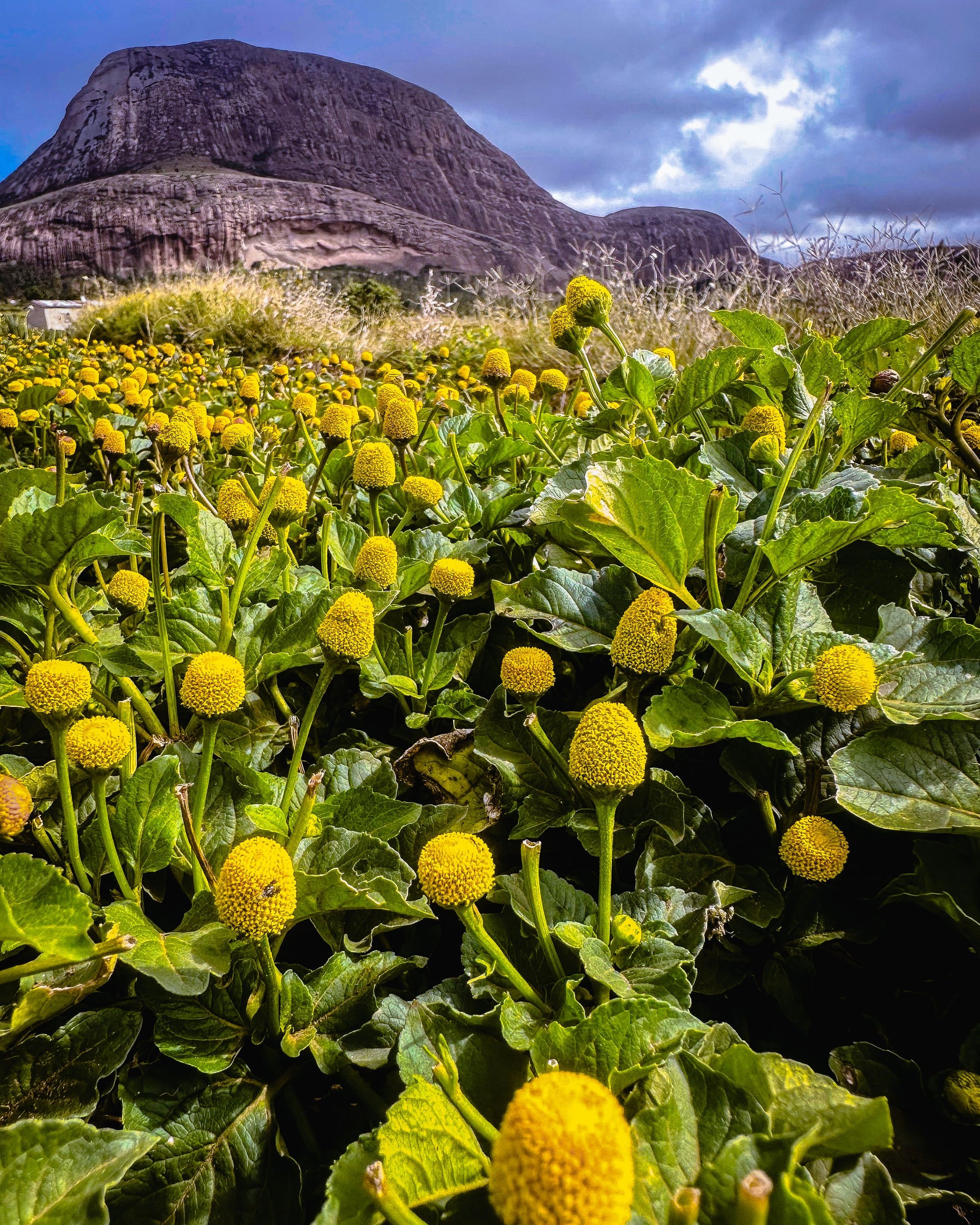
The yellow structure commonly called the Buzz Button flower is actually a composite flower head containing many small individual florets.
This is typical of the daisy family:
Asteraceae.
Instead of one simple flower producing one large seed, the flower head contains many florets capable of contributing to seed production.
5. A Composite Flower Head Is a Community of Flowers
Look closely at a mature Acmella oleracea flower head.
Its surface is made up of many tightly packed florets.
This explains its characteristic textured appearance.
It should not look like a smooth yellow sphere.
6. Why This Matters for Seed Formation
Because the head contains many individual florets, a mature head can contain many individual seed-like fruits.
Not every position necessarily produces a fully developed viable seed.
Therefore:
one flower head ≠ one seed
and:
one flower head ≠ guaranteed full seed set.
7. What Gardeners Call an Acmella Seed
In the Asteraceae, what gardeners casually call a "seed" is typically a small dry fruit containing the seed.
The botanical fruit type is generally called an:
achene
or, more precisely in much of the Asteraceae:
cypsela.
For practical gardening, however, calling these units seeds is perfectly understandable.
8. Seed Production Starts During Flowering
The transition from colourful flower head to seed-bearing structure is gradual.
A simplified sequence is:
Developing bud
↓
Open flower head
↓
Pollination and fertilisation
↓
Seed development
↓
Seed maturation
↓
Drying flower head
↓
Seed dispersal
The grower needs to collect the seed after sufficient development but before too much is naturally lost.
9. Flowering and Seed Harvest Have Different Goals
When Acmella oleracea is grown for culinary Buzz Buttons, flower heads are usually harvested while they still have the desirable fresh characteristics.
Seed production requires a different strategy.
Selected flower heads must remain on the plant long enough to complete seed development.
10. You Cannot Harvest the Same Flower Twice
Once a flower head is cut for:
- culinary use
- drying as botanical material
- extraction
it cannot continue maturing seeds on the parent plant.
This creates a practical production decision.
11. Divide the Crop by Purpose
A grower interested in both flowers and seed can designate some plants or flower heads specifically for seed production.
For example:
Production flowers → harvested for intended use
Seed flowers → left on selected plants to mature
This makes seed collection more deliberate.
12. Choose Seed Plants Early
Do not wait until the final day of the crop and collect whatever dried flower heads remain.
Instead, identify suitable seed-producing plants while the crop is healthy and actively growing.
This improves record keeping and allows those flowers to mature without being accidentally harvested.
13. What Makes a Suitable Seed Parent?
Useful considerations can include:
- correct botanical identity
- healthy growth
- absence of obvious severe disease
- normal flower development
- suitable maturity
- known crop or seed-lot history where traceability matters
This does not mean the largest plant automatically has the best genetics.
14. Bigger Is Not Automatically Genetically Better
Plant size can be influenced by:
- water
- soil
- nutrients
- competition
- sunlight
- planting density
- local microclimate
A large plant may simply have experienced more favourable growing conditions.
Avoid turning appearance alone into a genetic conclusion.
15. Selection Can Change a Population Over Time
If a grower repeatedly saves seed only from plants with particular characteristics, this can impose selection pressure.
Across generations, that can influence the characteristics represented in the saved seed population.
This may be intentional or accidental.
16. Seed Saving Is Therefore Also Population Management
For casual home growing, this may not be a major concern.
For systematic cultivation, however, records become more important.
Useful information can include:
- source
- seed lot
- planting date
- field or growing area
- parent population
- harvest period
- seed collection date
Traceability can begin before the seed is harvested.
17. Pollination Comes Before Seed Development
For a seed to develop normally through sexual reproduction, successful reproductive processes must occur within the flowers.
The details of pollination biology can vary among plant species and growing environments.
The practical point is:
A flower head appearing healthy does not guarantee that every floret will produce a mature viable seed.
18. Pollination Is Not the Same as Viability
Even successful pollination is only one stage.
After fertilisation, developing seeds must continue through maturation.
Environmental stress during this period can influence final seed development.
19. Flowering Is Not Seed Maturity
A bright yellow Buzz Button is visually mature as a flower.
That does not mean its seeds are ready to harvest.
This distinction is one of the most important points in seed saving.
20. The Flower Head Must Age
When a flower head is reserved for seed production, it remains attached to the plant beyond the stage when it would normally be collected as a fresh Buzz Button.
Over time, visible changes occur.
21. Colour Begins to Change
The vivid yellow appearance gradually declines.
The flower head may become:
- duller
- yellow-brown
- brown
- dry-looking
The exact appearance can vary with environmental conditions and maturity.
22. Texture Changes Too
Fresh Buzz Buttons contain more water and feel relatively succulent.
As the seed head matures and dries, the structure becomes:
- firmer
- drier
- more brittle
These changes can provide useful harvest clues.
23. The Stem Can Also Change
The supporting tissue around an ageing flower head may begin to dry.
A dry flower head on a drying stem can indicate advanced maturity.
But stem colour alone should not be used as the only harvest criterion.
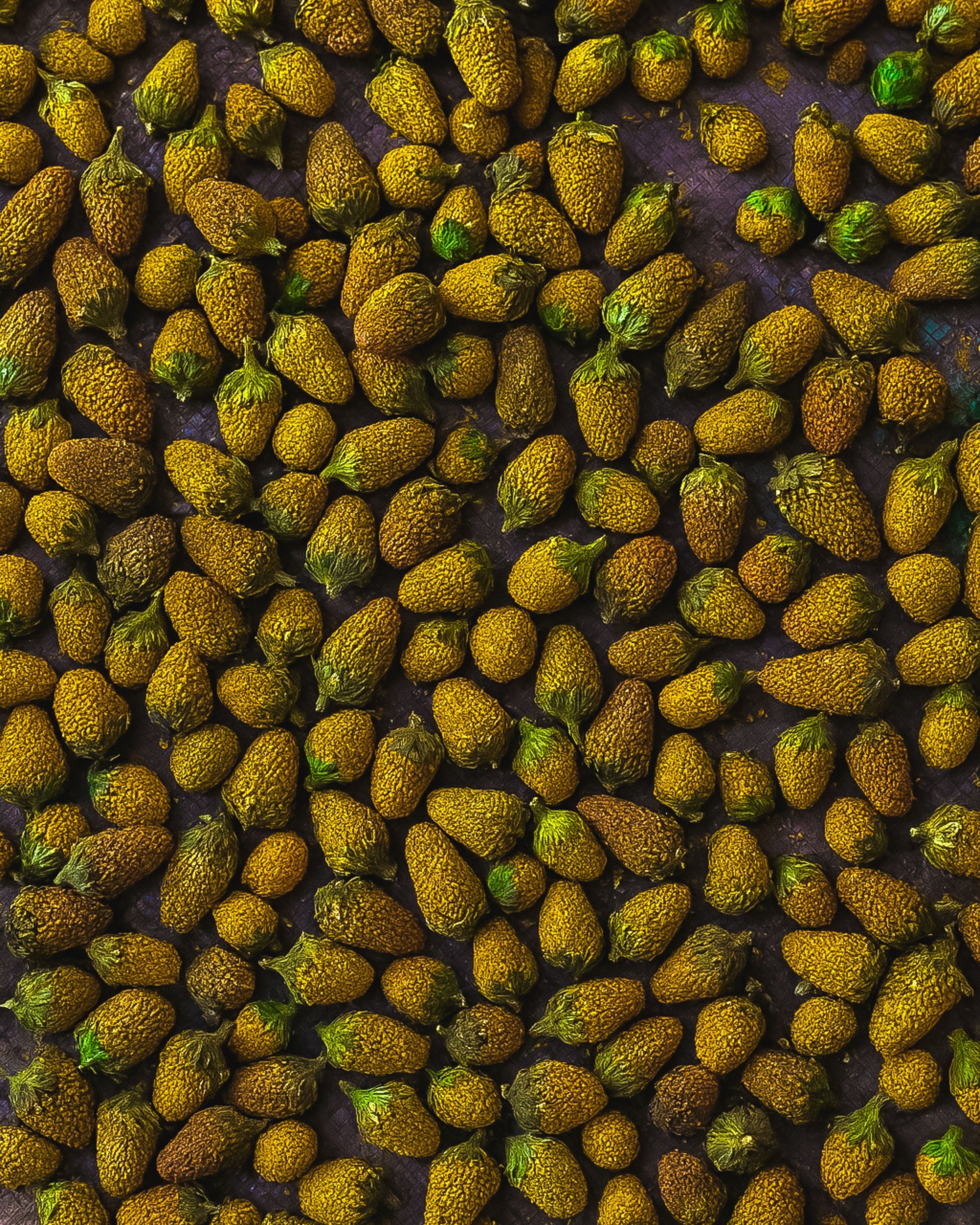
24. Mature Seed Heads Look Very Different from Fresh Buzz Buttons
A fresh Acmella oleracea flower head is typically:
- golden-yellow
- textured with many tiny florets
- somewhat elongated, conical, cylindrical or domed depending on maturity and perspective
- supported by green bracts
A mature dry seed head loses much of this fresh appearance.
25. Do Not Expect a Perfect Brown Ball
Natural Acmella flower heads are not perfectly spherical pom-poms when fresh, and they do not become perfect brown balls when dry.
Drying produces irregular shrinkage and texture.
Natural variation should be expected.
26. What Is Happening Inside?
While the visible flower head ages, the developing reproductive structures undergo physiological changes.
Seed development involves processes such as:
- embryo development
- accumulation of storage reserves
- reduction in water content during maturation
- changes in metabolism
The mature seed eventually becomes capable of surviving independently from the parent plant.
27. Physiological Maturity
Seed science uses the concept of:
physiological maturity.
Broadly, this describes a stage at which seed development on the parent plant has reached an advanced or completed state.
But physiological maturity is not always visually obvious.
28. Harvest Maturity Is a Practical Concept
Growers also need a practical harvest point.
The ideal moment balances two risks:
Harvest too early → immature seed
Harvest too late → seed loss or weather exposure
29. Why Early Harvest Is Risky
Seeds harvested before sufficient development may have:
- incomplete embryos
- inadequate reserves
- poor germination
- poor storage performance
Drying an immature seed does not necessarily finish the maturation process that should have occurred on the plant.
30. Drying Cannot Manufacture Maturity
This principle deserves emphasis:
Drying removes water. It does not automatically convert immature seed into fully developed viable seed.
Post-harvest handling cannot always compensate for premature collection.
31. Why Very Late Harvest Can Also Be Risky
Leaving mature seed heads outdoors indefinitely can expose them to:
- rain
- humidity
- wind
- seed dispersal
- insects
- physical loss
- microbial deterioration
The exact risks depend on the growing environment.
32. Natural Seed Dispersal Works Against the Seed Collector
Plants evolved to reproduce, not to make seed harvesting convenient for humans.
Once mature, dry fruits may detach and disperse.
Waiting too long can therefore reduce the amount of seed available to collect.
33. The Harvest Window
The practical seed-saving window occurs when:
- development is sufficiently advanced
- the head has substantially matured and dried
- seeds can be removed
- excessive natural loss has not yet occurred
This is more useful than relying on an exact number of days after flowering.
34. Why Exact Days Can Be Misleading
The time from flowering to seed maturity can be influenced by:
- temperature
- sunlight
- water availability
- plant health
- season
- growing environment
An exact universal statement such as:
"Harvest exactly X days after flowering"
would require evidence under the relevant conditions.
Visual and physical maturity indicators are often more practical.
35. Look at Several Signs Together
Instead of using one sign, combine observations.
Potential indicators include:
- loss of fresh yellow colour
- browning
- dry texture
- advanced ageing of the flower head
- mature-looking seed structures
- seeds releasing from the dry head
No single visual cue guarantees viability.
36. Seed Release Is an Important Clue
When mature dry material is gently manipulated, developed seeds may separate from the flower head relatively easily.
If everything remains soft, green and firmly immature, harvesting may be premature.
37. But Easy Release Is Not a Germination Test
A seed can detach easily and still fail to germinate.
Physical maturity indicators help decide when to harvest.
They do not prove viability.
38. Appearance Has Limits
A seed can look:
- dark
- full
- mature
and still be non-viable.
Another seed may look less impressive yet germinate successfully.
This is why germination testing ultimately matters.
39. Viability Is a Biological Property
A viable seed is capable of producing a living seedling under suitable conditions.
Appearance is only indirect evidence.
40. Germination Percentage
A basic germination test can estimate the proportion of tested seeds that successfully germinate under defined conditions.
A simplified calculation is:
Germination (%) = germinated seeds ÷ seeds tested × 100
For example, if 80 seeds are tested and 60 germinate:
60 ÷ 80 × 100 = 75%
This is an example calculation, not a claim about typical Acmella oleracea germination.
41. Seed Maturity and Seed Viability Are Related but Different
A mature-looking seed has passed visible developmental stages.
A viable seed has retained the biological ability to germinate.
The two concepts overlap, but they are not identical.
42. Germination and Seed Vigour Are Also Different
Two seed lots might eventually achieve similar germination percentages but differ in:
- speed of emergence
- uniformity
- seedling development under stress
Seed science often distinguishes simple viability from broader concepts of vigour.
43. Home Growers Usually Need a Simpler System
For most gardeners, an elaborate seed laboratory is unnecessary.
A practical system can be:
Collect mature seed carefully
↓
Dry appropriately
↓
Store under controlled conditions
↓
Run a germination test before important sowing
This provides much more useful information than appearance alone.
44. Watch the Weather Near Harvest
Seed heads that are approaching maturity may be vulnerable to prolonged wet conditions.
Rain can re-wet drying plant material.
High humidity can slow drying.
Wind can increase physical seed loss.
Weather therefore becomes part of harvest planning.
45. Dry Weather Can Make Collection Easier
Where practical, collecting mature seed heads when their surfaces are dry can simplify subsequent handling.
Wet material may need more careful post-harvest drying.
46. Do Not Seal Wet Seed Heads Immediately
Freshly collected material can still contain moisture.
Sealing moist botanical material in an airtight container can trap that moisture.
This may create undesirable conditions during storage.
Collection and long-term storage are separate stages.
47. Harvest Container Choice Matters
During collection, use a container that:
- catches loose seeds
- keeps batches separated
- is clean
- can be labelled
Paper bags, clean trays or other suitable collection systems may be useful depending on the scale and environmental conditions.
48. Why Paper Can Be Useful During Initial Collection
Paper can allow some moisture exchange during short-term handling.
But this does not mean a paper bag is automatically the best long-term seed-storage package.
Long-term storage has different requirements.
49. Plastic Bags Require Care with Moist Material
Plastic can be useful for containment, but sealing freshly collected damp plant material can trap moisture.
If plastic is used during collection, moisture conditions and duration need to be managed carefully.
50. Collect Over a Tray or Container
Acmella seeds are small.
When mature heads are handled, material can fall unexpectedly.
Working over a clean tray or collection container helps reduce losses.
51. Small Seeds Are Easy to Mix
This becomes especially important if saving multiple:
- seed lots
- cultivation areas
- parent selections
- harvest dates
One accidental spill can destroy traceability.
52. Label Before You Forget
A useful seed label can include:
Species: Acmella oleracea
Seed lot or source: if known
Collection location: where relevant
Harvest date: recorded
Parent group or field: where relevant
The exact system can be simple.
Consistency matters more than decorative complexity.
53. Never Rely Only on Memory
A bag of small brown seeds collected today may be obvious.
Six months later, it may not be.
Written records prevent avoidable confusion.
54. Seed Traceability
A simple traceability chain could look like:
Stored seed lot
↓
Seed harvest
↓
Parent crop
↓
Original planting material
For commercial or research cultivation, additional records may be needed.
55. Seed Lot Does Not Mean One Individual Seed
A seed lot is a defined quantity of seed treated as one identifiable batch for handling, testing or record keeping.
The definition and degree of uniformity depend on the context.
56. Avoid Mixing Harvests Without a Reason
Combining seeds from different dates or parent groups may be acceptable for some home-growing purposes.
But once mixed, their individual histories are lost.
If traceability matters, keep them separate until there is a deliberate reason to combine them.
57. Harvesting Individual Heads
For small-scale seed saving, mature heads can be cut individually.
Leave enough supporting stem for convenient handling if useful.
The seeds themselves are the target, not the stem.
58. Use Clean Cutting Tools
Clean scissors or pruning tools help reduce unwanted contamination and make collection easier.
This is particularly useful when moving between different plant groups.
59. Avoid Crushing the Heads During Harvest
Mature seed heads can become brittle.
Rough handling can release seed before it reaches the collection container.
Gentle handling reduces loss.
60. Bagging Seed Heads Before Cutting
For particularly mature heads that are already releasing seed, a collector can position a bag or container around or beneath the head before cutting.
This helps catch loose material.
61. Harvesting Multiple Heads
At larger scale, several mature seed heads may be collected together.
The same principles still apply:
- maturity
- cleanliness
- batch identity
- moisture management
- minimal seed loss
Scale does not change the biology.
62. Do Not Confuse Flower Harvest Standards with Seed Harvest Standards
A flower head intended for fresh culinary use should look fresh.
A flower head intended for seed collection should look mature and substantially dried.
The visual quality criteria are almost opposite.
63. Brown Is Not Automatically Bad
For fresh Buzz Buttons, browning may indicate declining freshness.
For seed production, browning is part of natural maturation.
Context changes the meaning of appearance.
64. But Brown Is Not Automatically Mature Either
A flower head can brown because of:
- physical damage
- disease
- environmental stress
- premature tissue death
Colour alone cannot establish seed maturity.
65. Inspect the Whole Head
Ask:
- Did the flower complete normal development?
- Has the head dried naturally?
- Are developed seeds present?
- Do they separate from mature tissue?
- Is there obvious mould or severe damage?
Combining observations is more reliable than looking only at colour.
66. Mouldy Seed Heads Deserve Caution
Visible fungal growth or severe deterioration is not a sign of desirable maturation.
Affected material should be separated from healthy seed lots rather than automatically mixed in.
67. Do Not Assume Surface Cleaning Repairs Damaged Seed
If a seed lot has been stored under conditions that allowed substantial deterioration, simply brushing or cleaning the surface does not necessarily restore seed quality.
Prevention is better than attempting to rescue poor material.
68. Insect Damage
Small seeds can also be affected by insects or other pests depending on the cultivation and storage environment.
Damaged material should be identified during cleaning.
69. Empty or Poorly Developed Units
Not everything that falls from a dry flower head is necessarily a fully developed seed.
Collected material may contain:
- viable seeds
- undeveloped fruits
- fragments of florets
- bracts
- dust
- stem pieces
Cleaning is therefore an important later stage.
70. Heavier Does Not Automatically Mean Viable
Sorting techniques sometimes use size or density as indicators of seed development.
These can help remove obvious debris or poorly developed material.
But:
large seed ≠ guaranteed viable seed
and:
heavy seed ≠ guaranteed viable seed.
Germination remains the practical biological test.
71. Avoid Aggressive Selection Based Only on Appearance
If every small seed is discarded without evidence, the collector may unintentionally change the seed population.
Cleaning should remove obvious debris and unsuitable material without assuming that appearance perfectly predicts genetics or viability.
72. Harvesting for Genetic Diversity
If the objective is maintaining a broader population rather than selecting a particular line, collecting mature seeds from multiple healthy plants can help represent more of that population.
The appropriate strategy depends on the cultivation goal.
73. Seed Saving and Breeding Are Not the Same Thing
Saving seeds means preserving planting material.
Breeding involves deliberate selection and crossing strategies to change genetic characteristics over generations.
A gardener can unintentionally impose selection, but that does not automatically constitute a formal breeding programme.
74. Open Pollination Adds Complexity
When flowers are exposed to insects and the surrounding environment, pollen movement can complicate parentage.
If strict genetic purity is required, controlled seed-production practices may be necessary.
75. Do Not Promise "True to Type" Without Knowing the Seed System
Whether offspring reproduce particular parent characteristics depends on:
- genetics
- pollination
- population structure
- cultivar status
- seed-production controls
Therefore, saved seed should not automatically be described as genetically identical to the parent plant.
76. Seed Is Not a Clone
A seed produced through sexual reproduction contains genetic material derived through reproductive processes.
It should not be treated as a genetically identical copy of the parent plant.
Vegetative propagation is a different concept.
77. Why This Matters for Commercial Acmella
If an Acmella crop is being grown for a consistent chemical profile, genetics can be one source of variation.
But genetics are only one source.
Spilanthol levels may also be influenced by:
- plant part
- maturity
- environment
- harvest timing
- post-harvest handling
- extraction
Seed selection cannot control all of these variables.
78. "High-Spilanthol Seed" Requires Evidence
It would be scientifically weak to call a seed high-spilanthol merely because its parent plant produced a strong sensory effect.
Chemical phenotype and inherited characteristics require proper evidence.
79. Tingling Is Not a Plant-Breeding Assay
The human mouth is sensitive to Buzz Button chemistry.
But chewing a flower does not quantify its spilanthol concentration or prove that offspring will inherit the same chemical profile.
For quantitative spilanthol measurement, appropriate analytical methods such as HPLC are more suitable.
80. Sensory Strength Does Not Establish Seed Quality
A parent plant with intensely tingling flowers does not automatically produce seeds with:
- better germination
- longer storage life
- greater vigour
These are different traits.
81. Seed Production Can Compete with Continued Flower Harvest
Allowing flowers to mature into seed changes how the plant's reproductive structures are managed.
Growers should therefore plan how much crop area or how many flower heads are reserved for seed.
82. You Usually Need Fewer Seed Heads Than Culinary Flowers
A mature composite flower head can contain many potential seeds.
Therefore, a relatively modest number of carefully selected seed heads may provide substantial planting material for a small garden.
Actual yield will vary.
83. Do Not Estimate Seed Supply from Flower Count Alone
Not every floret necessarily produces a viable seed.
Cleaning losses and germination percentage also matter.
The useful quantity is not:
number collected
but ultimately:
number of viable seeds available for planting.
84. Pure Live Seed as a Useful Concept
Professional seed systems sometimes distinguish the physical quantity of seed from the proportion that is both:
- actual seed of interest
- capable of germinating
Home growers do not need complicated certification calculations, but the principle is useful.
A jar containing many particles is not necessarily a jar containing many viable seeds.
85. Harvest in Separate Passes
Not every flower on an Acmella oleracea plant opens at the same time.
Therefore, seed heads may mature asynchronously.
One harvest date may capture:
- some mature heads
- some immature heads
- some over-mature heads
86. Selective Harvesting Can Improve Consistency
Instead of cutting every head at once, mature seed heads can be collected in several passes.
This allows less mature heads more time to develop.
87. This Is Similar to Flower Harvesting
Commercial flower crops often require repeated harvesting because reproductive structures develop over time.
Seed collection can follow the same biological reality.
The plant does not synchronise itself for human convenience.
88. Mark Seed Heads
A simple tag or coloured tie can identify flower heads reserved for seed production.
This prevents them from being accidentally harvested for culinary or botanical use.
89. Avoid Damaging the Developing Head
Once a head is selected for seed, minimise unnecessary handling.
Repeated squeezing or rubbing can damage tissue or release mature seed prematurely.
90. Protecting Seed Heads from Loss
In some seed-saving systems, breathable bags or similar methods can be used around mature seed structures to catch dispersing seed.
Any covering should avoid creating excessively damp conditions around the head.
91. Breathability Matters
A sealed moisture-trapping cover around a damp flower head could create undesirable humidity.
Seed-catching methods should balance:
retention
with:
airflow and moisture management.
92. Harvest Before Major Seed Loss
If mature seeds are already dropping freely, the collection window is closing.
Collecting promptly can prevent much of the crop from returning itself to the soil.
93. Volunteer Seedlings
Seeds that fall naturally may later germinate under suitable conditions.
These volunteer plants can be interesting in a garden.
But they do not provide the same controlled seed-lot traceability as labelled collected seed.
94. Seed Collection Hygiene
Use clean:
- hands
- trays
- bags
- tools
- work surfaces
This helps reduce contamination with soil, old plant material or seeds from other species.
95. Weed Seeds Are a Traceability Problem
If seed heads are processed over a dirty surface containing seeds from other plants, the final lot may become contaminated.
This is particularly problematic when the contaminating seeds look similar.
96. Clean Before Processing
Before threshing or separating Acmella seeds, clear the workspace.
Simple housekeeping can be more effective than trying to identify every contaminant afterward.
97. Keep the Lot Label with the Material
Labels should travel with the seed lot through:
harvest
↓
drying
↓
cleaning
↓
storage
Do not label only the final container.
98. Temporary Containers Need Labels Too
A tray of drying seed heads can easily be moved.
If several lots are drying simultaneously, an unlabelled tray can destroy traceability in minutes.
99. Record the Harvest Date
The harvest date later helps estimate:
- seed age
- storage duration
- when germination testing was performed
This becomes increasingly useful over multiple growing seasons.
100. Record the Year Clearly
A label reading:
October
is less useful than:
October 2026
Seed age matters.
101. Photographing the Parent Crop Can Help
Photographs can supplement written records by documenting:
- general plant appearance
- flower morphology
- growing area
- harvest stage
But photographs do not replace botanical identification or written lot information.
102. Photographing the Seed Head Can Improve Future Harvest Decisions
If you document what a successful mature seed head looked like and later confirm good germination, that record can help refine future harvest timing.
This creates a useful feedback loop.
103. Harvest Records Become Better with Germination Results
Imagine a lot labelled:
Harvest A
Later germination testing shows strong performance.
That information can be linked back to:
- harvest stage
- drying method
- storage conditions
Over time, the grower builds evidence from their own cultivation system.
104. This Is More Useful Than Universal Internet Rules
A statement such as:
"Always harvest when the head looks exactly like this"
may not capture environmental variation.
Your own records can connect local growing conditions with actual germination outcomes.
105. The Seed Quality Feedback Loop
A practical system is:
Observe harvest maturity
↓
Collect
↓
Dry
↓
Store
↓
Germination test
↓
Record result
↓
Improve next harvest
This is small-scale quality control.
106. Seed Harvest Is Not Complete When the Head Is Cut
Cutting the mature flower head is only the beginning of post-harvest handling.
The material still needs to be:
- dried appropriately
- separated
- cleaned
- inspected
- labelled
- packaged
- stored
107. Why Immediate Long-Term Packaging Is a Mistake
Freshly harvested seed heads may still contain residual moisture.
Putting them immediately into a tightly sealed long-term storage container can trap that moisture.
A separate drying stage is therefore important.
108. Seeds and Flower Heads May Dry at Different Rates
The complete harvested head contains:
- seed structures
- floral tissue
- bracts
- pieces of stem
These components may not lose moisture identically.
Allowing the collected material to dry before cleaning can make separation easier.
109. Drying Should Be Controlled, Not Aggressive
The objective is to reduce residual moisture appropriately while preserving seed viability.
Extreme heat should not be assumed to be helpful simply because it dries faster.
Living seeds are biological material.
110. Seed Drying Is Different from Drying Acmella for Extraction
This distinction is critical.
When drying flower heads for botanical extraction, the goal is preserving the desired chemical raw material.
When drying seeds for planting, the goal includes preserving:
a living embryo capable of germination.
The processing objectives are different.
111. Do Not Apply Botanical-Drying Conditions Blindly to Seed
A drying condition suitable for producing extracted botanical material may not be appropriate for seed intended for future germination.
Seed viability must remain part of the decision.
112. Living but Dormant
A dry seed may look inactive.
But if viable, it contains living biological structures capable of resuming growth when environmental conditions become suitable.
This is what makes seed storage different from storing dried botanical material for extraction.
113. Drying Slows Metabolism
Reducing seed moisture appropriately generally helps reduce metabolic activity and can support storage.
But the relationship between moisture, temperature and longevity is more complex than simply:
drier is always better.
114. Extreme Drying Is Not a Universal Rule
Different plant species can have different seed-storage behaviours.
Seed science distinguishes categories based on how seeds respond to drying and low-temperature storage.
Species-specific evidence matters.
115. Avoid Unsupported Storage Classification
Unless supported by reliable seed-science data for Acmella oleracea, it is better not to assign the species a specialised storage category merely from general horticultural assumptions.
The practical approach is to use controlled drying, appropriate storage and germination testing.
116. The Germination Test Closes the Evidence Gap
Visual inspection can suggest:
this seed looks mature.
Storage records can tell us:
this seed was kept under controlled conditions.
But germination testing answers the practical biological question:
Can this seed still produce a seedling under the test conditions?
117. Germination Is Not Guaranteed Even with Good Storage
Seed viability naturally changes over time.
Even well-stored seed does not remain viable forever.
The rate of ageing depends on the seed and its environment.
118. Storage Preserves, It Does Not Rejuvenate
A useful rule for the entire article is:
Storage cannot improve the biological maturity of the seed that entered the container.
The quality of the starting material matters.
119. The Seed Chain
For Acmella oleracea, a useful seed-quality chain is:
Correct botanical identity
↓
Healthy parent crop
↓
Flowering
↓
Successful reproductive development
↓
Seed maturation
↓
Timely harvest
↓
Post-harvest drying
↓
Cleaning
↓
Storage
↓
Germination testing
↓
Next planting
Every stage contributes.
120. Common Harvest Mistake: Collecting Bright Yellow Flowers
A fresh yellow Buzz Button may be ideal for culinary use.
It is generally not the visual stage you would target for mature seed collection.
Seed heads need additional time on the plant.
121. Common Harvest Mistake: Waiting for Every Head to Mature Together
Acmella can produce flowers over an extended period.
Waiting for every head on a plant to reach the same stage may allow the earliest heads to shed seed.
Selective harvesting is more practical.
122. Common Harvest Mistake: Using Colour Alone
Brown tissue can indicate maturity.
It can also indicate damage.
Check seed development and head condition rather than relying on colour alone.
123. Common Harvest Mistake: Collecting After Heavy Rain and Sealing Immediately
Wet plant material trapped inside a sealed container creates poor post-harvest conditions.
Allow appropriate drying before long-term storage.
124. Common Harvest Mistake: Mixing Lots
Mixing several harvests may erase useful information about:
- source
- parent group
- harvest timing
- storage age
Keep lots separate when traceability matters.
125. Common Harvest Mistake: Assuming Every Particle Is a Seed
Dry flower heads produce considerable debris.
Cleaning is necessary before evaluating the final seed lot.
126. Common Harvest Mistake: Assuming Every Seed Is Viable
A seed-like structure may be:
- immature
- empty
- damaged
- aged
- otherwise non-viable
Appearance is not enough.
127. Common Harvest Mistake: Using Tingling as a Seed-Quality Test
The sensory strength of the parent flower does not establish seed viability.
Spilanthol chemistry and seed germination are different quality attributes.
128. Common Harvest Mistake: Assuming Bigger Seed Is Always Better
Size can provide useful sorting information, but it is not a universal viability assay.
Use germination data to evaluate seed performance.
129. Common Harvest Mistake: Treating Seed Like Dried Botanical Material
Seed intended for planting contains living tissue.
Its handling goal is biological survival.
That makes seed drying and storage fundamentally different from storing dried Acmella for extraction.
130. A Practical Acmella Seed Harvest Workflow
For home growers and small-scale cultivation, the process can be kept simple.
Step 1
Confirm the plants are Acmella oleracea.
Step 2
Choose healthy plants or a defined parent population.
Step 3
Reserve selected flower heads for seed rather than harvesting them as fresh Buzz Buttons.
Step 4
Allow the heads to progress beyond the fresh yellow flowering stage.
Step 5
Watch for advanced drying, browning and mature seed development.
Step 6
Collect mature heads before substantial natural seed loss.
Step 7
Use clean, labelled containers.
Step 8
Keep different lots separate.
Step 9
Move harvested heads into the post-harvest drying stage.
Step 10
Later evaluate seed performance through germination testing.
131. What Good Harvesting Can Achieve
Careful harvesting can help produce seed material that is:
- sufficiently mature
- cleaner
- more traceable
- easier to process
- more suitable for storage
But it cannot guarantee germination.
132. What Harvesting Cannot Prove
Harvest appearance alone cannot establish:
- germination percentage
- seed vigour
- genetic purity
- future plant chemistry
- future spilanthol concentration
- storage longevity
Those questions require additional evidence.
133. Seed Quality Is Not Spilanthol Quality
This distinction matters particularly for Madabuzz.
A high-quality seed lot is evaluated according to characteristics relevant to propagation.
A high-quality botanical ingredient is evaluated according to characteristics relevant to its intended use.
These evidence systems overlap at the plant level, but they are not identical.
134. The Same Plant Can Have Several Quality Definitions
For example:
Seed production:
Identity, maturity, viability, germination, storage.
Fresh culinary Buzz Buttons:
Identity, freshness, sensory and food-quality considerations.
Dried botanical material:
Identity, post-harvest condition, moisture-related quality, traceability.
Standardised extract:
Identity, extraction, marker concentration, analytical specifications.
Quality must always be linked to purpose.
135. Why Seed Saving Matters for the Acmella Supply Chain
A botanical supply chain often begins long before harvest.
Planting material influences the crop that eventually produces:
- flowers
- dried botanical material
- extracts
- analytical samples
Seed management can therefore be considered the earliest stage of the cultivation quality chain.
136. But Seed Alone Does Not Determine Final Ingredient Quality
Even excellent seed can produce variable crops if cultivation and post-harvest conditions differ.
The complete chain remains:
Seed → Cultivation → Harvest → Post-Harvest → Drying → Storage → Extraction → Analysis
No single stage controls everything.
137. Final Part 1 Checklist
Before collecting Acmella oleracea seed, ask:
- Is the parent plant correctly identified?
- Which plants or flower heads are reserved for seed?
- Have the flower heads completed normal flowering?
- Have they progressed well beyond the fresh culinary stage?
- Are the heads substantially mature and dry?
- Are developed seed structures visible?
- Are seeds beginning to release from mature tissue?
- Is the material free from obvious severe mould or damage?
- Is the weather suitable for collection?
- Is the collection equipment clean?
- Is there a container ready to catch loose seed?
- Is the seed lot labelled?
- Is the harvest date recorded?
- Are different lots being kept separate?
- Will the material be dried before long-term storage?
- Will viability later be checked through germination?
If several of these questions cannot be answered, the seed-saving process probably needs more control.
138. Part 1 Takeaway
Saving Acmella oleracea seed starts long before the seeds enter a storage container.
The most important distinction is between:
a fresh flower head
and:
a mature seed head.
Buzz Buttons harvested at their attractive golden-yellow culinary stage have not necessarily completed seed development. For seed production, selected flower heads need to remain on the plant while reproductive structures mature and the head gradually dries.
At the same time, waiting indefinitely is not ideal. Mature seeds can be lost through natural dispersal or exposed to changing weather and other environmental pressures.
The practical objective is therefore to find the harvest window between:
too early
and:
too late.
Several other distinctions are equally important:
Flower maturity ≠ seed maturity
Seed maturity ≠ guaranteed viability
Brown colour ≠ guaranteed maturity
Large seed ≠ guaranteed viability
Easy seed release ≠ germination proof
Parent sensory strength ≠ seed quality
High parent spilanthol ≠ proven high-spilanthol offspring
Drying ≠ completion of immature seed development
Seed storage ≠ seed rejuvenation
Seed saving ≠ cloning
Botanical identity ≠ common-name identity
Seed quality ≠ finished botanical ingredient quality
The central principle is:
Harvest mature seed from correctly identified, healthy Acmella plants, keep the material traceable, and remember that the final evidence of successful seed saving comes when the stored seed is tested and grows.
Coming in Part 2
Part 2 will follow the harvested flower heads into drying, threshing, cleaning and seed preparation. It will explain how to dry Acmella oleracea seed without treating it like extraction material, how to separate the tiny seeds from dried flower-head debris, how to handle moisture and airflow, how to label seed lots, what visual sorting can and cannot tell you about viability, and how to prepare clean, dry seed for long-term storage.
Part 2: How to Dry, Clean and Prepare Acmella Seeds for Storage
Part 1 followed Acmella oleracea from flowering through seed development and harvest.
Once mature seed heads have been collected, a new stage begins:
post-harvest seed handling.
This stage can look deceptively simple. The flower heads are brown and dry-looking, so it is tempting to break them apart, pour the seeds into a container and put them away.
But seed intended for planting is living biological material.
The goal is not simply to make it look dry.
The goal is to prepare mature seed for storage while protecting its ability to germinate.
A practical sequence is:
Harvested seed heads → Post-harvest drying → Seed separation → Cleaning → Inspection → Final drying if needed → Labelling → Storage preparation
The central principle for Part 2 is:
Drying prepares mature seed for storage. It does not create maturity, prove viability or guarantee future germination.
139. What Happens Immediately After Harvest?
A harvested Acmella oleracea seed head may feel dry while still containing residual moisture.
Different parts of the harvested material can also contain different amounts of water.
The collection may contain:
- seeds
- dried florets
- bracts
- pieces of receptacle
- stem fragments
- dust
- other botanical debris
The first objective is therefore not long-term storage.
It is controlled post-harvest drying.
140. Why Seed Heads Need a Post-Harvest Stage
Seed heads collected from the plant have just left a changing outdoor environment.
They may have experienced:
- morning dew
- rain
- high humidity
- irrigation
- temperature changes
Even apparently dry heads can benefit from a controlled period of post-harvest handling before the seeds are sealed for storage.
141. Seed Drying Is Not the Same as Flower Drying
Madabuzz works extensively with Acmella oleracea flower heads, but seed handling has a different objective.
When flower heads are dried as botanical raw material, the goal is to preserve material for its intended botanical use.
When seeds are dried, the objective includes preserving:
future biological viability.
That distinction changes how aggressively the material should be treated.
142. A Seed Is Alive
A mature dry seed may appear inactive.
Inside it, however, a viable embryo remains living.
Metabolic activity is greatly reduced compared with an actively growing seedling, but the seed is not simply an inert particle.
143. Why Moisture Matters
Seed moisture strongly influences storage behaviour.
Excess moisture can increase:
- metabolic activity
- deterioration
- fungal risk
- other biological processes
Appropriate drying therefore supports storage.
144. But "As Dry as Possible" Is Too Simple
Seed storage biology is species-dependent.
Different seeds vary in their tolerance of:
- drying
- low temperatures
- long-term storage
Therefore, the scientifically safer principle is:
Dry seed appropriately for the species and intended storage system rather than assuming that maximum drying is universally best.
145. Avoid Inventing a Universal Moisture Percentage
It would be convenient to say:
"Acmella seeds must contain exactly X% moisture before storage."
But an exact universal target should not be invented without appropriate evidence and a defined measurement method.
Home growers rarely have equipment for precise seed-moisture determination anyway.
146. Practical Drying Still Matters
Lack of a laboratory moisture measurement does not mean drying should be ignored.
At small scale, growers can use controlled handling and consistent observations.
The goal is to avoid sealing obviously damp or recently harvested seed material into storage.
147. Start with a Clean Drying Area
The drying environment should be:
- clean
- protected from rain
- protected from contamination
- reasonably ventilated
- suitable for keeping seed lots separate
The seed should not be mixed with unrelated botanical material.
148. Air Movement Helps Moisture Leave
As moisture moves from the seed heads into the surrounding air, that humid air needs somewhere to go.
Gentle ventilation can support drying.
This does not mean blasting the tiny seeds with a powerful fan.
149. Acmella Seeds Are Small
Strong airflow can create a new problem:
seed loss.
A drying method should provide air exchange without blowing lightweight seeds and floral debris around the room.
150. Spread Seed Heads Rather Than Piling Them Deeply
A thick pile can restrict airflow and create uneven drying.
A shallow layer generally allows the material to interact more evenly with the surrounding air.
151. Avoid Unnecessary Compression
Do not pack freshly harvested seed heads tightly together.
Compressed material can retain local moisture and make inspection more difficult.
152. Drying Surface Matters
Suitable drying surfaces should be:
- clean
- dry
- easy to inspect
- capable of retaining tiny seeds
A tray lined with clean paper or another appropriate material can work at small scale.
153. Remember That Seeds May Fall During Drying
As the seed heads continue to dry, seeds can loosen.
The drying surface should therefore catch material released naturally.
A mesh with openings larger than the seeds could cause unnecessary losses.
154. Keep Seed Lots Physically Separate
If two lots are dried side by side, leave enough separation to prevent loose seeds from mixing.
Physical barriers or individual trays can help.
155. Label the Drying Tray
The label should remain with the material throughout processing.
Useful information may include:
- Acmella oleracea
- seed lot
- harvest date
- source or parent group
- field or growing area where relevant
Never rely on recognising the tray later.
156. Drying Conditions Should Be Stable
Large uncontrolled swings in humidity can complicate drying.
Seed material interacts with the surrounding atmosphere.
It can lose moisture in one environment and regain moisture in another.
157. Seeds Can Reabsorb Moisture
Drying is not necessarily a one-way process.
If dried seed is moved into a humid environment, it can absorb water from the air.
This is why post-drying handling and packaging matter.
158. Dry Weather Outdoors Does Not Guarantee Controlled Drying
Outdoor drying may expose seeds to:
- changing humidity
- dew
- wind
- insects
- rain
- direct sunlight
- contamination
A controlled protected area provides more predictable handling.
159. Direct Sunlight Is Not Automatically Better
Sunlight can provide heat and encourage water loss, but it also creates:
- variable temperature
- intense radiation
- uneven heating
There is no reason to assume that stronger sunlight automatically produces better planting seed.
160. Faster Drying Is Not Automatically Better
The objective is not to win a drying race.
The objective is to prepare viable mature seeds for storage.
Aggressive drying conditions that expose living seed to unnecessary stress should not be considered superior merely because they work quickly.
161. Avoid High-Temperature Drying Without Evidence
An oven or heated dehydrator may appear convenient.
But seed intended for planting is different from dried culinary material.
Excessive heat can damage living tissue.
162. Do Not Copy a Food-Dehydration Recipe
A temperature suitable for drying:
- herbs
- fruit
- flowers
- spices
is not automatically appropriate for planting seed.
The intended end use is different.
163. Room Conditions Can Be Practical
For small-scale seed saving, protected drying under moderate ambient conditions with airflow can be a practical approach.
Exact drying time will depend on:
- starting moisture
- humidity
- temperature
- airflow
- amount of material
- maturity
164. Avoid a Universal Number of Drying Days
A statement such as:
"Dry Acmella seeds for exactly seven days"
would create false precision.
Seven days in a dry environment is not equivalent to seven days in a humid environment.
Condition matters more than the calendar alone.
165. Inspect During Drying
Check the material regularly.
Look for:
- condensation
- persistent dampness
- unusual odour
- visible fungal growth
- seed loss
- contamination
Early detection is easier to manage than discovering a problem after storage.
166. Condensation Is a Warning Sign
If moisture condenses inside a container holding drying material, the environment is clearly retaining substantial water vapour.
That is not a suitable condition for long-term sealed storage.
167. Musty Odour Deserves Investigation
A musty or abnormal smell can indicate undesirable biological activity or deterioration.
Odour alone cannot identify microorganisms, but it is a useful reason to inspect the material carefully.
168. Visible Mould Is Not Normal Seed Maturation
Do not confuse:
natural brown dry tissue
with:
visible fungal growth.
Mouldy material should be isolated rather than automatically mixed into a healthy seed lot.
169. Can Mouldy Seed Be Saved?
There is no universal home treatment that can guarantee restoration of compromised seed.
The effect depends on:
- organism involved
- severity
- seed damage
- storage history
For valuable seed lots, specialist seed-health evaluation may be appropriate.
170. Prevention Is Easier Than Rescue
Good seed handling therefore prioritises:
mature harvest
prompt controlled drying
clean processing
appropriate storage
rather than trying to repair deterioration later.
171. When Are Seed Heads Dry Enough to Process?
At small scale, physical characteristics can provide practical clues.
Mature dried heads should generally feel:
- dry
- brittle
- no longer succulent
The seed structures should separate more readily from surrounding floral tissue.
172. "Dry to the Touch" Is Not a Laboratory Measurement
Surface feel cannot quantify internal seed moisture.
It is a practical screening tool.
For controlled professional storage, quantitative moisture measurement may provide stronger evidence.
173. Drying and Cleaning Can Overlap
As the flower heads dry, some seeds may release naturally.
Others remain inside the dry structure until it is gently broken apart.
Once the material is adequately dry for handling, cleaning can begin.
174. What Is Threshing?
In seed processing, threshing means separating seeds or seed-bearing units from the surrounding plant structure.
For Acmella oleracea, this can involve gently breaking apart mature dried flower heads.
175. Acmella Threshing Can Be Simple
At home scale, sophisticated machinery is unnecessary.
A dried head can be gently:
- rubbed
- rolled
- crumbled
over a clean collection surface.
The objective is to release the seeds without losing them.
176. Gentle Is Better Than Violent
Aggressive crushing creates excessive fine debris and may physically damage seed.
Use only enough force to separate mature material.
177. Mature Heads Should Separate More Easily
A well-matured dry flower head generally breaks apart more readily than a fresh head.
If the tissue remains soft and moist, further drying may be appropriate before cleaning.
178. Work Over a Large Clean Surface
A white or light-coloured tray can make small dark seeds easier to see.
A raised edge helps prevent material from rolling or blowing away.
179. Process One Lot at a Time
If traceability matters, complete or thoroughly clean the workspace between lots.
Small seeds can hide:
- in tray corners
- inside tools
- on cloth
- in brushes
Cross-contamination can be surprisingly easy.
180. What Comes Out of a Dried Flower Head?
After threshing, the mixture may contain:
Seeds
plus:
Bracts + dried florets + receptacle fragments + stem pieces + dust
This mixed material is sometimes broadly called the uncleaned seed fraction.
181. Cleaning Has a Clear Purpose
Seed cleaning attempts to increase the proportion of useful seed while removing obvious foreign material.
It does not magically increase the biological quality of the individual seeds that remain.
182. Clean Seed Is Not Automatically Viable Seed
This distinction is essential.
A beautifully cleaned seed lot can still have poor germination.
Physical purity and biological viability are different attributes.
183. Start with Large Debris
Large pieces of:
- stem
- bract
- dried flower tissue
can often be removed manually.
This simplifies later separation.
184. Sieving May Help
A suitable sieve can separate particles by size.
But the openings must be chosen carefully because Acmella seeds are small.
A sieve that is too coarse may lose the seeds together with the debris.
185. Test the Sieve First
Before processing an entire valuable seed lot, test a small quantity.
Determine where the seeds go:
retained above
or:
passing through.
Never assume.
186. Multiple Sieves Can Separate Fractions
At larger scale, screens of different sizes can help separate:
- coarse debris
- seed-rich fraction
- fine dust
The exact screen dimensions should be determined from the actual seed lot rather than invented as universal values.
187. Winnowing Uses Airflow
Winnowing separates material partly by aerodynamic behaviour.
Lighter debris may move differently from denser seed.
This traditional principle can work for many seeds.
188. Winnowing Tiny Acmella Seed Requires Care
Because the seeds themselves are small and light, excessive airflow can remove valuable seed along with the debris.
Start gently.
189. A Fan Is Not Automatically a Seed Cleaner
A household fan can create inconsistent airflow.
If used carelessly, it can distribute the entire seed lot across the room.
Controlled airflow is preferable.
190. Gravity Can Help Too
Material dropped carefully over a short distance in gentle airflow may separate into fractions.
But this technique should be practised with a small sample first.
191. Manual Sorting Is Useful at Small Scale
For a home seed lot, manual removal of obvious debris may be simpler than elaborate equipment.
Precision tweezers, a small brush and a contrasting tray can help.
192. Do Not Chase Perfect Cosmetic Purity
For home sowing, a small amount of harmless dry floral debris may not be important.
The goal is usable clean seed, not a photographically perfect sample.
Commercial seed standards may be different.
193. Physical Purity Can Be Measured
In formal seed testing, physical purity can be assessed by separating components and determining their proportions.
This can distinguish:
- pure seed
- other seeds
- inert matter
But such formal testing is usually unnecessary for a small garden seed collection.
194. Remove Obvious Foreign Seeds
Seeds from weeds or other crops can create confusion later.
If they can be confidently identified, remove them.
Better still, prevent contamination during harvest and processing.
195. Identification Gets Harder After Mixing
Once several similar-looking small seeds are combined, visual separation may be difficult.
Clean harvesting is therefore part of seed cleaning.
196. What Does a Good Acmella Seed Look Like?
Mature Acmella seeds are small and dry, with appearance reflecting their botanical structure.
However, photographs and visual descriptions should be used cautiously.
Colour and size can vary.
197. Do Not Build a Viability Rule from Colour Alone
A darker seed is not automatically viable.
A lighter seed is not automatically dead.
Colour may help identify obvious immaturity or damage, but it is not a germination assay.
198. Fullness Can Be Useful but Limited
Obviously empty or collapsed structures may be poor candidates for sowing.
But a visually full seed can still be non-viable.
199. Damage Can Be Visible
Remove material showing obvious severe:
- crushing
- insect damage
- decay
- structural breakage
Such damage may compromise the seed.
200. Microscopic Inspection
For research or commercial work, magnification can help examine seed morphology and damage.
But magnification still cannot directly establish whether the embryo will germinate.
201. The Float Test Is Not a Universal Viability Test
A common internet recommendation is to place seeds in water and assume:
sink = good
float = bad.
This should not be treated as a universal rule.
202. Why Floating Can Mislead
Buoyancy can depend on:
- trapped air
- seed structure
- surface characteristics
- density
- hydration
It does not directly measure embryo viability.
203. Water Exposure Also Changes the Seed
Putting dry seed into water begins hydration.
That may be undesirable if the seed is supposed to return immediately to dry long-term storage.
Use evidence-based testing rather than casual soaking of the whole seed lot.
204. Cutting Seeds Open Is Destructive
Dissection can reveal internal structures.
But the tested seed can no longer be planted normally afterward.
For a small valuable lot, destructive testing should be used thoughtfully.
205. Germination Testing Is More Direct
If the practical question is:
"Will these seeds grow?"
a germination test on a representative sample is more informative than many appearance-based tricks.
206. But Germination Testing Uses Seeds Too
Seeds used in a germination test are generally removed from the stored planting lot.
The sample size therefore needs to balance:
- useful information
- available seed quantity
207. Sampling Matters
Testing only the five best-looking seeds can overestimate the performance of the whole lot.
The test sample should represent the lot reasonably well.
208. Mix Before Taking a Test Sample
If larger and smaller seeds have separated during handling, sampling only from the top of the container may create bias.
Gentle mixing before sampling can improve representativeness.
209. Do Not Damage Seed While Mixing
The objective is homogenisation, not abrasion.
Small seeds can be handled gently.
210. Cleaning Can Introduce Selection Bias
Imagine discarding every seed that looks slightly smaller.
The remaining lot may germinate differently.
But you have also intentionally selected a subset of the original population.
This should be recognised when seed characteristics matter.
211. Cleaning Is Not Breeding, but Selection Can Occur
Routine removal of obviously empty or damaged material is normal.
Repeatedly selecting only seeds with a specific appearance across generations can create additional selection pressure.
212. Keep Cleaning Criteria Consistent
If comparing seed lots, use similar cleaning methods.
Otherwise, differences between lots may partly reflect processing rather than the original seed quality.
213. Record Cleaning Date
For traceable lots, record when seed heads were:
- harvested
- dried
- cleaned
- packaged
This creates a simple post-harvest history.
214. Record Unusual Events
Examples include:
- seed heads harvested after rain
- unexpectedly humid drying conditions
- visible pest damage
- delayed processing
These notes can become useful if germination later performs poorly.
215. Good Records Help Diagnose Problems
Suppose two seed lots came from similar plants.
One later germinates well and the other poorly.
Records may reveal that one lot experienced prolonged damp conditions before drying.
That does not automatically prove causation, but it provides a useful investigation lead.
216. Post-Harvest Quality Control Is a Chain
Think:
Harvest maturity
↓
Drying
↓
Cleaning
↓
Inspection
↓
Packaging
↓
Storage
↓
Germination testing
A problem at any stage can influence the final result.
217. What If the Seeds Feel Dry After Cleaning?
Cleaning exposes the seeds directly and removes much of the surrounding flower tissue.
This is a good opportunity to reassess whether the material appears suitably dry for packaging.
218. Final Drying May Be Appropriate
If cleaning exposes residual moisture or if environmental conditions were humid, an additional controlled drying period may be useful before sealing the seed.
Again, exact duration depends on conditions.
219. Do Not Seal Immediately After Wet Cleaning
If any seed-processing method introduces water, the seed must be appropriately dried again before dry storage.
For ordinary Acmella cleaning, dry methods are often simpler.
220. Avoid Washing Without a Clear Reason
Washing can remove some surface debris but introduces water into the process.
For small dry seed lots, mechanical cleaning may be more straightforward.
If seed sanitation is required, that is a separate technical question.
221. Seed Cleaning Is Not Seed Disinfection
Removing debris does not mean microorganisms have been eliminated.
Likewise:
clean-looking ≠ sterile.
222. Sterile Seed Is Not the Normal Goal of Home Seed Saving
Seeds naturally interact with microorganisms.
Home growers generally aim for:
- healthy
- dry
- clean
- viable
seed rather than sterility.
223. Commercial Seed Health Is More Complex
Commercial propagation systems may need additional controls for:
- seed-borne pathogens
- phytosanitary requirements
- quarantine organisms
- regional regulations
These requirements depend on where the seed is produced and transported.
224. International Seed Movement Can Be Regulated
Moving seeds between countries can involve plant-health and customs requirements.
A seed that is biologically viable is not automatically legally importable everywhere.
225. Seed Quality and Legal Compliance Are Different
A germination test answers a biological question.
A phytosanitary document answers a regulatory plant-health question.
One cannot substitute for the other.
226. Madagascar Seed Production and Traceability
For an Acmella supply chain beginning in Madagascar, planting material can form the first traceable stage.
A conceptual chain is:
Seed lot
↓
Cultivation area
↓
Growing crop
↓
Flower harvest
↓
Drying
↓
Botanical batch
↓
Extraction or distribution
This can strengthen understanding of how botanical material moved through production.
227. But Seed Traceability Does Not Prove Final Extract Quality
Knowing the original seed lot is useful.
It does not establish:
- final spilanthol concentration
- microbiological quality
- extraction performance
- finished-product stability
Those require their own evidence.
228. Seed Genetics and Environment Interact
The eventual plant phenotype reflects genetics interacting with environmental conditions.
Cultivation variables may include:
- soil
- water
- temperature
- sunlight
- nutrition
- competition
- pests
Therefore, the same seed source can perform differently in different environments.
229. Storage Starts Before the Container
A common mistake is to think:
"Storage begins when I close the jar."
In reality, storage quality begins with harvest and drying.
A seed that spends several days damp before packaging has already experienced part of its post-harvest history.
230. Packaging Cannot Undo Poor Drying
A premium airtight container cannot restore seed that deteriorated before it entered the package.
Packaging protects existing quality.
It does not manufacture it.
231. The Same Principle Applies to Botanical Ingredients
This mirrors a broader Madabuzz quality principle:
Later quality control cannot completely compensate for poor earlier handling.
For seeds, the chain begins with maturity and post-harvest care.
232. Preparing Seed for Storage
Before moving to long-term storage, the seed lot should ideally have:
- completed appropriate drying
- been separated from major floral debris
- been inspected
- been labelled
- been assigned a lot identity where needed
Then packaging decisions can be made.
233. Do Not Forget the Harvest Year
The final seed label should clearly identify when the seed was harvested.
For example:
Acmella oleracea
Harvest: 2026
Additional details can be added depending on the cultivation system.
234. Add the Lot Number Before Storage
A simple code can connect the physical seed container with records.
For example, a grower might use an internal system based on:
- crop
- field
- harvest
- year
The exact format matters less than consistency.
235. Do Not Invent Meaningless Complexity
A 20-character lot code is not automatically more traceable than a simple clear code.
A good lot system should allow the user to retrieve relevant records reliably.
236. Label the Container, Not Only the Lid
Lids can be switched accidentally.
Placing the main identification on the container itself can reduce mix-ups.
A duplicate label can provide additional security.
237. Internal Labels Can Provide Backup
Where suitable, an additional written label can protect against external labels becoming detached or unreadable.
Any label material should be appropriate for the storage system.
238. Digital Records Can Complement Physical Labels
A spreadsheet or cultivation database can record:
- seed lot
- origin
- harvest date
- drying dates
- cleaning date
- storage location
- germination results
The physical container still needs identification.
239. Photographs Can Be Linked to the Lot
Images of:
- parent plants
- mature seed heads
- cleaned seeds
can supplement records.
They are particularly useful when developing a long-term cultivation programme.
240. A Seed Lot Is an Evidence Package
A well-managed seed lot is more than a container of seeds.
It combines:
physical material
identity
history
storage information
performance data
This is the beginning of practical seed quality management.
241. How Much Seed Should Be Saved?
The answer depends on:
- future planting area
- expected germination
- seed age
- desired backup
- cultivation strategy
Because germination is rarely guaranteed for every individual seed, storing exactly the number of plants required would provide little margin.
242. But More Is Not Automatically Better
Saving enormous quantities of poorly handled seed does not improve quality.
A smaller, well-managed and tested lot may be more useful than a large unidentified mixture.
243. Consider a Backup Lot
Where seed is important, dividing a properly prepared lot into separate storage containers can reduce the risk of losing everything through one accident.
This can also reduce repeated opening of the main reserve.
244. Dividing the Lot Does Not Create Independent Genetics
Two containers filled from the same seed lot remain parts of the same underlying lot.
They are storage backups, not separate genetic populations.
245. Small Working Lot vs Reserve Lot
A practical system can use:
Working seed
for routine sowing,
and:
Reserve seed
kept closed until needed.
This can reduce repeated exposure of the entire stock.
246. But First the Seed Must Be Ready
Dividing damp seed into several sealed containers simply creates several damp storage problems.
Drying and preparation come first.
247. The Transition from Drying to Storage
The most important question at this stage is:
Is this seed lot sufficiently mature, clean, dry and documented to enter its intended storage system?
If the answer is uncertain, resolve the uncertainty before sealing the seed away.
248. Common Drying Mistake: Using Too Much Heat
Seeds are living biological material.
Do not assume that a hotter dehydrator is automatically more effective.
249. Common Drying Mistake: Deep Piles
Thick layers can dry unevenly and make damp areas difficult to detect.
Use a manageable layer with appropriate airflow.
250. Common Drying Mistake: Strong Fan Directly on Seeds
Tiny Acmella seeds can be blown away.
Ventilation should support drying without causing physical loss.
251. Common Drying Mistake: Direct Sun as a Universal Rule
Direct sunlight combines light and heat under variable conditions.
It should not automatically be treated as the optimal seed-drying method.
252. Common Drying Mistake: Following a Fixed Number of Days
Drying time depends on environmental conditions and the starting material.
The calendar alone does not tell you how dry the seed is.
253. Common Cleaning Mistake: Threshing Too Early
Moist or flexible flower heads may be difficult to separate cleanly.
Adequate post-harvest drying can make processing easier.
254. Common Cleaning Mistake: Crushing Everything into Dust
Aggressive grinding creates unnecessary debris and may damage seed.
Thresh gently.
255. Common Cleaning Mistake: Using an Untested Sieve
If the openings are wrong, valuable seeds can disappear with the waste fraction.
Test with a small sample first.
256. Common Cleaning Mistake: Aggressive Winnowing
Acmella seeds are small.
Too much airflow can remove the seeds you intended to save.
257. Common Cleaning Mistake: The Float Test
Floating and sinking should not be treated as a universal binary viability test.
Germination testing provides more direct evidence.
258. Common Cleaning Mistake: Selecting Only the Biggest Seeds
This may unintentionally alter the population and still does not guarantee viability.
Size is not a substitute for germination.
259. Common Storage-Preparation Mistake: Mixing Harvest Years
Combining older and newer seed makes age-related performance harder to understand.
Keep harvest years separate when practical.
260. Common Storage-Preparation Mistake: Losing the Label
Unidentified seed quickly loses much of its value for traceable cultivation.
Treat the label as part of the seed lot.
261. Common Storage-Preparation Mistake: Sealing Too Early
The desire to "protect" freshly collected seed can lead to trapping residual moisture.
Protection from the environment becomes useful only after the seed has been appropriately prepared.
262. A Practical Post-Harvest Workflow
For a small Acmella oleracea seed lot:
1. Collect mature seed heads
Keep them labelled by lot.
2. Move them to a protected drying area
Avoid rain, uncontrolled moisture and contamination.
3. Spread them in a manageable layer
Allow appropriate air exchange.
4. Monitor the material
Watch for dampness, mould or unusual deterioration.
5. Allow the heads to become dry and brittle
Avoid unnecessary high heat.
6. Thresh gently
Break apart the dry heads over a clean tray.
7. Remove large debris
Separate stems and obvious floral material.
8. Clean the seed-rich fraction
Use gentle manual, screening or airflow methods as appropriate.
9. Inspect the seeds
Remove obviously damaged or severely deteriorated material.
10. Allow additional drying if needed
Do not seal residual moisture into long-term storage.
11. Label clearly
Keep species, lot and harvest date attached to the material.
12. Prepare for storage
Choose packaging and storage conditions based on the intended duration and available evidence.
263. What Drying Can Tell You
Successful drying can tell you that the material has moved from a freshly harvested state toward a condition more appropriate for storage.
It cannot tell you:
how many seeds are viable.
264. What Cleaning Can Tell You
Cleaning can improve:
- physical purity
- handling
- visibility
- sowing convenience
It cannot prove:
germination performance.
265. What Appearance Can Tell You
Appearance can help identify:
- obvious debris
- severe physical damage
- obvious immaturity
- visible deterioration
It cannot provide a complete biological assessment.
266. What Records Can Tell You
Records tell you:
- where the seed came from
- when it was harvested
- how it was processed
- where it was stored
They cannot directly prove viability either.
267. What Germination Testing Adds
Germination testing connects the stored seed to actual biological performance.
This makes it one of the most practical tools for evaluating a seed lot.
268. Why Testing Before Storage Can Be Useful
A germination test performed after processing can establish an early performance reference.
Later testing can then show whether performance has changed during storage.
Conceptually:
Initial germination
↓
Storage
↓
Later germination
↓
Compare
This is much more informative than simply asking whether old seeds still look normal.
269. Do Not Confuse Germination Decline with One Failed Test
Germination results can be influenced by test conditions.
If a later test performs poorly, consider:
- temperature
- moisture
- substrate
- seed sample
- test procedure
before concluding that storage alone caused the decline.
270. Consistent Testing Improves Comparability
When comparing seed lots or storage periods, use reasonably consistent germination conditions.
Changing the test method can make interpretation harder.
271. Seed Age Should Always Be Known
Without a harvest date, it becomes difficult to answer:
"How old are these seeds?"
Age is one of the most basic pieces of storage information.
272. Seed Storage Is an Experiment Over Time
Every stored seed lot is undergoing biological ageing.
Good storage attempts to slow deterioration.
It does not stop time.
273. Part 2 Checklist
Before placing Acmella oleracea seed into long-term storage, ask:
- Was the seed harvested at an appropriately mature stage?
- Were the seed heads protected from rain after harvest?
- Were they dried in a clean environment?
- Was airflow adequate?
- Was excessive heat avoided?
- Were the heads spread rather than deeply piled?
- Was visible mould absent?
- Were seed lots kept separate?
- Was threshing gentle?
- Was the cleaning surface clean?
- Were sieves tested before use?
- Was airflow controlled during winnowing?
- Was obvious debris removed?
- Were obviously damaged seeds identified?
- Was the float test avoided as a universal viability rule?
- Was additional drying allowed after cleaning if needed?
- Is the harvest year known?
- Is the lot clearly labelled?
- Are processing records available where needed?
- Is the seed ready to enter a defined storage system?
- Will germination eventually be tested?
These questions provide a stronger basis for seed storage than simply asking whether the seeds "look dry."
274. Part 2 Takeaway
Once Acmella oleracea seed heads leave the plant, quality depends increasingly on post-harvest handling.
The objective is not simply to produce the driest-looking seed possible.
It is to move mature seed safely from the field or garden into a condition suitable for storage while protecting its biological viability.
That requires several important distinctions:
Dry-looking ≠ measured dry
Drying ≠ seed maturation
Faster drying ≠ better drying
Hotter drying ≠ better drying
Sun drying ≠ automatically superior drying
Clean seed ≠ viable seed
Large seed ≠ viable seed
Dark seed ≠ viable seed
Heavy seed ≠ viable seed
Sinking seed ≠ guaranteed viable seed
Floating seed ≠ automatically dead seed
Physical purity ≠ germination percentage
Seed cleaning ≠ seed disinfection
Clean-looking ≠ sterile
Seed traceability ≠ seed viability
Seed viability ≠ future spilanthol concentration
Good packaging ≠ correction of poor drying
Storage ≠ rejuvenation
The practical sequence remains:
Harvest mature seed, dry it appropriately, clean it gently, keep the lot traceable, avoid unnecessary environmental stress, and use germination testing to evaluate what appearance alone cannot tell you.
For Madabuzz and other growers working with Acmella oleracea, this approach places seed management within the same broader quality philosophy used for botanical raw materials: quality should be protected throughout the chain rather than inspected only at the end.
Coming in Part 3
Part 3 will complete the guide with Acmella seed storage, longevity and viability testing. It will cover storage containers, humidity and moisture control, light, temperature, refrigeration and freezing considerations, condensation, repeated opening, seed ageing, working lots versus reserve lots, germination testing, interpreting germination percentages, old seed, common storage myths, and a complete plant-to-seed-to-next-crop quality-control framework.
Part 3: How to Store Acmella Seeds, Protect Viability and Test Germination
Parts 1 and 2 followed Acmella oleracea seeds from flowering through maturity, harvest, drying and cleaning.
Now comes the stage that determines whether those carefully collected seeds remain useful:
storage.
A seed can look completely inactive, but a viable seed contains living biological structures capable of resuming growth when suitable conditions return.
Storage therefore has a different purpose from storing dried Acmella flower heads for extraction.
The objective is not simply to preserve appearance.
It is to preserve the seed's ability to germinate.
A practical seed-management chain is:
Mature seed → Appropriate drying → Cleaning → Packaging → Controlled storage → Germination testing → Sowing → Next crop
The central principle for Part 3 is:
Seed storage preserves existing viability. It cannot create viability that was missing when the seed entered storage.
275. What Happens to a Seed During Storage?
A dry seed may appear unchanged for months or years.
Biologically, however, time continues.
Seeds gradually age.
The rate at which viability declines depends on the seed and its storage environment.
276. Seed Ageing Is Normal
No seed lot remains biologically unchanged forever.
Over time, deterioration can eventually reduce:
- germination
- seedling performance
- uniformity of emergence
Good storage aims to slow this process.
It cannot stop biological ageing indefinitely.
277. Storage Is About Managing Deterioration
A useful way to think about seed storage is:
Good storage → slower deterioration
rather than:
Good storage → permanent preservation
This distinction prevents unrealistic expectations.
278. Four Major Storage Variables
For practical Acmella oleracea seed storage, four important variables deserve attention:
Moisture
Temperature
Light
Time
Packaging connects all four to the seed.
279. Moisture Is Especially Important
Seeds interact with moisture in their surroundings.
If dry seed is exposed to humid air, it can absorb water.
If seed is sealed while still too moist, that moisture becomes trapped inside the package.
280. Why Excess Moisture Can Be a Problem
Higher seed moisture can support increased biological and chemical activity.
Under unsuitable conditions, it can also contribute to:
- deterioration
- fungal growth
- loss of storage quality
This is why drying before packaging matters.
281. Packaging Cannot Remove Moisture That Is Already There
An airtight container can prevent substantial moisture exchange with the environment.
But if damp seed is sealed inside, the container also traps that moisture.
Therefore:
Dry first, seal second.
282. Moisture Content and Relative Humidity Are Different
Seed moisture content describes water associated with the seed material.
Relative humidity describes the water-vapour condition of the surrounding air.
The two interact, but they are not interchangeable measurements.
283. Seeds Move Toward Moisture Equilibrium
When seeds remain exposed to surrounding air, they exchange moisture with it.
In humid conditions they may gain water.
In dry conditions they may lose water.
This is one reason packaging matters after drying.
284. A Paper Envelope Is Not a Moisture Barrier
Paper envelopes are convenient for:
- identification
- organisation
- short-term handling
But paper readily exchanges water vapour with the surrounding environment.
Whether that is acceptable depends on storage conditions and duration.
285. Airtight Containers Change the System
A well-sealed container can greatly reduce moisture exchange with outside air.
Possible containers include suitable:
- glass jars
- sealed vials
- moisture-resistant seed packets
- other airtight storage systems
The important factor is the complete barrier and closure performance, not simply the material name.
286. Airtight Does Not Mean Dry
This distinction is critical.
Airtight packaging controls exchange.
It does not guarantee that the contents were dry when sealed.
287. Desiccants Can Help Control Moisture
A desiccant is a material that absorbs water from its environment.
Silica gel is a familiar example.
In appropriate seed-storage systems, desiccants can help maintain a dry internal environment.
288. Desiccant Does Not Replace Initial Drying
Putting wet seed into a container with silica gel should not be treated as a universal substitute for proper seed drying.
The seed should enter storage in an appropriate condition.
289. More Desiccant Is Not Automatically Better
Seed species differ in their tolerance of drying.
The objective is not to remove every possible molecule of water.
Use storage methods appropriate to the seed biology and intended duration.
290. Avoid Unsupported Exact Moisture Targets
For a professional seed-storage programme, seed moisture may be measured quantitatively.
For home Acmella seed saving, exact moisture targets should not be invented without appropriate species-specific evidence and measurement methods.
291. Temperature Matters Too
Temperature influences many biological and chemical processes associated with seed ageing.
In general seed-storage practice, cooler conditions can slow many deterioration processes.
But this does not mean:
colder is always better under every circumstance.
292. Temperature and Moisture Interact
Cool storage of appropriately dry seed is different from placing damp seed into a cold environment.
Moisture management remains fundamental.
293. Stable Conditions Are Useful
Repeated movement between very different temperatures can create practical problems.
One of the most important is:
condensation.
294. Condensation Can Re-Wet Stored Seed
Imagine a sealed container of cold seeds removed from refrigeration and immediately opened in warm humid air.
Moisture from the air may condense on cold surfaces.
This can introduce water to seed that had previously been stored dry.
295. Let Cold Containers Warm Before Opening
A practical strategy is to allow a sealed cold container to approach room temperature before opening it.
Because it remains closed during warming, humid room air is less able to contact the cold seed directly.
296. This Is Why Small Storage Portions Can Help
If one large container is repeatedly:
cooled → opened → warmed → closed → cooled again
the entire seed reserve experiences repeated environmental transitions.
Dividing seed into smaller portions can reduce this exposure.
297. Working Lot and Reserve Lot
A useful system is:
Working lot
for routine sowing,
and:
Reserve lot
kept sealed until needed.
This can reduce repeated opening of the main seed stock.
298. A Reserve Lot Is Also Insurance
If the working container is:
- spilled
- contaminated
- exposed to moisture
- mislabelled
a separate reserve may protect part of the original seed supply.
299. Storage Containers Should Be Labelled Individually
Every container should identify at least:
- species
- seed lot where relevant
- harvest year
Additional information can be linked through records.
300. Never Store Mystery Seeds
A perfectly preserved seed with no reliable identity has limited value for traceable cultivation.
Identification is part of seed quality.
301. Light Exposure
Seeds stored for planting generally do not need continuous bright light.
Protecting stored seed from unnecessary direct sunlight is a sensible storage practice.
302. Light Also Creates Heat
A transparent container left in direct sunlight may experience both:
- light exposure
- temperature increase
This makes direct sunlight an unnecessarily variable storage environment.
303. Darkness Is Not a Complete Storage Strategy
A seed packet stored in a dark but hot and humid environment is not necessarily well protected.
Storage conditions must be considered together.
304. Think in Systems
A more complete model is:
Appropriately dry seed
suitable container
controlled moisture exposure
appropriate temperature
protection from unnecessary light
time
=
storage environment
305. What About Room-Temperature Storage?
Room-temperature storage may be practical for seed intended for relatively near-term use.
But "room temperature" is not one universal condition.
A room can vary considerably by:
- season
- building
- climate
- sunlight
- heating
- ventilation
306. A Cupboard Can Be Useful
A clean, dry, relatively stable cupboard away from direct sunlight and major heat sources may provide a practical environment for home seed storage.
But the surrounding climate still matters.
307. Avoid Obvious Heat Sources
Do not store seed directly beside:
- radiators
- ovens
- boilers
- sunny windows
- other strong heat sources
These can create unnecessary temperature exposure.
308. Avoid Damp Storage Areas
Basements, sheds and other storage spaces can vary greatly in humidity.
A location that feels cool may still be damp.
Cool and dry are separate characteristics.
309. "Cool, Dark and Dry" Is Useful but Incomplete
This familiar seed-storage advice captures useful principles.
But it does not define:
- exact temperature
- seed moisture
- packaging barrier
- storage duration
- species-specific behaviour
It should therefore be understood as practical guidance rather than a complete scientific specification.
310. Should Acmella Seeds Be Refrigerated?
Refrigeration may be useful in some seed-storage systems, particularly when seeds are appropriately dried and protected from moisture.
However, it should not automatically be presented as necessary for every Acmella oleracea seed lot.
311. Refrigeration Does Not Repair Poor Seed
A refrigerator cannot restore:
- immature seed
- dead seed
- badly deteriorated seed
It can only influence the future storage environment.
312. Refrigeration Introduces Moisture-Management Questions
Every time cold seed is removed and opened, condensation becomes a potential concern.
Packaging and handling therefore become especially important.
313. Refrigerators Can Be Humid Environments
A refrigerator is not automatically a dry seed-storage chamber.
Seed should be protected appropriately from the surrounding refrigerator environment.
314. Do Not Store Loose Seed Beside Food
For practical hygiene and identification reasons, seed should remain inside dedicated, clearly labelled packaging.
315. What About Freezing?
Low-temperature seed storage is widely used for suitable seeds in professional conservation systems.
But freezing should not be treated as a universal home-storage rule for every species or every seed condition.
316. Seed Condition Before Freezing Matters
Freezing wet biological material is very different from storing appropriately dried seed at low temperature.
Water status can strongly affect what happens during cooling.
317. Do Not Put Freshly Harvested Damp Seeds Straight into a Freezer
The seed should first complete appropriate post-harvest preparation.
Cold temperature is not a substitute for drying.
318. Species-Specific Storage Behaviour Matters
Seed scientists distinguish different types of seed according to their responses to drying and low-temperature storage.
Not every plant species behaves identically.
319. Avoid Overclassifying Acmella Without Evidence
Unless supported by appropriate botanical seed-storage evidence, it is better not to make an absolute claim about the exact long-term storage category of Acmella oleracea.
Practical storage plus germination testing provides stronger guidance for growers.
320. Freezing Does Not Stop Time Completely
Even very low-temperature storage should not be described as making seeds immortal.
Professional seed conservation depends on:
- correct seed preparation
- controlled storage
- documentation
- periodic viability monitoring
321. Seed Banks Test Seeds Too
A seed bank does not simply place seed in cold storage and forget about it forever.
Viability monitoring is an important part of long-term conservation.
This same principle can be scaled down for a home grower.
322. Germination Testing Is the Practical Feedback Tool
A germination test answers a straightforward question:
Under the defined test conditions, what proportion of this seed sample produces seedlings according to the chosen germination criterion?
This gives direct biological information.
323. Germination Percentage Formula
The basic calculation is:
Germination (%) = Number germinated ÷ Number tested × 100
For example:
If 50 seeds are tested and 40 germinate:
40 ÷ 50 × 100 = 80%
This is only an example calculation.
It is not a claim that 80% is typical for Acmella oleracea.
324. Sample Size Matters
Testing two seeds and seeing both germinate gives:
100%
mathematically.
But it provides much less information about the whole lot than testing a larger representative sample.
325. Do Not Sacrifice an Entire Rare Lot
On the other hand, a grower with very limited seed may not want to use a large fraction for testing.
The appropriate sample size depends partly on:
- seed quantity
- value
- purpose
- required confidence
326. Representative Sampling Matters
Do not deliberately choose only:
- the largest
- darkest
- most attractive
seeds for the test unless that selected fraction is specifically what you want to evaluate.
The sample should represent the stored lot.
327. Mix the Lot Gently Before Sampling
Seed can segregate by:
- size
- shape
- density
during handling.
Gentle mixing before sampling can reduce bias.
328. Germination Conditions Matter
A seed can be viable yet fail to germinate if the test environment is unsuitable.
Important variables may include:
- moisture
- temperature
- oxygen
- light conditions where relevant
- substrate
Therefore, test conditions should be reasonably appropriate and consistent.
329. Germination Test ≠ Absolute Viability Test
This distinction matters.
If a seed does not germinate during a particular test, possible explanations include:
- non-viability
- dormancy
- unsuitable conditions
- insufficient test duration
- test error
A germination test measures performance under the conditions used.
330. Dormancy Complicates Interpretation
Some viable seeds do not germinate immediately even when they encounter apparently favourable conditions.
This biological state is called:
dormancy.
Seed dormancy varies among species.
331. Do Not Assume Every Failed Acmella Seed Is Dormant
Dormancy should not become a convenient explanation for every failed germination test.
Poor performance could also reflect:
- immaturity
- ageing
- damage
- unsuitable germination conditions
Interpretation needs evidence.
332. Germination Speed Can Also Be Informative
Two seed lots could both eventually reach the same germination percentage.
But one may germinate:
- faster
- more uniformly
than the other.
Recording timing can therefore add useful information.
333. Seed Vigour Goes Beyond Final Germination
Seed vigour broadly concerns aspects of performance beyond whether a seed eventually germinates.
Professional vigour testing can be more sophisticated.
For home growers, emergence speed and uniformity can provide useful observations without pretending to be formal laboratory tests.
334. Record the Start Date
A useful germination record includes:
- seed lot
- harvest year
- test start date
- number of seeds tested
- test conditions
- number germinated
- observations
This makes future comparisons possible.
335. Record Germination Over Time
Instead of recording only the final number, growers can note germination periodically.
For example:
Day/observation point → cumulative germination
This reveals the speed and pattern of emergence.
336. Avoid Inventing an Exact Universal Germination Period
An exact statement such as:
"If Acmella has not germinated by Day X, every seed is dead"
would require appropriate evidence and defined test conditions.
Allow biological variability.
337. Compare Old Seed with Newer Seed Carefully
If testing seed from different harvest years, keep the test conditions as similar as practical.
Otherwise, differences may partly reflect the test rather than seed age.
338. Time 0 Germination Is Valuable
A germination test performed soon after seed preparation provides an initial reference.
Later results can be compared against it.
339. A Simple Seed Stability Study
For a grower interested in storage performance:
Seed lot prepared
↓
Initial germination test
↓
Seed stored
↓
Later germination test
↓
Compare results
This is essentially a simple biological stability study.
340. Use the Same Seed Lot
Comparing one newly harvested seed lot with a completely different old lot does not isolate storage effects well.
Genetic and harvest differences may also contribute.
341. Follow the Same Lot Through Time
A stronger design is:
Lot A after preparation
versus:
Lot A after storage
This better evaluates how that lot changed.
342. Storage Experiments Can Compare Conditions
If enough seed is available, a grower could divide one lot into different storage systems.
For example:
Storage condition A
versus:
Storage condition B
The same original seed lot provides a more meaningful comparison.
343. Change One Major Variable at a Time
If one sample is:
- refrigerated
- airtight
- dark
while another is:
- warm
- open
- brightly lit
any difference cannot easily be assigned to one cause.
Controlled comparisons are more informative.
344. Packaging Comparison
A simple experiment might compare different containers while keeping:
- seed lot
- location
- duration
similar.
This can help evaluate packaging performance.
345. Temperature Comparison
Similarly, portions of the same seed lot could be stored at different controlled temperatures.
But moisture and packaging should be considered carefully.
346. Germination Is the Outcome That Matters
A storage condition that makes seeds look attractive but produces poor germination has not preserved their primary planting function.
For planting seed:
biological performance matters.
347. What If Germination Declines?
Suppose an initial test gives a higher germination percentage than a later test.
This may be consistent with seed ageing.
But first consider whether the tests were comparable.
348. Check the Test Conditions
Ask:
- Was the same substrate used?
- Was moisture similar?
- Was temperature similar?
- Was the sample representative?
- Was the test allowed to run comparably?
Method differences can create apparent changes.
349. Check Storage Records
Review:
- storage duration
- temperature
- moisture exposure
- container integrity
- opening history
- unusual events
These records can help explain performance changes.
350. Check the Seeds Physically
Look for:
- mould
- insect damage
- moisture
- structural damage
- contamination
These observations add context.
351. Do Not Blame One Variable Automatically
Poor germination after storage does not automatically prove:
temperature was the cause
or:
humidity was the cause.
Several factors may have contributed.
352. Old Seeds Can Still Germinate
Seed age alone does not determine the fate of every individual seed.
Some seeds within an older lot may remain viable while others have lost viability.
This creates declining germination percentages rather than a single moment when every seed dies.
353. Seed Lots Age as Populations
Think of a seed lot as many individual biological units.
Over time:
some remain viable
while:
others lose viability.
This is why germination percentage is useful.
354. "Expired Seed" Is Too Simple Biologically
A labelled storage date can be useful for quality management.
But seed viability does not usually behave like a switch where every seed becomes dead at midnight on one date.
Testing gives more useful information.
355. Old Seed May Require a Higher Sowing Quantity
If testing shows lower germination, growers may choose to sow more seeds to achieve the desired number of plants.
The amount should be based on actual germination information where possible.
356. Example of Adjusting for Germination
Suppose a grower wants approximately 20 seedlings and a seed lot shows 50% germination under representative test conditions.
A simple theoretical calculation would suggest:
20 ÷ 0.50 = 40 seeds
This is only planning mathematics.
Actual emergence may differ from the laboratory or home test.
357. Germination Percentage Does Not Guarantee Field Emergence
A seed may germinate successfully in a controlled test but fail after sowing because of:
- drought
- excessive water
- temperature
- pests
- disease
- planting depth
- soil conditions
Therefore:
germination test ≠ guaranteed field establishment.
358. Germination and Emergence Are Different
Germination concerns the biological process beginning from the seed.
Emergence concerns successful growth of the seedling through the growing medium into the visible environment.
A grower ultimately cares about both.
359. Keep Seed Storage Records Across Seasons
A simple record might contain:
| Seed Lot | Harvest Year | Storage Method | Germination Test | Result |
|---|---|---|---|---|
| Lot A | 2026 | Defined storage condition | Test date | Recorded % |
The values should come from actual records, not assumptions.
360. Over Time, Your Own Data Become Valuable
After several growing seasons, records can reveal patterns.
You may learn how your own Acmella seed performs under:
- your harvest conditions
- your drying process
- your packaging
- your local climate
This is more useful than copying an unsupported universal shelf-life claim.
361. How Long Do Acmella Seeds Last?
This is one of the most obvious questions.
It is also one that should not receive an invented universal number.
Storage longevity depends on:
- initial seed quality
- maturity
- drying
- moisture
- temperature
- packaging
- seed biology
- time
362. Avoid Exact Shelf-Life Claims Without Evidence
Statements such as:
"Acmella seeds last exactly three years"
should require evidence and storage context.
A seed stored under controlled dry conditions is not equivalent to seed kept in an open paper packet in a humid greenhouse.
363. Better Question: Are These Seeds Still Viable?
Instead of relying only on age, test the seed.
A germination test can provide direct evidence about the current lot.
364. Label Age Still Matters
Testing does not make harvest dates unnecessary.
Age provides important context and allows changes over time to be interpreted.
Use both:
records + testing.
365. Common Myth: Seeds Last Forever If They Are Dry
False.
Drying can support storage, but seeds continue to age.
366. Common Myth: Refrigeration Makes Seeds Permanent
False.
Cool storage can slow many deterioration processes under suitable conditions.
It does not make seeds biologically immortal.
367. Common Myth: Freezing Any Seed Makes It Last Forever
False.
Low-temperature storage depends on seed type, preparation and moisture condition.
368. Common Myth: The Freezer Repairs Old Seeds
False.
Cold storage cannot restore biological viability already lost.
369. Common Myth: Airtight Packaging Guarantees Good Seed
False.
Airtight packaging can preserve a controlled internal environment.
If the seed enters the package damp or damaged, sealing does not correct that problem.
370. Common Myth: Silica Gel Makes Any Seed Safe to Store
False.
Desiccants are tools for moisture management.
They do not correct:
- immaturity
- genetic problems
- physical damage
- previous deterioration
371. Common Myth: Dark Seeds Are Better
Colour alone does not establish viability.
Use germination testing.
372. Common Myth: Large Seeds Always Germinate Better
Size can relate to development in some contexts, but it is not a universal viability test.
Do not replace testing with visual assumptions.
373. Common Myth: Seeds That Float Are Dead
Floating is not a universal test of seed viability.
Buoyancy and biological viability are different properties.
374. Common Myth: Seeds That Sink Are Alive
The reverse is equally unreliable.
A dense seed can still be non-viable.
375. Common Myth: If There Is No Mould, Storage Was Perfect
Seed can lose viability without visible fungal growth.
Appearance is not a complete storage assessment.
376. Common Myth: If the Seed Looks the Same, It Has Not Aged
Ageing can occur internally without obvious external changes.
Germination testing provides stronger evidence.
377. Common Myth: Germination Percentage Tells You Everything
Germination percentage is extremely useful, but it does not establish:
- genetic identity
- genetic purity
- seed health
- field emergence
- future plant chemistry
- future spilanthol concentration
It answers a defined biological performance question.
378. Common Myth: High-Germination Seed Produces High-Spilanthol Plants
Unsupported.
Seed germination and spilanthol production are different characteristics.
Final plant chemistry can depend on genetics plus cultivation, plant part, maturity and post-harvest handling.
379. Common Myth: Madagascar Origin Guarantees Better Seed
Origin alone does not establish:
- germination
- genetic quality
- storage quality
- vigour
Those characteristics require their own evidence.
380. Common Myth: One Successful Germination Proves the Whole Lot
One seed can demonstrate that at least one seed was viable.
It cannot establish the germination percentage of the complete lot.
381. Common Myth: 100% Germination Means Perfect Seed
A test result must be interpreted with its sample size and test conditions.
Two seeds out of two and 100 seeds out of 100 both mathematically equal 100%, but they provide different levels of information about a larger lot.
382. Common Myth: Germination Test Results Never Change
Seed is biological material.
As storage time increases, performance can change.
That is why periodic testing is useful.
383. When Should Stored Seed Be Tested?
Useful moments can include:
- after seed preparation
- before an important sowing
- after extended storage
- when storage conditions were uncertain
- when previous emergence was unexpectedly poor
The exact schedule depends on the grower's needs.
384. Before an Important Crop, Test First
If a planting season depends on an older seed lot, a preliminary germination test can reduce uncertainty.
This is especially useful when replacement seed would be difficult to obtain after sowing has already failed.
385. Keep Some Seed in Reserve
Do not necessarily use the entire lot for the first sowing.
A reserve can provide:
- backup
- repeat testing
- later planting material
provided it is stored appropriately.
386. Regenerating an Ageing Seed Lot
If a valuable seed lot still germinates but performance is declining, growers may choose to grow plants and collect a new generation of seed.
This is called seed regeneration in conservation contexts.
387. Regeneration Is Not Simply "Refreshing" Old Seed
The old seeds themselves do not become younger.
Instead:
old viable seed → plants → new seed
This creates a new generation.
388. Regeneration Can Change Genetics
If only a small subset of the original seed lot germinates and reproduces, the regenerated population may not fully represent the original genetic diversity.
This matters in conservation and breeding.
389. Population Size Can Matter
Maintaining genetic diversity is more complex than simply producing a few new seeds from one surviving plant.
For home growing this may be less critical.
For conservation or commercial genetic management, it can be important.
390. Keep Original and Regenerated Lots Separate
If traceability matters, do not simply pour new-generation seed into the old container.
Record the new harvest as a new lot or generation.
391. A Seed Lot Has a History
For example:
Original seed source
↓
2026 cultivation
↓
2026 harvested seed lot
↓
Storage
↓
2027 planting
↓
2027 regenerated seed lot
This provides much more information than one jar labelled "Acmella seeds."
392. Seed Traceability Supports Cultivation Traceability
For a botanical supply chain, seed records can connect planting material to:
- field
- harvest
- dried botanical lot
This creates an early traceability layer.
393. But Do Not Overstate What Seed Traceability Proves
Knowing the seed lot does not prove:
- sustainable cultivation
- ethical labour practices
- chemical potency
- finished extract quality
Those require additional evidence.
394. From Seed to Madabuzz Botanical Material
For Madagascar-grown Acmella, the quality chain can be understood as:
Planting material
↓
Cultivation
↓
Flower development
↓
Harvest
↓
Post-harvest handling
↓
Drying
↓
Storage
↓
Transport
↓
Extraction where applicable
↓
Analytical testing
Seed management is the beginning, not the entire quality system.
395. Seed Quality and Botanical Quality Eventually Separate
A seed lot is primarily judged by characteristics related to propagation.
Once plants grow, different quality questions emerge.
396. During Cultivation
Important questions include:
- botanical identity
- plant health
- environmental conditions
- pests and diseases
- flowering
- harvest timing
397. After Flower Harvest
Quality questions change toward:
- post-harvest handling
- drying
- moisture-related control
- contamination
- storage
- traceability
398. After Extraction
The questions may change again toward:
- extraction method
- carrier
- marker concentration
- standardisation
- HPLC analysis
- stability
Quality is purpose-specific.
399. Spilanthol Does Not Determine Seed Viability
Because Madabuzz focuses heavily on spilanthol, this distinction is worth repeating.
Spilanthol is an important Acmella alkamide associated with the plant's characteristic sensory properties.
It is not a germination test.
400. Seed Germination Does Not Determine Spilanthol Concentration
A seed lot with excellent germination may produce plants whose final chemical profiles vary according to:
- genetics
- cultivation
- plant part
- maturity
- harvest
- post-harvest handling
Germination percentage should not be converted into a potency claim.
401. Sensory Testing Does Not Determine Seed Quality Either
Chewing a flower from the parent crop can demonstrate a sensory response.
It cannot establish the future viability of its seeds.
Different questions need different tests.
402. A Practical Home Storage System
For a small amount of properly prepared Acmella oleracea seed, a practical workflow can be:
1. Confirm the seed is mature
Do not try to correct immature seed through storage.
2. Dry appropriately
Avoid sealing recently harvested damp material.
3. Clean the seed
Remove major debris and obviously damaged material.
4. Label the lot
Include species and harvest year.
5. Choose suitable packaging
Consider moisture exchange and intended storage duration.
6. Protect from unnecessary heat, moisture and direct light
Use a stable storage location.
7. Avoid repeated opening of the whole reserve
Use smaller working portions where useful.
8. Record the storage location
Do not lose the seed inside an unlabelled cupboard.
9. Test germination before important sowings
Especially when the seed is older.
10. Record the result
Use the information to improve future seed management.
403. A More Controlled Seed System
For cultivation programmes requiring stronger traceability:
Seed lot ID
↓
Harvest record
↓
Drying record
↓
Cleaning record
↓
Packaging
↓
Storage condition
↓
Storage location
↓
Germination test
↓
Sowing record
↓
Crop record
↓
Next seed generation
This creates a genuine seed-quality history.
404. Questions to Ask About Purchased Acmella Seed
When purchasing seed for important cultivation, useful questions can include:
- What species is it?
- What is the botanical name?
- What is the seed origin?
- What is the harvest year or lot?
- How has it been stored?
- Is germination information available?
- When was germination last tested?
Not every retail supplier will provide every detail.
But these questions show what information actually matters.
405. "Fresh Seed" Needs Context
A seller may describe seed as:
fresh.
That word can mean different things.
Useful information is more specific:
When was it harvested?
How was it stored?
Has germination been tested?
406. "High Germination" Needs Context Too
Ask:
- what percentage?
- tested when?
- how many seeds?
- under what conditions?
A number without test context is incomplete.
407. Germination Results Age
A germination result describes a seed lot at the time it was tested.
If years pass afterward, the original result does not prove that the seed still performs identically.
408. This Mirrors Laboratory Testing of Botanical Ingredients
The same reasoning appears elsewhere in botanical quality control.
A test result belongs to:
a defined sample
at:
a defined time
using:
a defined method.
Context matters.
409. Seed Storage Is Quality Control Before Cultivation
Most botanical quality discussions begin at harvest.
But for a grower saving planting material, quality management can begin one generation earlier.
Seed is the starting material for the next crop.
410. The Complete Acmella Seed Cycle
The complete cycle is:
Correctly identified Acmella plant
↓
Flowering
↓
Pollination and reproductive development
↓
Seed maturation
↓
Mature seed-head harvest
↓
Post-harvest drying
↓
Threshing
↓
Cleaning
↓
Seed inspection
↓
Final drying where needed
↓
Labelling
↓
Packaging
↓
Storage
↓
Germination testing
↓
Sowing
↓
Seedling establishment
↓
Mature Acmella plant
↓
Flowering again
The seed closes the botanical cycle.
411. Final Storage Checklist
Before putting an Acmella oleracea seed lot away, ask:
- Is the species correctly identified?
- Were the seeds harvested from mature heads?
- Were the seed heads appropriately dried?
- Were they cleaned gently?
- Is the seed free from obvious severe mould or damage?
- Has residual moisture been considered?
- Is the container suitable for the intended storage period?
- Is moisture exchange controlled where necessary?
- Is the container clearly labelled?
- Is the harvest year recorded?
- Is the seed-lot identity recorded where relevant?
- Is the storage location protected from direct sunlight?
- Is unnecessary heat avoided?
- Is excessive humidity avoided?
- If refrigerated, is condensation managed?
- Will the container remain sealed while warming before opening?
- Is repeated opening being minimised?
- Would a working lot and reserve lot be useful?
- Is a germination test planned before important sowing?
- Are germination results recorded?
- Are old and new seed generations kept distinguishable?
If these questions can be answered clearly, the seed-storage system is much easier to manage.
412. How to Read Seed Storage Claims
When you encounter a statement such as:
"Acmella seeds remain viable for X years."
ask:
Which seed lot?
How mature was the seed at harvest?
How was it dried?
What packaging was used?
At what temperature?
At what moisture condition?
How was viability measured?
How large was the test sample?
What germination conditions were used?
Without this context, an exact number may be much less useful than it appears.
413. Better Language for Seed Longevity
Instead of claiming a universal lifespan, scientifically stronger language is:
Acmella seed longevity depends on initial seed quality, drying, moisture, packaging, temperature and storage duration. Germination testing provides direct evidence of whether a stored seed lot remains capable of germinating under the conditions tested.
This preserves the uncertainty without making the information less useful.
414. What "Store Cool" Actually Means
"Store cool" communicates the general intention to avoid excessive heat.
It does not define an exact scientifically validated temperature range unless one is provided separately.
415. What "Keep Dry" Actually Means
"Keep dry" means protecting appropriately prepared seed from unwanted moisture exposure.
It does not prove that the seed had an appropriate moisture condition when packaged.
416. What "Keep Dark" Actually Means
Protecting seed from unnecessary light and direct sunlight can be sensible.
Darkness does not compensate for excessive heat or moisture.
417. What "Airtight" Actually Means
Airtight packaging limits exchange with the surrounding atmosphere.
It does not mean:
dry
sterile
or:
permanently viable.
418. What "Refrigerated" Actually Means
Refrigerated storage tells you something about temperature.
It does not tell you:
- seed moisture
- packaging quality
- condensation control
- initial viability
Storage labels describe conditions, not complete seed quality.
419. What "Germination Tested" Actually Means
This is useful information.
But it should ideally be accompanied by:
- test date
- result
- relevant test context
A ten-year-old germination result does not necessarily describe the current seed lot.
420. What Seed Storage Cannot Do
Even excellent storage cannot:
- finish development of seriously immature seed
- repair a dead embryo
- reverse severe deterioration
- guarantee genetic uniformity
- guarantee field emergence
- guarantee future spilanthol concentration
- guarantee botanical ingredient quality
Storage protects what enters it.
421. What Good Storage Can Do
Appropriate storage can help:
- reduce unnecessary environmental stress
- protect seeds from moisture exposure
- reduce physical contamination
- preserve traceability
- slow deterioration
- maintain planting material for future use
That makes storage a valuable part of cultivation quality control.
422. The Most Important Measurement Comes Later
A seed can be:
- beautifully cleaned
- carefully labelled
- stored in premium packaging
- kept under controlled conditions
and still fail to germinate.
Ultimately, biological performance provides the evidence.
423. From Storage Back to Germination
When planting season arrives, stored seed moves into a completely different environment.
The goals reverse.
During storage we generally try to maintain a relatively inactive state.
During germination we provide conditions that allow active growth to resume.
424. The Storage-to-Germination Transition
Conceptually:
Dry stored seed
↓
Water uptake
↓
Metabolic activation
↓
Germination
↓
Seedling development
This is why water management has opposite roles during storage and sowing.
425. Water Is Neither Simply Good nor Bad
During storage, unwanted moisture can accelerate deterioration.
During germination, water is essential.
The correct question is always:
Water at which stage, in what amount and for what purpose?
Context matters.
426. The Same Applies to Temperature
A temperature suitable for storage may not be optimal for germination.
A temperature suitable for germination may not be desirable for long-term storage.
Again:
purpose determines the condition.
427. The Seed Cycle Is a Controlled Change of Environment
Successful seed management moves the seed through different environments intentionally:
Development on plant
↓
Maturation
↓
Drying
↓
Storage
↓
Rehydration
↓
Germination
Trying to apply one environmental rule to every stage does not make biological sense.
428. Final Takeaway
Saving Acmella oleracea seeds is not simply a matter of collecting brown flower heads and putting them into a packet.
Successful seed saving begins while the flowers are still attached to the parent plant.
The seed must first develop.
Then it must mature.
It must be harvested at an appropriate stage.
The harvested heads must be dried.
The seeds must be separated and cleaned.
The prepared seed must then enter a suitable storage environment.
And eventually, its viability must be tested through germination.
Across the complete three-part guide, the most important distinctions are:
Fresh flower ≠ mature seed head
Flower maturity ≠ seed maturity
Seed maturity ≠ guaranteed viability
Brown colour ≠ guaranteed maturity
Large seed ≠ guaranteed viable seed
Dark seed ≠ guaranteed viable seed
Heavy seed ≠ guaranteed viable seed
Floating seed ≠ dead seed
Sinking seed ≠ viable seed
Drying ≠ maturation
Faster drying ≠ better drying
Clean seed ≠ viable seed
Physical purity ≠ biological viability
Clean-looking ≠ sterile
Airtight ≠ dry
Dark storage ≠ complete storage control
Cool storage ≠ permanent viability
Refrigeration ≠ seed rejuvenation
Freezing ≠ universal preservation
Seed age ≠ exact viability
Germination percentage ≠ field emergence
Germination ≠ seed vigour
Seed viability ≠ genetic purity
Seed viability ≠ spilanthol concentration
Seed origin ≠ seed quality
Madagascar origin ≠ guaranteed germination
Storage ≠ improvement of poor starting material
Good storage ≠ permanent preservation
The central principle for the complete guide is:
Harvest mature Acmella seed, dry and clean it carefully, protect it from unnecessary moisture, heat and contamination, keep every lot traceable, and use germination testing to determine whether stored seed still performs its most important function: producing the next generation of plants.
For Madabuzz, seed management represents the earliest stage of a much longer quality chain.
Seed → Plant → Flower → Harvest → Drying → Storage → Botanical ingredient
Good quality does not suddenly appear when the flower is harvested.
It begins with correctly identified planting material and continues through every stage that follows.
That makes seed saving more than a gardening technique.
It is the beginning of botanical traceability.