

art 1: Understanding the Changes That Begin Immediately After Harvest
Table of Contents
- Introduction
- Why Harvest Changes the Plant
- Fresh Acmella oleracea: Characteristics and Composition
- What Happens Immediately After Harvest?
- The Role of Moisture in Post-Harvest Changes
- Conclusion to Part 1
Introduction
Freshly harvested Acmella oleracea is a living botanical material that continues to change long after it has been removed from the plant. The bright yellow flower heads, crisp green leaves, and flexible stems seen at harvest represent only one stage in the plant's post-harvest life cycle. From the moment harvesting begins, natural biological processes gradually transform the fresh material into a dried botanical product suitable for storage and further use.
These changes affect much more than appearance. Moisture content, texture, weight, flexibility, colour stability, and overall storage potential all begin to change within hours of harvest. Understanding these natural processes is essential for growers, researchers, cosmetic manufacturers, and botanical suppliers because every post-harvest decision influences the final quality of the harvested material.
One of the most common misconceptions is that drying improves the quality of Acmella oleracea. In reality, drying is a preservation technique rather than a quality-enhancing process. A carefully dried flower head retains many of the characteristics it possessed when harvested, but it cannot compensate for poor cultivation, immature harvesting, insect damage, disease, or improper handling.
Fresh and dried Acmella oleracea each have their own characteristics and practical advantages. Fresh material offers the appearance and structure of a living plant, while dried material provides greater stability, easier transport, and improved suitability for long-term storage. Neither form is inherently "better." Instead, each is appropriate for different applications depending on the intended purpose.
This guide explores the scientific differences between fresh and dried Acmella oleracea, explains the biological processes that begin immediately after harvest, and examines how proper post-harvest management helps preserve the quality established during cultivation.
Why Harvest Changes the Plant
Harvesting marks a major transition in the life of the plant.
Once a flower head is detached, it is no longer connected to the root system that supplies:
- water;
- mineral nutrients;
- carbohydrates for continued growth;
- physiological support.
Although the plant has been harvested, its tissues remain biologically active for a period of time.
This explains why harvested material continues changing even before drying begins.
The Plant Does Not Immediately Become Inactive
A common misunderstanding is that harvested flowers instantly become biologically inactive.
In reality, freshly harvested tissues continue to:
- respire;
- lose moisture;
- undergo natural ageing;
- respond to environmental conditions.
These ongoing processes explain why careful post-harvest handling begins immediately after harvesting.
Quality Begins Changing Naturally
Every harvested flower gradually changes over time.
Without appropriate handling, these natural processes may result in:
- wilting;
- softening;
- moisture loss;
- microbial growth;
- structural deterioration.
The purpose of post-harvest handling is not to prevent all change, but to slow deterioration and preserve quality for as long as possible.
Fresh Acmella oleracea: Characteristics and Composition
Fresh flower heads possess several features that distinguish them clearly from dried botanical material.
These characteristics reflect the presence of abundant water within healthy plant tissues.
High Moisture Content
Fresh Acmella oleracea contains a substantial amount of water distributed throughout the flower heads, stems, and leaves.
This moisture contributes to:
- firmness;
- flexibility;
- cell expansion;
- healthy appearance.
It also explains why fresh flowers are considerably heavier than dried flowers harvested from the same plants.
Bright Colour
Healthy fresh flower heads typically display:
- vibrant golden-yellow flower heads;
- bright green stems;
- healthy green foliage.
Natural pigments remain well preserved while the tissues remain hydrated.
Firm Texture
Water pressure inside plant cells gives fresh flowers their firm structure.
Fresh flower heads usually feel:
- resilient;
- slightly flexible;
- well supported.
Leaves remain crisp, and stems bend naturally without becoming brittle.
Living Plant Tissues
Even after harvest, the flower heads remain composed of living plant cells.
Although detached from the parent plant, these cells continue carrying out normal metabolic processes for a period of time.
What Happens Immediately After Harvest?
The first few hours after harvest are often the most important for preserving quality.
Several natural processes begin almost immediately.
Moisture Begins Leaving the Plant
Water gradually evaporates from harvested tissues.
As moisture is lost:
- flower heads become lighter;
- leaves soften;
- stems become less flexible;
- overall weight decreases.
The speed of moisture loss depends on environmental conditions such as temperature, humidity, and airflow.
Respiration Continues
Harvested flower heads continue to respire.
Respiration consumes stored carbohydrates and releases energy.
Although this process is entirely natural, it gradually contributes to:
- tissue ageing;
- reduced freshness;
- continued metabolic activity.
Cooling harvested material and beginning post-harvest processing promptly help reduce the rate of respiration.
Natural Senescence
Senescence is the natural ageing process of plant tissues.
After harvest, senescence gradually affects:
- colour;
- firmness;
- texture;
- overall appearance.
This process cannot be completely prevented, but suitable post-harvest handling slows its progression.
Microorganisms Remain Present
Fresh flowers naturally carry microorganisms from the growing environment.
Under warm and moist conditions, these microorganisms may multiply and contribute to:
- mould;
- bacterial growth;
- spoilage.
Prompt drying and clean handling practices reduce these risks considerably.
The Role of Moisture in Post-Harvest Changes
Among all the changes occurring after harvest, moisture loss has the greatest influence on the transformation from fresh to dried Acmella oleracea.
Water Supports Plant Structure
Water inside plant cells maintains:
- cell pressure;
- tissue firmness;
- flexibility;
- fresh appearance.
As moisture decreases, the physical structure gradually changes.
Moisture Removal Improves Storage Stability
Although water is essential for living plant tissues, it also creates favourable conditions for deterioration.
High moisture supports:
- microbial growth;
- continued respiration;
- tissue breakdown.
Removing moisture gradually slows these processes and makes the harvested material more suitable for long-term preservation.
Fresh and Dried Material Behave Differently
Fresh flower heads are:
- heavier;
- softer;
- more flexible;
- biologically active;
- highly perishable.
Properly dried flower heads become:
- lighter;
- firmer;
- easier to store;
- less susceptible to microbial spoilage;
- more stable during transport.
These differences result primarily from controlled moisture removal rather than changes in the botanical identity of the plant.
Common Misconceptions
Several misconceptions frequently arise when comparing fresh and dried Acmella oleracea.
Examples include:
- drying improves plant quality;
- fresh flowers should look identical after drying;
- heavier flowers are always higher quality;
- drying completely stops all biological change.
Understanding the natural processes that occur after harvest helps avoid these misunderstandings and supports better post-harvest decision-making.
Conclusion to Part 1
The transformation from fresh to dried Acmella oleracea begins the moment the flower heads are harvested. Although detached from the living plant, the tissues continue to respire, lose moisture, and undergo natural ageing. These processes gradually change the flower's appearance, weight, texture, and storage potential, making careful post-harvest handling essential for preserving quality.
Moisture loss is the defining factor in this transformation. As water is removed under controlled conditions, the flower heads become lighter, firmer, and significantly more stable for long-term storage. Drying does not improve the quality of the harvested material, but it helps preserve the condition achieved during cultivation by slowing deterioration and reducing the risk of spoilage. In Part 2, we will compare the physical characteristics of fresh and dried Acmella oleracea, examine how drying affects appearance, structure, and handling, and explain why careful drying techniques are essential for maintaining high-quality botanical material.
Part 2: Comparing Fresh and Dried Flower Heads
Table of Contents
- Physical Changes During Drying
- Comparing Fresh and Dried Acmella oleracea
- How Drying Influences Appearance and Structure
- Environmental Factors That Affect Quality
- Common Misconceptions About Dried Flowers
- Conclusion to Part 2
Physical Changes During Drying
As Acmella oleracea flower heads lose moisture, several physical changes occur naturally. These changes are expected and should not automatically be interpreted as signs of poor quality. Instead, they reflect the normal transformation from fresh botanical material into a stable dried product.
The extent of these changes depends on:
- harvest maturity;
- drying conditions;
- handling practices;
- environmental humidity;
- drying duration.
Well-managed drying allows these changes to occur gradually while preserving the flower's overall structure.
Weight Reduction
One of the most obvious changes is a significant reduction in weight.
Fresh flower heads contain a high proportion of water, which contributes considerably to their overall mass.
As drying progresses:
- water evaporates;
- the flower heads become lighter;
- storage and transport become easier;
- the material becomes less susceptible to microbial spoilage.
The reduction in weight is a normal consequence of moisture removal rather than a loss of botanical identity.
Texture Changes
Fresh flower heads are naturally:
- firm;
- resilient;
- slightly flexible.
After drying, they gradually become:
- firmer;
- lighter;
- less flexible;
- more brittle if handled roughly.
This transition occurs because water that once supported the plant cells has been removed.
Structural Shrinkage
Some reduction in size is expected during drying.
As moisture leaves the tissues:
- flower heads become more compact;
- stems contract slightly;
- leaves curl naturally;
- overall dimensions decrease.
High-quality drying preserves the characteristic shape of the flower despite this natural shrinkage.
Comparing Fresh and Dried Acmella oleracea
Fresh and dried flower heads each possess characteristics that make them suitable for different applications.
Neither form is inherently superior, but each offers distinct advantages depending on the intended use.
| Characteristic | Fresh Flower Heads | Dried Flower Heads |
|---|---|---|
| Moisture content | High | Low |
| Weight | Heavy | Lightweight |
| Texture | Flexible | Firm to brittle |
| Storage life | Short | Significantly longer |
| Microbial susceptibility | Higher | Lower when properly dried |
| Transport | More difficult | Easier |
| Appearance | Bright and vibrant | Naturally darker and slightly smaller |
| Handling | Delicate | More robust when stored correctly |
These differences result primarily from controlled moisture removal.
How Drying Influences Appearance and Structure
The appearance of dried Acmella oleracea differs noticeably from fresh flowers, yet these changes are both predictable and desirable for long-term preservation.
Colour Changes
Fresh flower heads typically display:
- bright golden-yellow florets;
- vivid green stems;
- vibrant foliage.
After drying, colours usually become:
- softer;
- slightly darker;
- more muted.
Excessive browning or blackening, however, may indicate unsuitable drying conditions.
Surface Texture
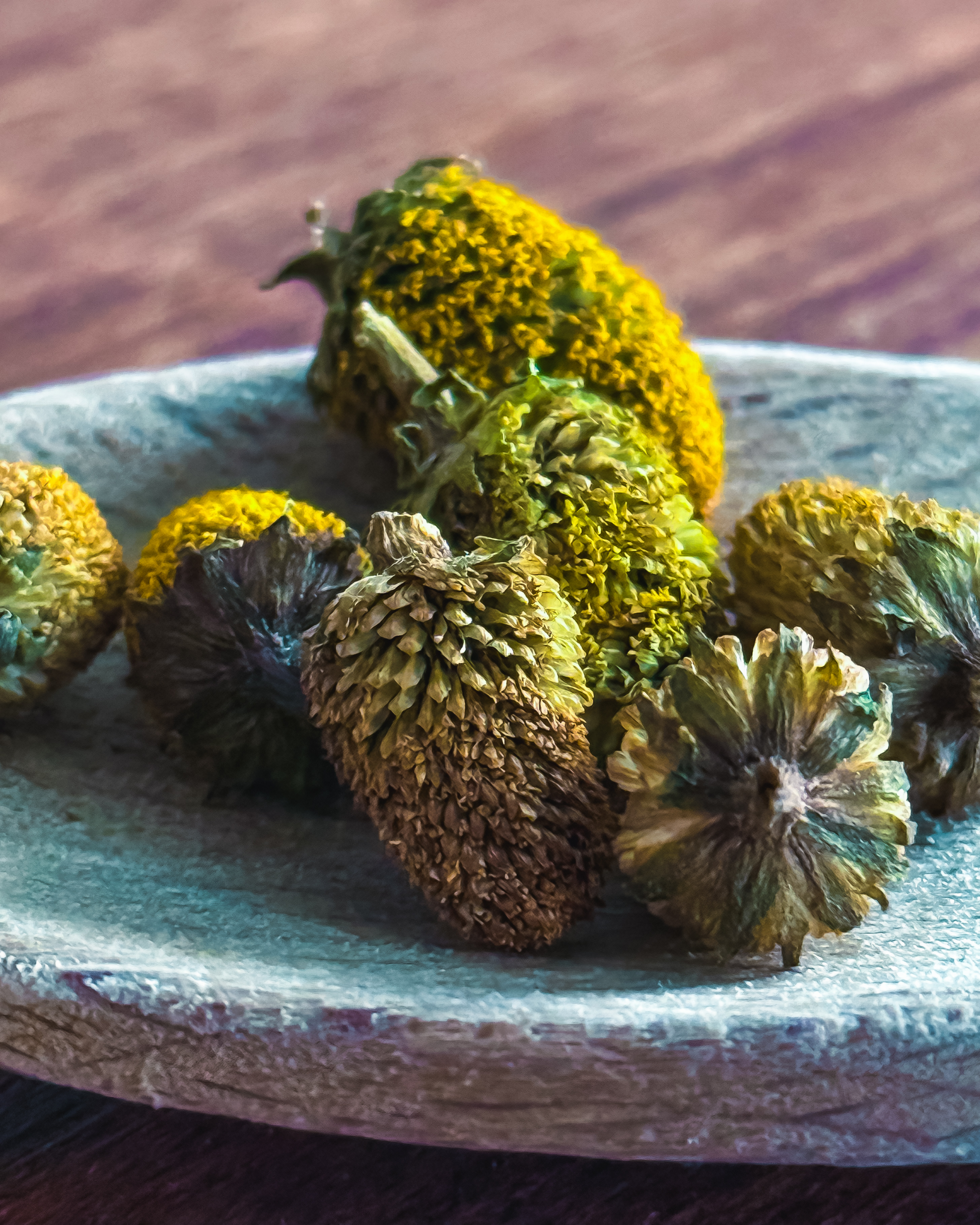
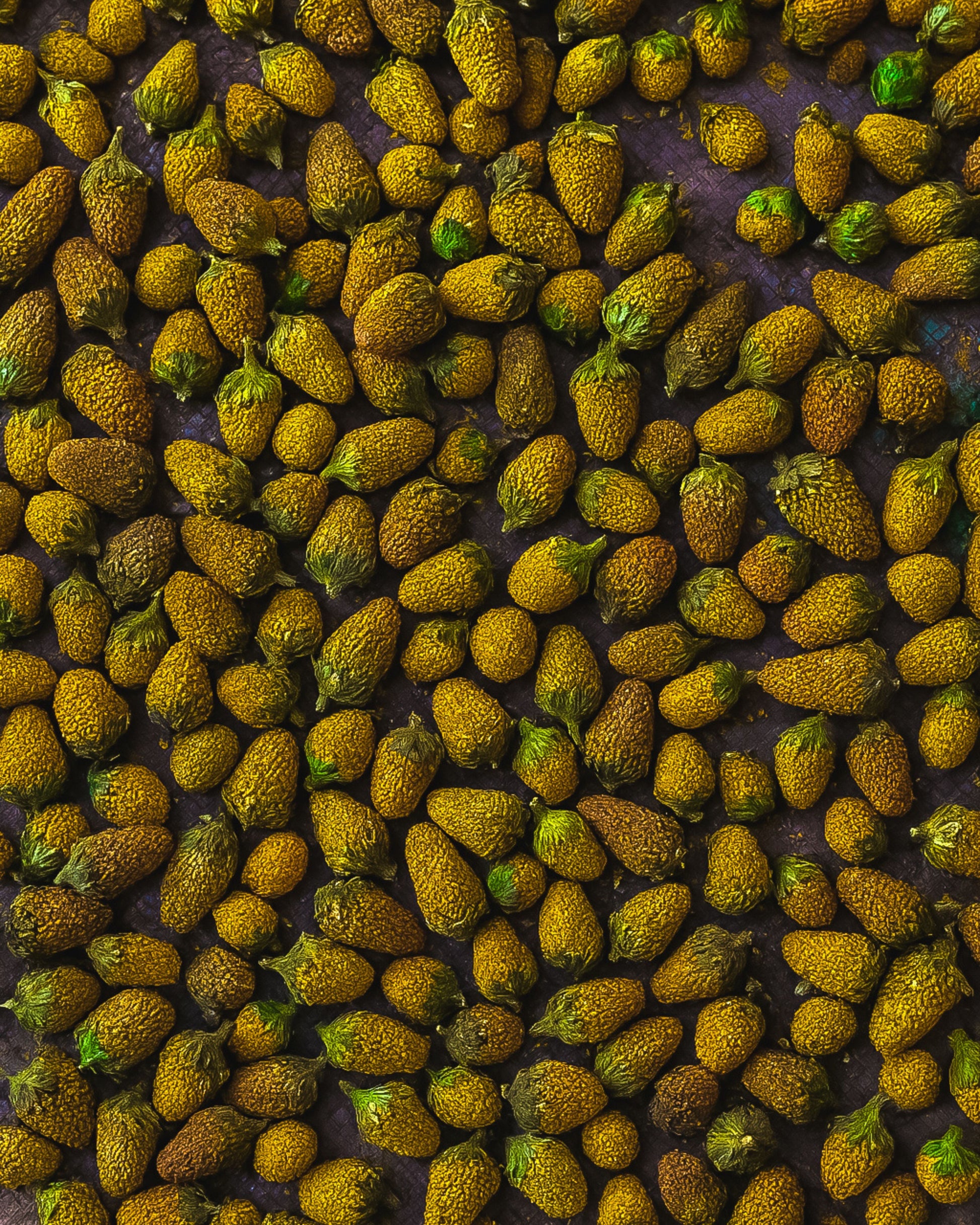
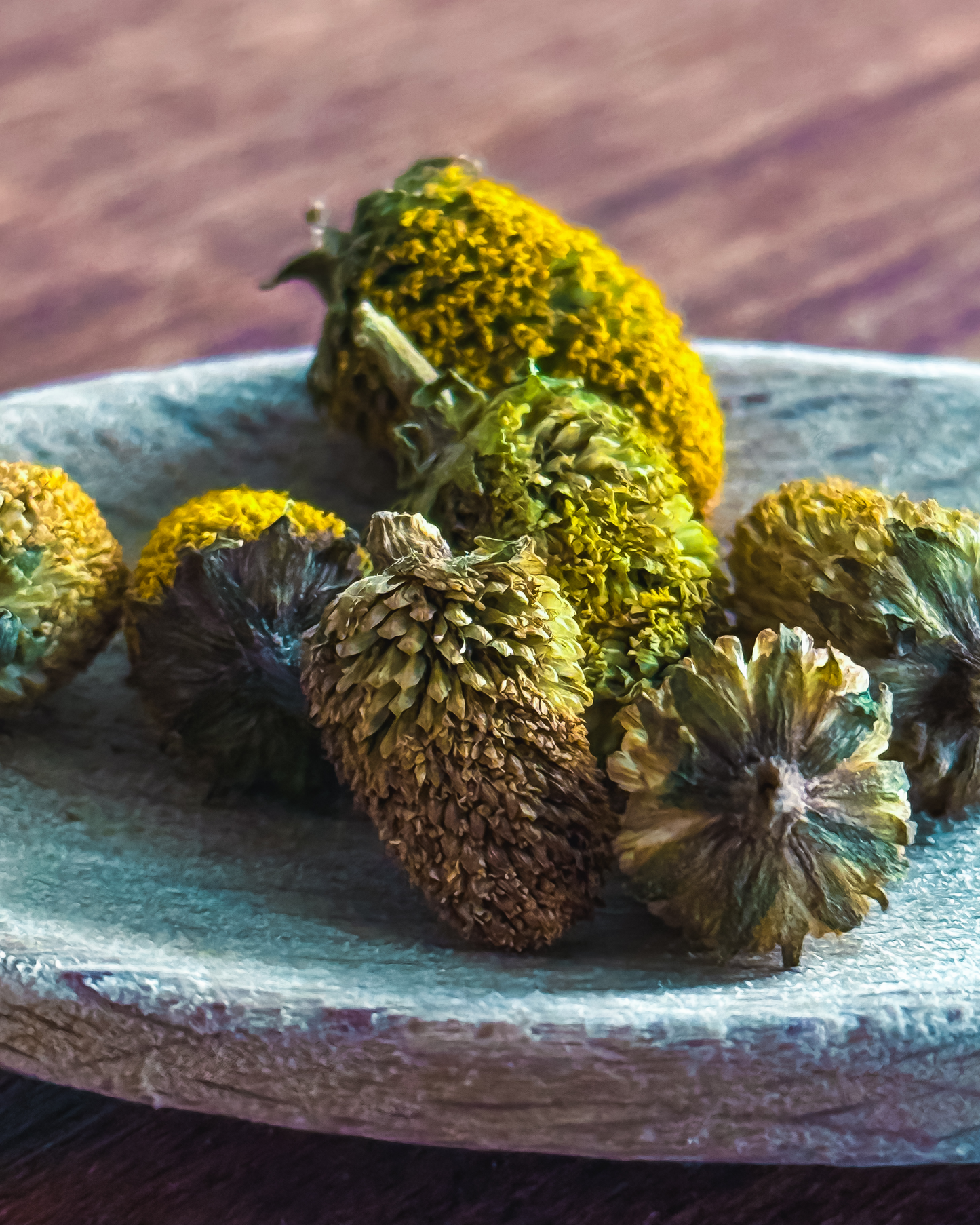
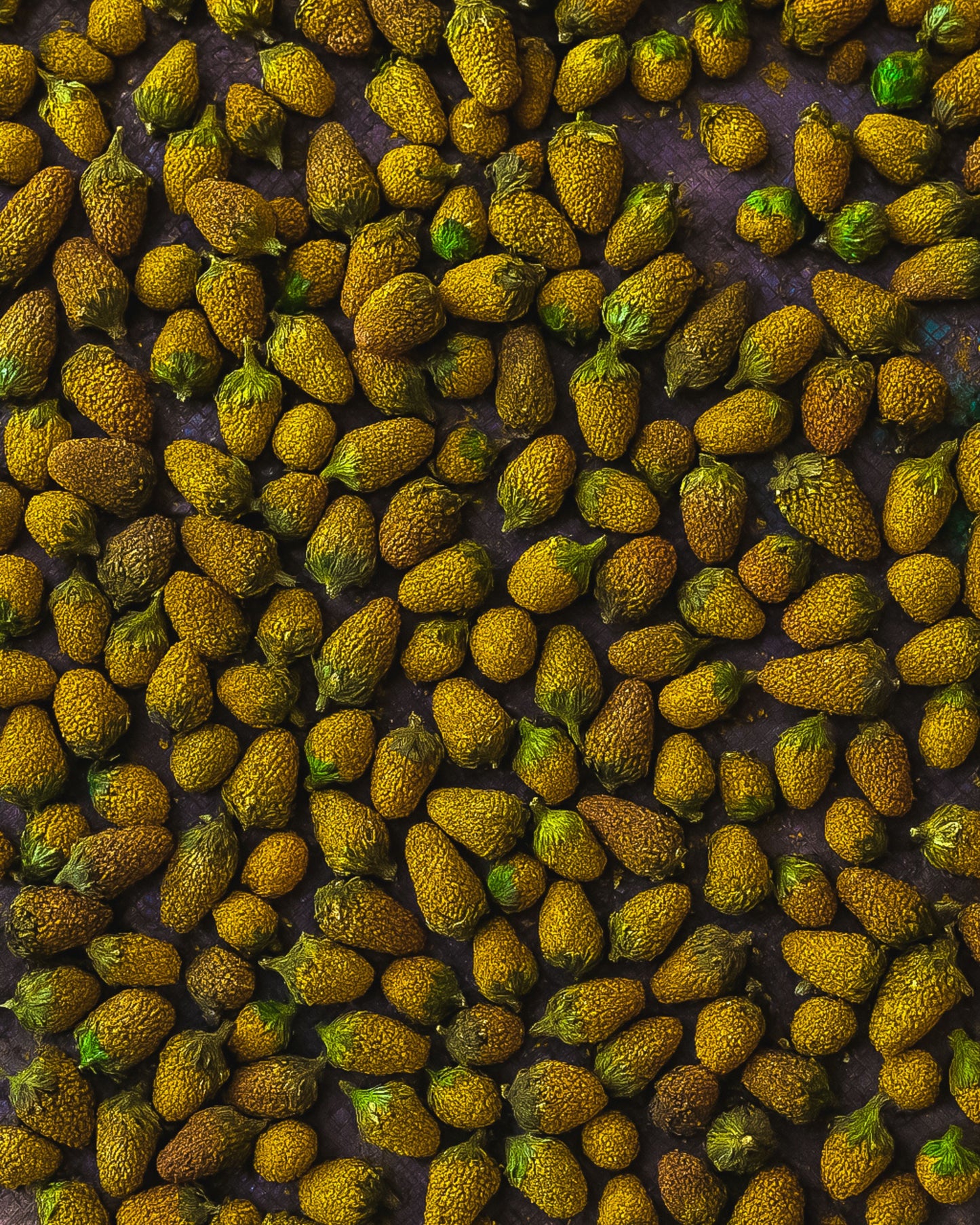
The distinctive textured surface of Acmella oleracea flower heads remains visible after drying.
Individual florets become:
- more pronounced;
- slightly compressed;
- naturally wrinkled.
This texture is a normal characteristic of properly dried flower heads and should not be confused with deterioration.
Leaf Appearance
Leaves undergo some of the most noticeable visual changes.
Fresh leaves are:
- smooth;
- flexible;
- bright green.
During drying they commonly become:
- thinner;
- curled;
- darker green or olive;
- more fragile.
These changes occur naturally as moisture is removed.
Stem Characteristics
Fresh stems bend easily because of their internal water content.
Dried stems gradually become:
- stiffer;
- lighter;
- more rigid.
Careful handling remains important to prevent unnecessary breakage.
Environmental Factors That Affect Quality
The quality of dried Acmella oleracea depends heavily on the conditions during drying.
Several environmental factors influence the final appearance and stability.
Temperature
Moderate drying temperatures generally produce better results than excessive heat.
Very high temperatures may contribute to:
- rapid shrinkage;
- uneven drying;
- colour changes;
- structural damage.
Gradual moisture removal usually preserves quality more effectively.
Airflow
Consistent airflow is essential.
Good ventilation:
- removes evaporated moisture;
- promotes even drying;
- reduces the likelihood of mould.
Poor airflow may leave some flower heads drying more slowly than others.
Humidity
Humidity strongly affects drying efficiency.
High humidity may:
- slow drying;
- increase mould risk;
- prolong the drying process.
Low to moderate humidity generally supports more reliable drying.
Light Exposure
Direct sunlight is usually avoided during drying.
Prolonged exposure may contribute to:
- colour fading;
- uneven heating;
- reduced visual quality.
Many growers prefer shaded or indoor drying areas with continuous airflow.
Common Misconceptions About Dried Flowers
Several misconceptions arise when people first compare fresh and dried Acmella oleracea.
Understanding these helps set realistic expectations.
"Dried Flowers Should Look Exactly Like Fresh Flowers"
They should not.
Some shrinkage, colour softening, and changes in texture are entirely normal.
The objective is to preserve the flower's natural structure, not to maintain the exact appearance of a freshly harvested flower.
"The Less Shrinkage, the Better"
A moderate degree of shrinkage is unavoidable.
Completely preventing shrinkage is neither realistic nor necessary.
Instead, successful drying aims to minimise distortion while allowing natural moisture loss.
"Darker Flowers Are Always Lower Quality"
Not necessarily.
Properly dried flower heads often develop a slightly darker appearance than fresh flowers.
Colour alone is not a reliable indicator of quality.
Assessment should also consider:
- structural integrity;
- absence of mould;
- cleanliness;
- complete drying.
"Fast Drying Always Produces Better Results"
Rapid drying under excessive heat may reduce quality rather than improve it.
Controlled, gradual drying generally provides:
- more even moisture removal;
- better structural preservation;
- lower risk of damage.
Patience is often rewarded with a higher-quality finished product.
Evaluating Dried Flower Quality
Well-dried Acmella oleracea flower heads generally display the following characteristics:
- intact cone-shaped flower heads;
- naturally wrinkled but well-preserved surface texture;
- uniform drying throughout the batch;
- no visible mould;
- no soft or damp areas;
- minimal physical damage;
- clean appearance free from excessive debris.
Quality assessment should consider the entire batch rather than individual flowers in isolation.
Conclusion to Part 2
Drying transforms Acmella oleracea from a fresh, moisture-rich botanical material into a lightweight, stable product suitable for long-term storage. As water is gradually removed, the flower heads naturally become smaller, firmer, and less flexible while retaining their distinctive textured surface and characteristic overall shape. Changes in colour, weight, and structure are expected outcomes of proper drying and should not be mistaken for quality loss when drying has been carried out under appropriate conditions.
The final quality of dried Acmella oleracea depends largely on environmental control during the drying process. Moderate temperatures, good airflow, suitable humidity, and protection from direct sunlight all contribute to preserving the flower's appearance and structural integrity. In Part 3, we will examine how fresh and dried Acmella oleracea differ in storage stability, handling, and practical applications, answer frequently asked questions, and summarise the key scientific principles that guide effective post-harvest preservation.
Part 3: Storage, Applications and Long-Term Quality
Table of Contents
- Storage Differences Between Fresh and Dried Material
- Practical Applications of Fresh and Dried Acmella oleracea
- Frequently Asked Questions
- Final Scientific Perspective
- Key Takeaways
Storage Differences Between Fresh and Dried Material
One of the greatest differences between fresh and dried Acmella oleracea is how each should be stored. Moisture content largely determines storage stability, handling requirements, and the length of time botanical material remains in good condition.
Understanding these differences helps growers, researchers, and manufacturers choose the most appropriate form for their intended use.
Fresh Material Requires Immediate Attention
Freshly harvested flower heads remain biologically active.
They continue to:
- respire;
- lose moisture;
- undergo natural ageing;
- support microbial growth if conditions become favourable.
For this reason, fresh material should be processed as soon as possible after harvest.
Delays increase the likelihood of:
- wilting;
- bruising;
- microbial contamination;
- quality deterioration.
Dried Material Offers Greater Stability
Once drying has been completed correctly, Acmella oleracea becomes considerably easier to store.
Properly dried flower heads are:
- lighter;
- less susceptible to mould;
- easier to package;
- more stable during transport;
- suitable for longer-term storage.
Although drying greatly improves storage stability, dried material still requires protection from moisture, excessive heat, and prolonged light exposure.
Storage Conditions Matter
Regardless of whether the material is fresh or dried, storage conditions strongly influence quality.
Ideal storage environments are:
- clean;
- dry;
- protected from direct sunlight;
- well organised;
- maintained at stable temperatures.
Good storage practices help preserve the quality established during cultivation and post-harvest handling.
Practical Applications of Fresh and Dried Acmella oleracea
Fresh and dried Acmella oleracea each have practical uses depending on the purpose of cultivation.
The choice between fresh and dried material is usually based on logistics, handling requirements, and intended application rather than one form being universally better than the other.
Fresh Flower Heads
Fresh flower heads are commonly valued because they retain their natural appearance and living plant structure.
They are frequently used for:
- botanical observation;
- horticultural education;
- ornamental displays;
- culinary presentation;
- fresh harvest evaluation.
Because fresh material changes rapidly after harvest, careful handling is essential.
Dried Flower Heads
Dried flower heads are generally preferred when long-term preservation is required.
They are well suited for:
- botanical collections;
- educational reference material;
- cosmetic ingredient processing;
- research storage;
- commercial botanical supply.
Drying also makes packaging and transportation considerably easier.
Research Applications
Researchers may work with either fresh or dried material depending on the objectives of a particular study.
Accurate documentation should accompany both forms and may include:
- botanical identity;
- harvest date;
- batch number;
- post-harvest handling records;
- storage conditions.
Good documentation supports reproducibility and traceability.
Commercial Production
Commercial producers often prioritise consistency between harvests.
High-quality post-harvest management helps maintain:
- uniform appearance;
- clean botanical material;
- reliable batch documentation;
- consistent product quality.
Standard operating procedures are commonly used to achieve reproducible handling practices.
Fresh Versus Dried: Which Is Better?
A common question is whether fresh or dried Acmella oleracea is the superior choice.
Scientifically, there is no universal answer.
Each form offers different advantages.
Fresh material provides:
- natural appearance;
- living plant tissues;
- maximum hydration;
- immediate observation after harvest.
Dried material provides:
- longer storage life;
- easier transport;
- improved handling;
- greater physical stability.
The appropriate choice depends entirely on the intended application.
Frequently Asked Questions
Does drying improve the quality of Acmella oleracea?
No.
Drying preserves the quality present at harvest but cannot improve damaged, immature, or poorly handled material.
Why do dried flower heads weigh much less?
Fresh flower heads contain a high proportion of water.
During drying, most of this moisture is gradually removed, producing a much lighter finished product.
Should dried flowers look exactly like fresh flowers?
No.
Some shrinkage, colour softening, and changes in texture are natural consequences of controlled moisture removal.
Properly dried flowers should retain their characteristic overall shape without appearing identical to fresh material.
Can fresh flowers be stored for long periods?
Fresh botanical material is naturally perishable.
Without appropriate preservation, quality gradually declines because of respiration, water loss, and natural ageing.
Why are dried flowers easier to transport?
The reduction in moisture decreases weight while improving physical stability and reducing the likelihood of microbial spoilage during transport.
Can dried flower heads absorb moisture again?
Yes.
If stored under humid conditions, dried flowers may reabsorb moisture from the surrounding environment.
For this reason, they should always be stored in clean, dry, well-sealed containers.
Best Practices for Maintaining Quality
Whether working with fresh or dried Acmella oleracea, several principles remain consistent.
The most effective practices include:
- harvesting healthy flower heads;
- minimising handling damage;
- processing material promptly;
- drying under controlled conditions;
- storing in clean, dry containers;
- protecting material from moisture and direct sunlight;
- maintaining accurate batch records.
Together, these practices help preserve quality throughout the entire post-harvest process.
Final Scientific Perspective
The transition from fresh to dried Acmella oleracea is a natural progression driven primarily by moisture loss and the gradual slowing of biological activity after harvest. Fresh flower heads remain living tissues that continue to respire, lose water, and undergo natural ageing, making them highly perishable and dependent on prompt post-harvest handling. Controlled drying transforms this moisture-rich material into a more stable botanical product that is easier to store, transport, and preserve over extended periods.
Although fresh and dried flower heads differ noticeably in appearance, weight, texture, and handling characteristics, neither form is inherently superior. Each serves different purposes depending on the intended application. Fresh material is valued for its natural appearance and immediate use, while dried material offers greater storage stability and logistical advantages for research, education, cosmetic manufacturing, and commercial distribution.
Perhaps the most important principle is that drying preserves quality rather than creating it. High-quality dried Acmella oleracea begins with healthy plants, careful harvesting, and appropriate post-harvest handling. Every subsequent step, including cleaning, drying, storage, and documentation, is designed to protect the quality established in the field. By understanding the scientific differences between fresh and dried material, growers and manufacturers can make informed decisions that support consistent botanical quality and reliable long-term preservation.
Key Takeaways
- Fresh Acmella oleracea remains biologically active after harvest and continues to lose moisture, respire, and undergo natural ageing.
- Drying removes moisture gradually, producing lighter, more stable flower heads that are easier to store and transport.
- Fresh and dried material differ naturally in appearance, weight, texture, flexibility, and storage life, but both have important applications.
- Proper storage protects dried flower heads from moisture, heat, light, contamination, and unnecessary physical damage.
- Drying does not improve botanical quality. It preserves the condition established through successful cultivation, careful harvesting, and effective post-harvest handling.