

Part 1: What High-Quality Dried Acmella Actually Means
Dried Acmella oleracea can look deceptively simple.
A bag of dried Buzz Button flower heads may contain small yellow-brown botanical pieces that appear broadly similar. Yet appearance alone tells us only part of the quality story.
For a buyer, formulator, researcher or botanical supplier, several different questions matter:
Is it actually Acmella oleracea?
Which part of the plant was harvested?
Were the flower heads harvested and dried appropriately?
Has the material remained dry and well stored?
Is there evidence of contamination or deterioration?
Can the batch be traced to its source?
Has its spilanthol concentration actually been measured?
A visually attractive dried flower is not automatically a high-quality botanical ingredient. Equally, natural colour variation or an irregular flower shape does not automatically indicate poor quality.
The most useful way to think about dried Acmella quality is as a chain:
Botanical Identity → Plant Part → Harvest → Drying → Storage → Physical Inspection → Sampling → Laboratory Testing → Traceability
Each stage answers a different question.
The central principle of Part 1 is:
High-quality dried Acmella is not defined by one visual characteristic or one spilanthol number. Quality is a combination of correct botanical identity, appropriate plant material, controlled post-harvest handling, acceptable physical condition, traceability and evidence appropriate to the intended use.
1. Start with the Botanical Name
The first question is not whether the flowers look attractive.
It is:
What plant is this?
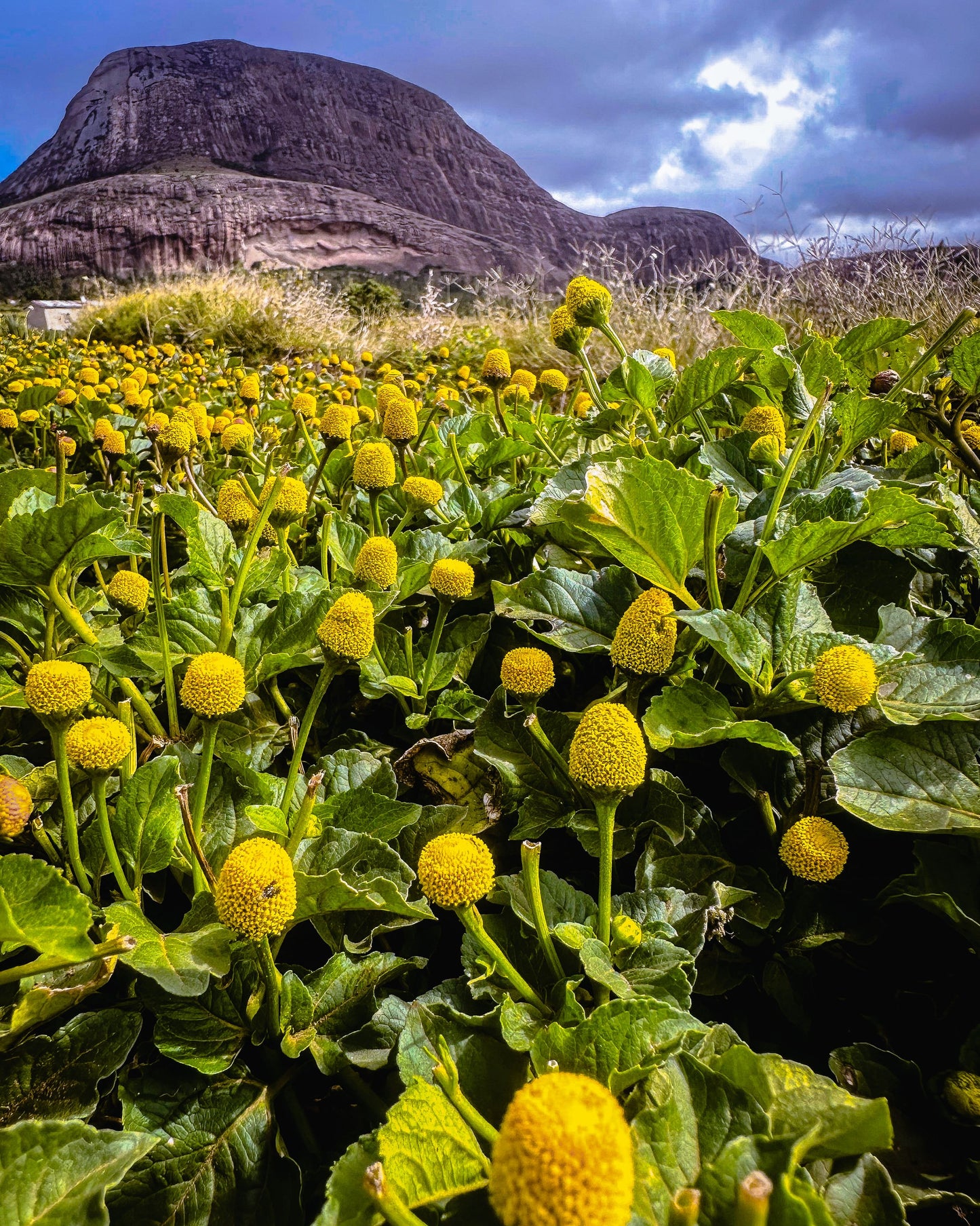
The accepted botanical name is Acmella oleracea (L.) R.K.Jansen.
2. Older Names Can Still Appear
Botanical literature, supplier documents and older commercial material may use the name:
Spilanthes oleracea L.
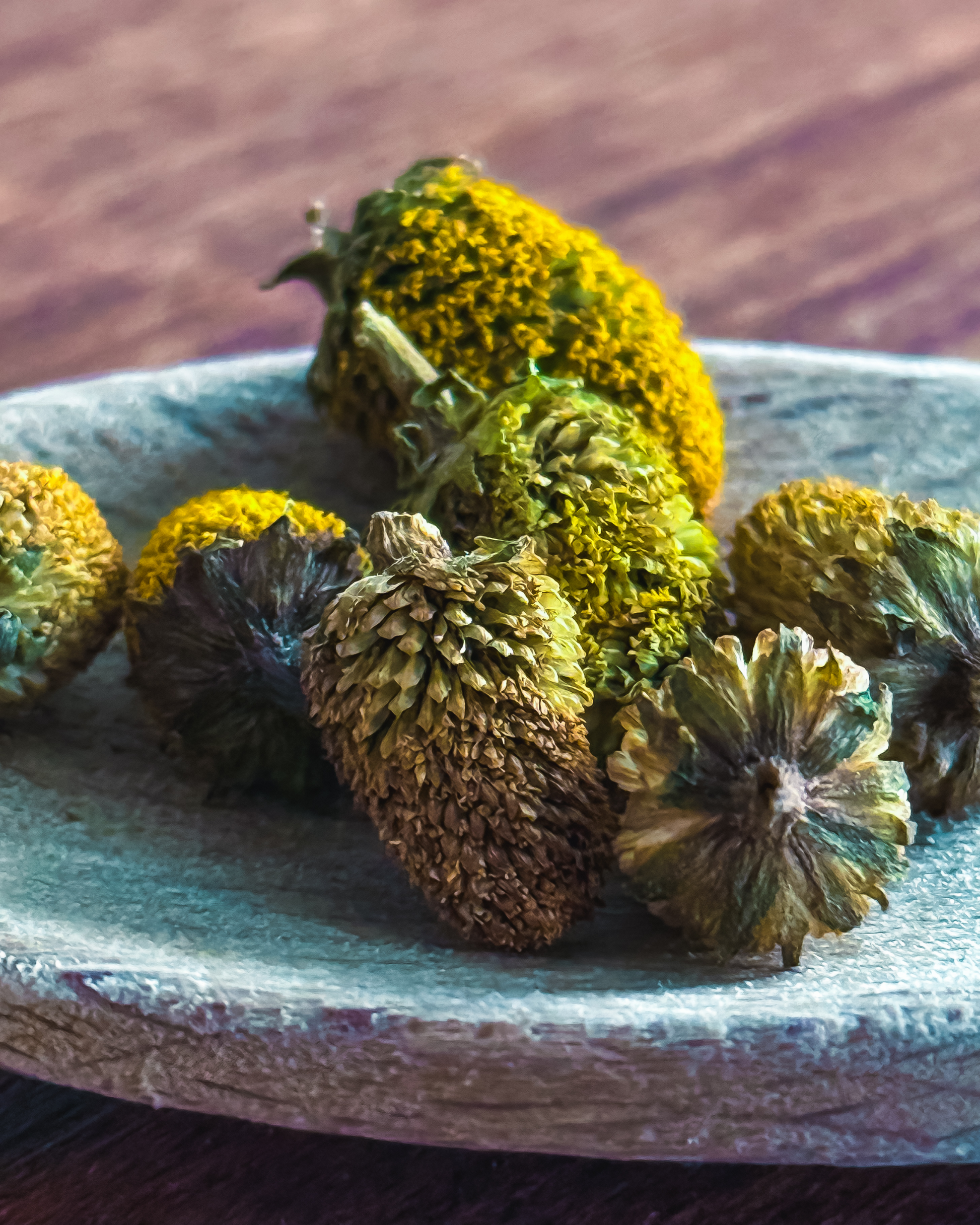
This is associated with the same plant in modern taxonomic treatment, but botanical naming should still be handled carefully.
3. Common Names Are Less Precise
Acmella oleracea may be sold under names such as:
- Buzz Buttons
- Electric Daisy
- Paracress
- Toothache Plant
- Sichuan Buttons
These names can be useful commercially.
They are not substitutes for botanical identification.
4. "Buzz Button" Is Not a Taxonomic Certificate
A supplier can place the words "Buzz Buttons" on a bag without those words independently proving species identity.
Common names can overlap between regions, suppliers and related plants.
5. Botanical Identity Comes Before Potency
Before asking:
How much spilanthol does it contain?
ask:
What botanical material was actually tested?
A precise chemical result attached to uncertain botanical identity has limited value.
6. Identity and Quality Are Related but Different
Correctly identified Acmella oleracea can still be poorly:
- harvested
- dried
- stored
- handled
Correct species identity is necessary for a species-specific product, but it does not establish complete quality.
7. High Quality Is Multidimensional
A useful quality framework includes several separate dimensions:
Identity
Is the botanical material what it claims to be?
Plant part
Are these flower heads, leaves, stems or a mixture?
Physical condition
Does the material show appropriate dried morphology?
Post-harvest quality
Was drying and storage suitable?
Chemical specification
Does the batch meet defined analytical requirements?
Microbiological quality
Does testing, where relevant, support the intended use?
Traceability
Can the batch be followed through the supply chain?
8. No Single Dimension Replaces the Others
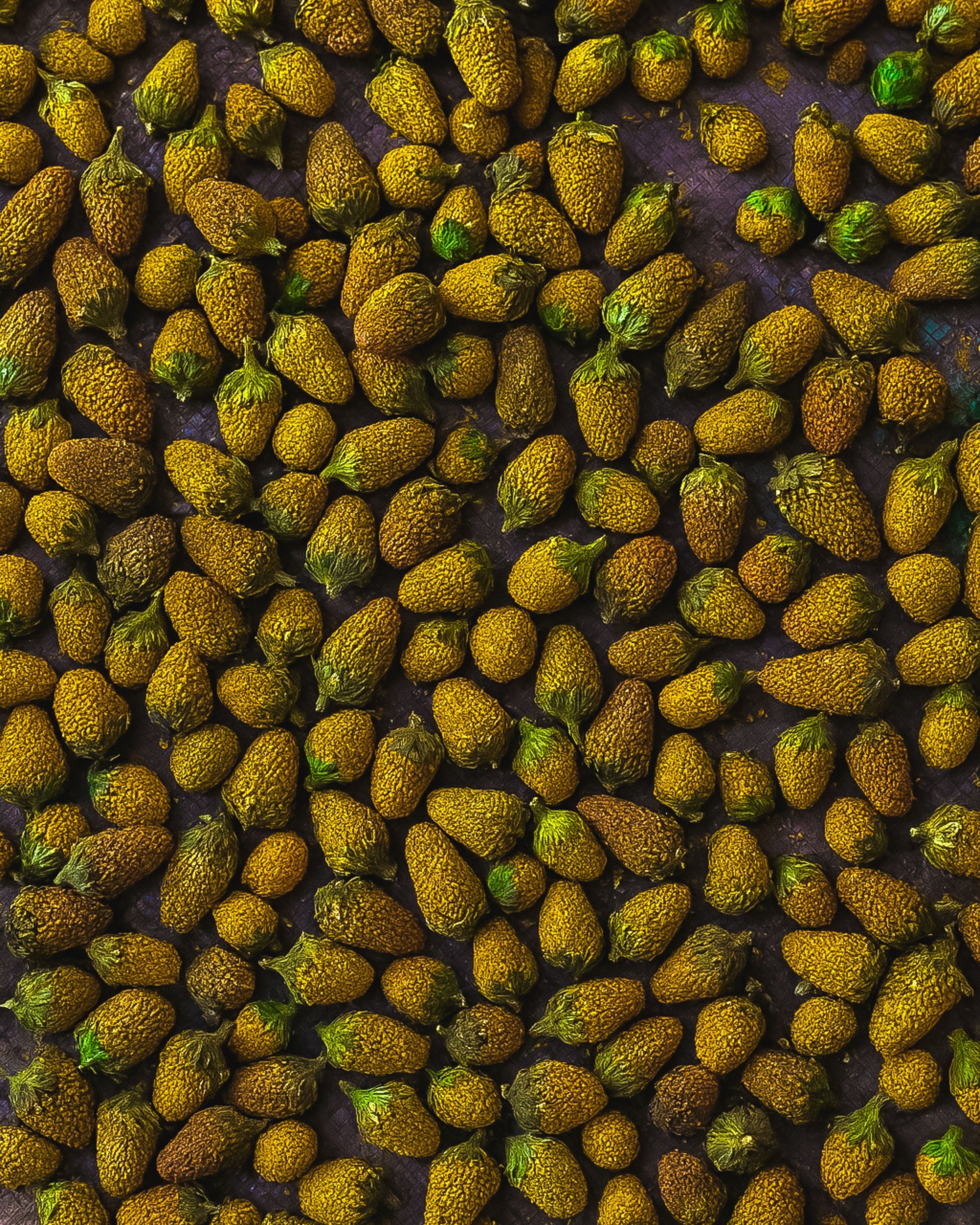
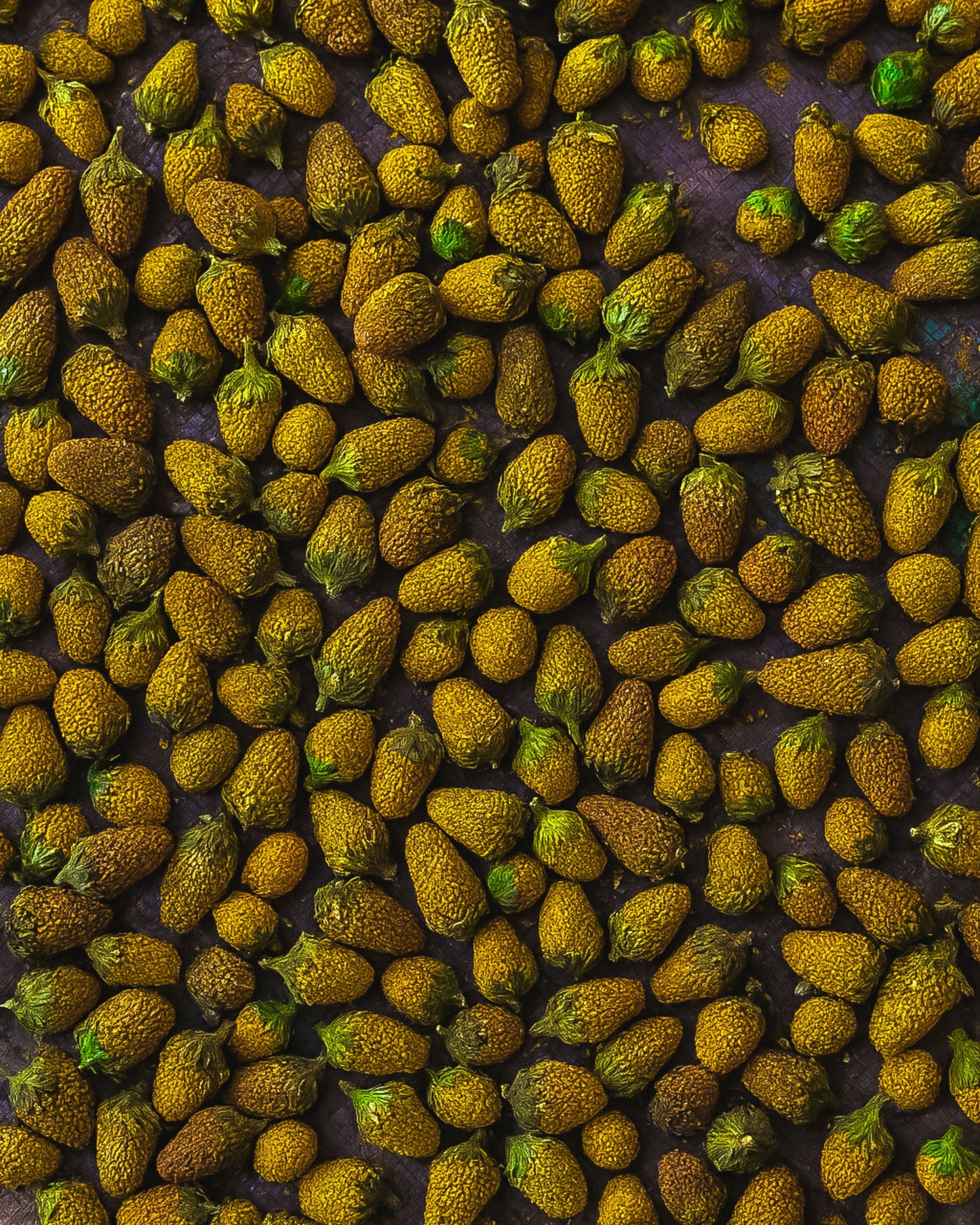
A high spilanthol result does not prove:
- botanical identity
- microbiological quality
- traceability
- good storage
Likewise, excellent traceability does not establish spilanthol concentration.
9. Start with the Plant Part
Acmella oleracea is not chemically uniform from root to flower.
Different plant parts can contain different concentrations of constituents.
10. Flower Heads Are Particularly Important
The flower heads are generally the most important plant part when discussing spilanthol-rich Acmella raw material.
Leaves can also contain measurable spilanthol.
Stems generally contain less relative to flower heads.
11. Plant-Part Composition Changes the Batch
Consider two bags.
Bag A: predominantly dried flower heads.
Bag B: flower heads mixed with substantial stems and leaves.
Even if both are genuine Acmella oleracea, they are not necessarily equivalent botanical raw materials.
12. "Acmella" Is Not a Complete Raw-Material Description
Useful specifications should identify what is being supplied.
For example:
dried Acmella oleracea flower heads
provides more information than:
dried Acmella.
13. "Aerial Parts" Means Something Different
A botanical material described as aerial parts may include above-ground structures such as:
- flowers
- leaves
- stems
depending on the specification.
It should not automatically be interpreted as flower-head material.
14. Flower-Head Content Can Affect Chemical Results
If flower heads generally contain more spilanthol than major vegetative parts, changes in plant-part composition can contribute to differences between batches.
This is one reason raw-material specifications matter.
15. More Flowers Does Not Automatically Mean a Better Product
The appropriate plant part depends on the intended ingredient.
A product specifically sold as dried flower heads should be assessed against that description.
A whole-herb preparation has a different specification.
16. Flower-Head Purity Is Not Chemical Purity
A bag containing only Acmella flower heads is still complex plant material.
It contains many botanical constituents.
It is not pure spilanthol.
17. Spilanthol Is One Compound Within the Plant
Spilanthol is a prominent alkamide associated with the characteristic sensory properties of Acmella oleracea.
But it is not the entire chemical identity of the plant.
18. Acmella Contains Other Constituents
The botanical matrix can include:
- other alkamides
- pigments
- lipids
- carbohydrates
- proteins
- structural plant material
- numerous minor constituents
The exact profile depends on the material and analytical method.
19. High Spilanthol Does Not Mean Pure Acmella Chemistry
Even an extract standardised to spilanthol remains different from purified spilanthol.
Similarly, dried flower heads remain whole botanical material.
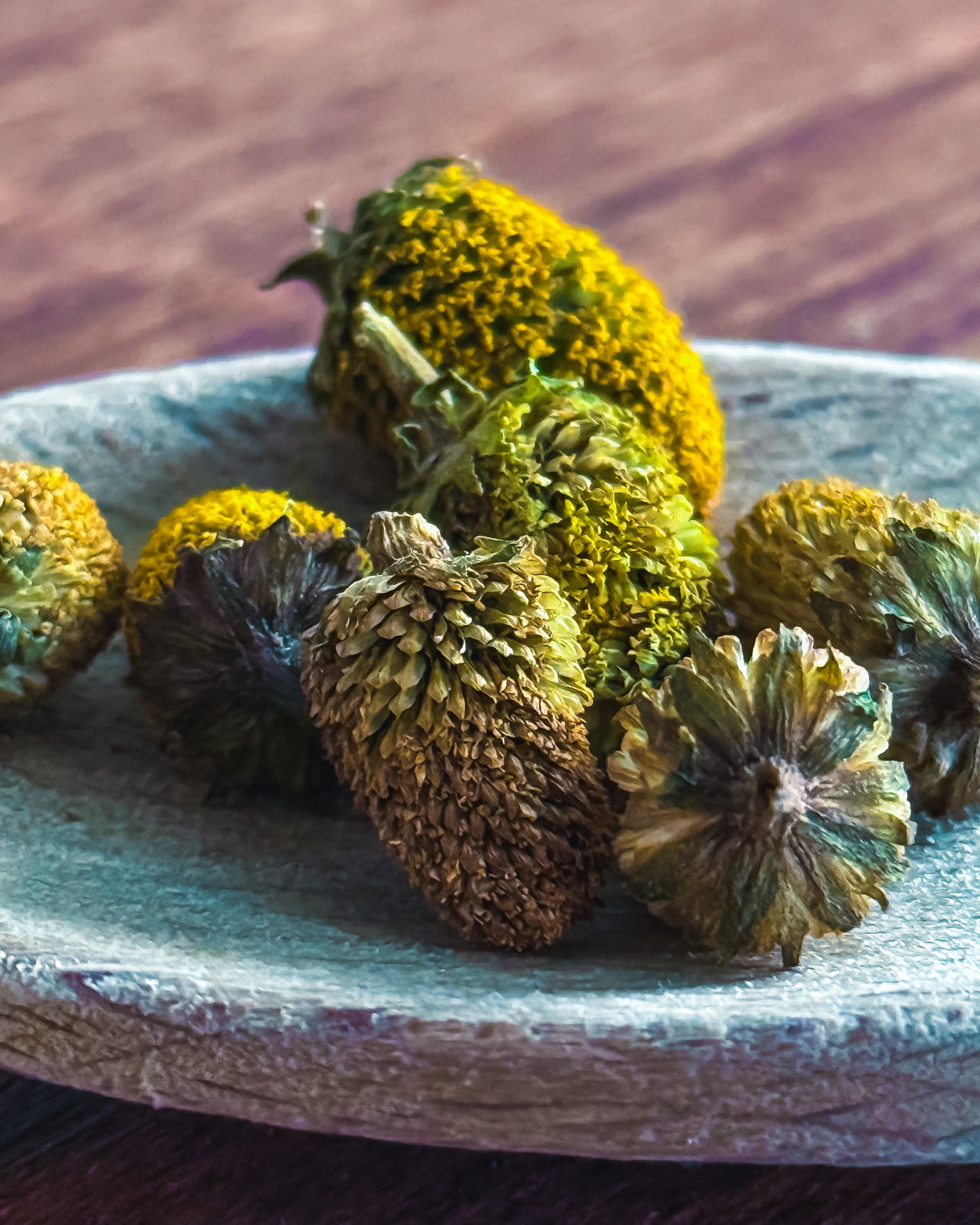
20. What Should Dried Acmella Flower Heads Look Like?
Drying changes fresh Acmella substantially.
A fresh flower head is not expected to look identical after water removal.
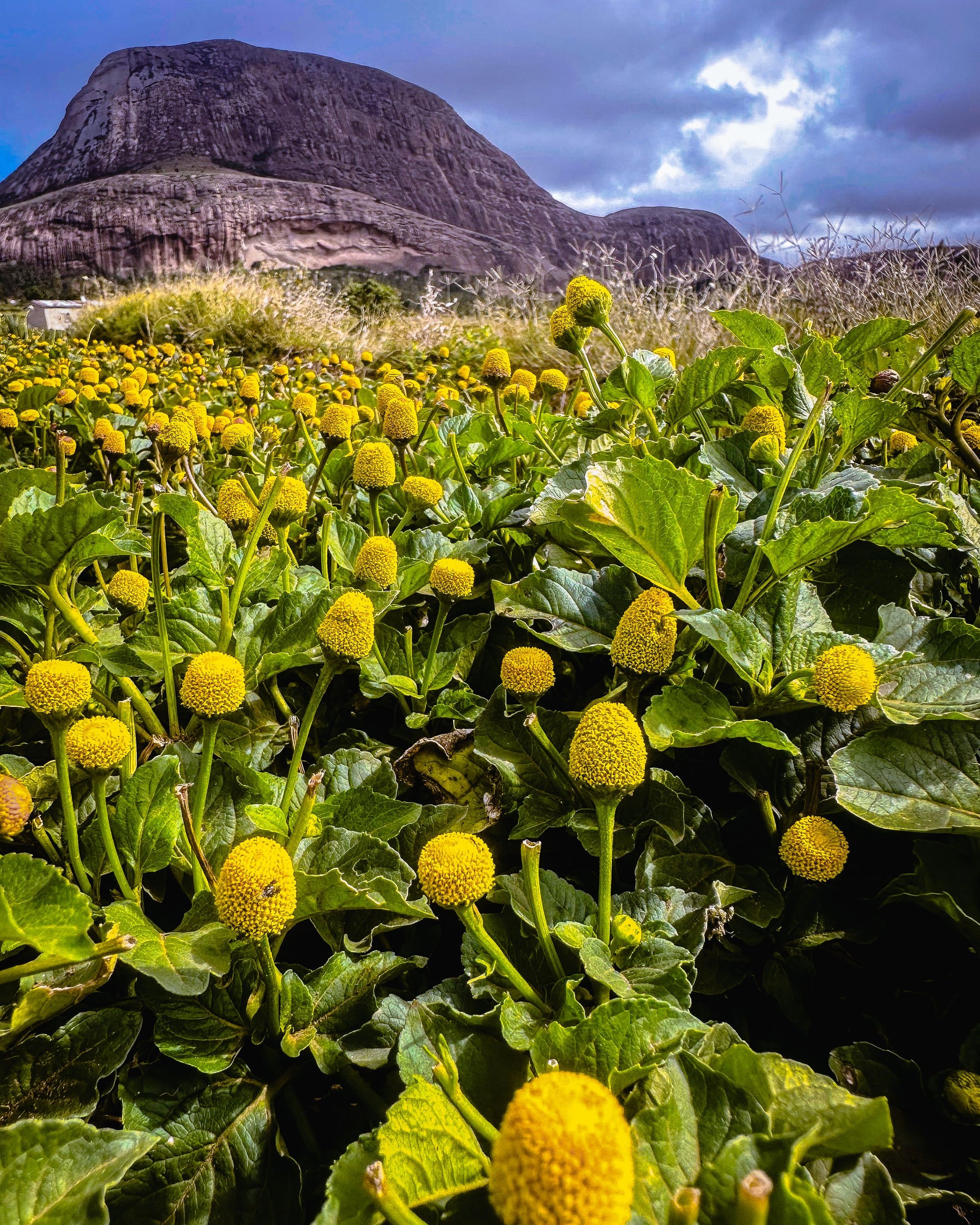
21. Fresh Acmella Has Distinctive Morphology
Fresh Acmella oleracea flower heads are typically:
- textured
- composed of many small florets
- golden-yellow
- naturally domed to elongated
- supported by green involucral structures
Natural variation occurs.
22. Real Flowers Are Not Yellow Pom-Poms
Acmella flower heads should not be imagined as perfectly smooth yellow spheres.
Their surface reflects the composite floral structure.
23. Drying Preserves Some Morphological Information
After drying, the head may still retain enough structure to recognise features of the original botanical form.
But drying causes:
- shrinkage
- colour change
- loss of fresh firmness
- texture change
24. Natural Shrinkage Is Expected
Water contributes substantially to fresh plant tissue.
As water is removed, the flower head becomes smaller and lighter.
This is normal.
25. Dried Acmella Should Not Look Like a Perfect Ball
Natural dried heads commonly appear:
- irregular
- compact
- shrunken
- textured
A perfectly smooth spherical shape would not represent typical natural morphology well.
26. Dried Heads Can Become More Ovoid or Compact
The original elongated or domed fresh structure can contract during drying.
The final shape depends on:
- original maturity
- drying
- handling
- natural variation
27. Texture Matters
A high-quality botanical reference should retain visible natural structure.
The dried head should not resemble:
- a manufactured bead
- a smooth pellet
- a plastic sphere
28. Natural Variation Is Not a Defect
Within one genuine botanical batch, individual heads may differ in:
- size
- shape
- colour
- degree of shrinkage
Agricultural material is biologically variable.
29. Perfect Uniformity Can Be Misleading
A photograph showing dozens of absolutely identical flowers may look attractive.
It does not realistically represent normal agricultural variation.
30. Colour Changes During Drying
Fresh golden-yellow flowers generally become less vivid as they dry.
Possible dried colours can include shades of:
- muted yellow
- yellow-brown
- tan
- brown
The precise appearance depends on multiple factors.
31. Bright Yellow Is Not Automatically Higher Quality
It is tempting to rank dried flowers by colour alone.
That is unreliable.
A brighter dried flower does not automatically contain more spilanthol.
32. Darker Does Not Automatically Mean Lower Spilanthol
The opposite assumption is also unreliable.
Colour can be influenced by:
- maturity
- drying
- storage
- oxidation
- natural variation
Chemical concentration still requires measurement.
33. Colour Can Still Provide Useful Clues
Although colour is not a chemical assay, unusual colour changes can help identify material that deserves closer inspection.
Visual inspection is useful as screening.
34. Screening Is Not Proof
The correct interpretation is:
Appearance can raise questions.
It cannot always answer them.
35. Excessive Darkening Deserves Investigation
If material appears much darker than expected, possible explanations could involve:
- advanced maturity
- drying conditions
- storage history
- deterioration
The visual observation alone cannot identify the cause.
36. Never Diagnose Processing History from Colour Alone
A dark flower does not prove it was overheated.
A pale flower does not prove it was gently dried.
Processing claims need supporting records or controlled comparison.
37. What About Green Material?
Some green botanical tissue may remain associated with flower heads.
The involucre beneath the flower is a normal botanical structure.
38. Green Bracts Are Not Automatically Foreign Matter
The structures naturally attached to the flower head should not be mistaken for contamination.
Botanical knowledge matters during inspection.
39. Stems Are Different
A batch specified as flower heads may contain small amounts of naturally associated stem material depending on the harvest and specification.
Large quantities of stems, however, change the plant-part composition.
40. Define Acceptable Stem Content
Commercial quality control works better when expectations are written.
Instead of saying:
very few stems
a specification can define an appropriate measurable acceptance criterion where necessary.
The actual limit should be established for the product rather than invented.
41. Leaves May Also Appear
Leaves are genuine parts of Acmella oleracea.
But their presence in a flower-head product affects the composition of the batch.
42. Genuine Plant Material Can Still Be Unwanted Material
This distinction is important.
A leaf can be authentic Acmella and still be outside the specification for a flower-head product.
43. Foreign Matter Is Another Category
Foreign material can include things that do not belong in the defined botanical product.
Depending on the production environment, inspection may look for:
- unrelated plant material
- soil particles
- stones
- fibres
- packaging fragments
- insects or insect debris
The relevant specification depends on the intended product and quality system.
44. Foreign Matter and Adulteration Are Not the Same
Foreign matter may enter accidentally.
Adulteration implies a different problem, such as substitution or deliberate addition.
The distinction matters.
45. Visual Inspection Can Detect Some Foreign Material
Large, obvious contaminants may be visible.
This makes sorting valuable.
46. Visual Inspection Cannot Detect Everything
It cannot reliably detect all:
- microorganisms
- pesticide residues
- heavy metals
- chemical contaminants
These require appropriate analytical approaches where relevant.
47. "Clean-Looking" Is Not a Laboratory Result
A clean-looking bag of dried flowers can still require testing depending on intended use and specification.
48. Aroma Can Be Part of Sensory Inspection
Botanical raw materials often have characteristic aromas.
An experienced inspector may notice unusual changes.
49. Aroma Is Subjective
Human perception varies.
Aroma evaluation can support inspection but should not be treated as a precise chemical measurement.
50. Stronger Aroma Does Not Mean More Spilanthol
Volatile aroma and spilanthol concentration are not interchangeable concepts.
51. Tingling Can Also Be Observed Sensory-Wise
Acmella is well known for its characteristic oral sensory effect.
But sensory testing of raw material must be treated carefully.
52. Tingling Is Not an HPLC Method
A strong sensation cannot provide an exact spilanthol percentage.
53. Weak Tingling Does Not Automatically Prove a Bad Batch
Sensory response can vary with:
- amount sampled
- plant material
- individual sensitivity
- sample condition
- chemical composition
A controlled analytical method answers the concentration question more directly.
54. Never Use Unverified Material for Casual Sensory Testing
Identity and suitability for ingestion should be established before botanical material is tasted.
Sensory testing should not replace safety or quality procedures.
55. Dryness Is a Major Quality Consideration
Drying is used to reduce water in harvested plant material.
This can improve storage stability compared with highly moist fresh material.
56. But "Dry" Is Not a Precise Measurement
A flower may feel dry to the fingers while still containing measurable moisture.
Touch alone cannot quantify moisture content.
57. Moisture Content and Water Activity Are Different
This distinction is essential.
Moisture content describes how much water is present in the material.
Water activity describes the availability of water in a way that relates to physical, chemical and microbiological behaviour.
They are not the same measurement.
58. Low Moisture Does Not Automatically Equal Low Water Activity
The relationship depends on the material.
Two botanical materials with similar moisture content can potentially have different water activities.
59. Water Activity Is Not Percentage Water
An aw value is not simply another way of writing moisture percentage.
These concepts should not be confused.
60. Why Water Matters After Harvest
Excess residual moisture can contribute to storage problems.
Depending on conditions, it may support:
- microbial growth
- physical deterioration
- chemical change
Drying therefore needs control.
61. Drying Too Slowly Can Create Problems
Freshly harvested plant material contains substantial water.
If drying conditions allow material to remain wet for too long, deterioration risks can increase.
62. But Faster Is Not Automatically Better
Aggressive drying conditions may alter:
- colour
- aroma
- texture
- chemical composition
The goal is appropriate drying, not simply maximum speed.
63. Heat Is a Processing Variable
Higher temperature can accelerate water removal.
It can also accelerate certain chemical reactions.
Therefore, drying temperature should be treated as a controlled variable.
64. There Is No Universal Magic Drying Temperature
The appropriate drying process depends on:
- equipment
- airflow
- load
- material thickness
- target endpoint
- quality objective
One exact number should not be presented as universally optimal without supporting evidence.
65. Sun Drying Is Not Automatically Inferior
Sun drying can be part of traditional or commercial botanical processing.
Its quality depends on how the process is managed.
66. Freeze-Drying Is Not Automatically Superior
Freeze-drying can produce distinctive physical characteristics and may preserve certain qualities well in some materials.
But the process alone does not prove:
- higher spilanthol
- better safety
- better overall quality
Comparative data are needed.
67. Drying Method Is Not a Quality Ranking by Itself
A well-managed sun-dried batch can be preferable to a poorly handled batch produced with sophisticated equipment.
Process control matters.
68. Madagascar Drying Should Be Described Accurately
When documenting a real supply chain, the actual process should be shown rather than replacing it with a generic industrial image.
If Acmella flower heads are dried on textile mats at ground level, that is the process that should be documented accurately.
69. Drying Surface Matters
Botanical material should be protected from inappropriate contamination during drying.
The condition and cleanliness of the drying surface are therefore relevant quality considerations.
70. Ground-Level Drying Does Not Automatically Mean Poor Quality
Physical height above the ground is not itself a complete quality measure.
The relevant questions concern:
- surface cleanliness
- environmental exposure
- handling
- contamination control
- drying performance
71. Documentation Makes Processing Interpretable
Useful drying records can include:
- batch or lot identity
- harvest date
- plant part
- drying method
- relevant process conditions
- completion date
The exact level of documentation depends on the operation.
72. "Sun-Dried" Does Not Tell the Whole Story
The phrase does not tell us:
- how thickly flowers were spread
- whether they were turned
- weather conditions
- how the endpoint was assessed
- how material was stored afterwards
Process labels need context.
73. Drying Ends, Storage Begins
Once material reaches the intended dried condition, the next challenge is maintaining that condition.
Poor storage can compromise good drying.
74. Dried Botanicals Can Reabsorb Moisture
Many dried materials interact with humidity in the surrounding environment.
Packaging and storage therefore matter.
75. Humidity Exposure Can Change the Material
If dried flowers absorb moisture during storage, this can affect:
- texture
- physical stability
- microbiological risk
depending on conditions.
76. Packaging Is Part of Quality Preservation
Suitable packaging can help protect botanical material from environmental exposure.
Relevant concerns may include:
- moisture
- oxygen
- light
- physical damage
- contamination
77. No Package Provides Infinite Protection
Barrier properties differ between packaging materials.
Seals and handling also matter.
78. Transparent Packaging Can Increase Light Exposure
If light-sensitive constituents or appearance are important, packaging choice deserves consideration.
But the actual chemical effect should be measured rather than assumed.
79. Oxygen Exposure Can Matter
Plant constituents may undergo oxidative changes.
The extent depends on:
- chemical composition
- time
- temperature
- packaging
- matrix
80. "Oxidation" Should Not Become a Catch-All Explanation
Not every colour or aroma change is automatically oxidation.
Specific mechanisms require evidence.
81. Storage Temperature Matters
Chemical and biological processes are generally influenced by temperature.
However, one universal storage temperature should not be invented for every dried Acmella product.
82. Stable Conditions Are Valuable
Large environmental fluctuations can complicate botanical storage.
A defined storage environment improves reproducibility and traceability.
83. Light, Heat and Moisture Often Interact
Storage quality is rarely controlled by only one factor.
For example:
warm + humid + poorly sealed
creates a different environment from:
cooler + dry + appropriately packaged.
84. Storage Time Matters Too
Dried botanical material does not remain chemically frozen indefinitely.
Changes can occur over time.
85. Age Alone Does Not Determine Quality
An older batch is not automatically unacceptable.
A newer batch is not automatically excellent.
Storage history matters.
86. Shelf Life Should Be Evidence-Based
A supplier should not simply choose an attractive shelf-life number without supporting rationale.
Stability information should relate to the actual:
- material
- packaging
- storage conditions
- quality specifications
87. Appearance Cannot Establish Shelf Life
A flower that still looks acceptable may have undergone changes that are not visible.
Conversely, harmless visual changes may occur without making the material unsuitable for every purpose.
88. Storage Records Strengthen Traceability
Useful records can connect:
Harvest Lot → Drying Lot → Storage Lot → Analytical Sample
This helps explain later results.
89. What Does Mould Look Like?
Visible fungal growth may appear as abnormal:
- fuzzy growth
- filamentous material
- unusual surface patches
But visual inspection has limitations.
90. Not Every Pale Fibre Is Mould
Plant hairs, fibres or other natural structures can sometimes be misinterpreted.
Microscopy or microbiological investigation may be needed where there is doubt.
91. Visible Mould Is a Serious Warning Sign
Material showing suspected mould should not simply be mixed into an acceptable batch to dilute the problem.
It requires appropriate investigation and disposition.
92. Removing the Visible Piece May Not Solve the Problem
Visible growth may not represent the full extent of contamination.
The surrounding lot may require assessment.
93. Smell Is Not Enough to Rule Out Microbiological Problems
A batch can smell normal and still contain microorganisms.
Microbiology cannot be reliably assessed by the nose.
94. Dry Material Is Not Sterile Material
Drying can reduce conditions favourable to microbial growth.
It does not mean every microorganism has been eliminated.
95. Low Water Activity and Sterility Are Different
Even when water activity is sufficiently low to restrict growth of many organisms, viable microorganisms may still be present.
96. Microbiological Testing Answers a Different Question
Depending on intended use, testing may assess relevant microbial quality parameters.
This is different from measuring:
- moisture
- spilanthol
- botanical identity
97. A CoA May Contain Several Types of Results
A Certificate of Analysis can report results for defined specifications.
Possible categories can include:
- identity
- chemical assay
- moisture-related parameters
- microbiological parameters
- contaminants
depending on the product and testing programme.
98. A CoA Is Not Automatically Complete
The presence of a document titled "CoA" does not mean every relevant quality question has been tested.
Read what was actually measured.
99. Ask Which Batch the CoA Represents
A useful CoA should connect to the actual lot being supplied.
A generic example from another batch provides different evidence.
100. A Beautiful CoA Does Not Fix Poor Sampling
Laboratory analysis only describes the submitted sample.
If that sample does not represent the lot, interpretation becomes weaker.
101. Sampling Is Part of Quality Control
Imagine a large batch containing natural variation.
If someone selects only three particularly attractive flowers for analysis, the laboratory may receive an unrepresentative sample.
102. Representative Sampling Matters
A sampling strategy should aim to capture relevant variation within the lot.
The appropriate procedure depends on:
- batch size
- packaging
- material type
- test objective
103. Laboratory Precision Cannot Repair Sampling Bias
A highly precise HPLC result can still describe the wrong portion of the batch if sampling was poor.
This principle is fundamental.
104. High-Quality Dried Acmella Needs a Lot Identity
A lot number allows information to be connected.
Without it, documents and analytical results can become difficult to associate with physical material.
105. Lot Number Alone Is Not Traceability
A code printed on a bag is useful only if records exist behind it.
106. Traceability Means Following the Material
A meaningful traceability system may connect:
Growing Location
↓
Harvest
↓
Drying
↓
Storage
↓
Batch Formation
↓
Testing
↓
Distribution
The exact structure varies between supply chains.
107. Origin Is Not the Same as Traceability
A label saying:
Origin: Madagascar
provides geographical information.
It does not by itself show:
- which farm
- which harvest
- which drying lot
- which analytical sample
108. Madagascar Origin Does Not Prove Quality
Madagascar can be a meaningful sourcing origin for Acmella.
But the country name alone does not prove:
- botanical identity
- high spilanthol
- low microbial counts
- good drying
- sustainability
- ethical sourcing
These require their own evidence.
109. Origin Does Not Prove Potency
Two batches grown in the same region can differ.
Variation can arise from:
- genetics
- maturity
- cultivation
- weather
- harvest
- drying
- storage
110. "Premium Origin" Is Not an Analytical Category
Marketing language should not replace measurable specifications.
If a supplier claims higher potency, the relevant evidence should include suitable chemical analysis.
111. What Does Spilanthol Testing Tell Us?
Under an appropriate method, chemical analysis can estimate or quantify spilanthol in a defined sample.
This is valuable.
But the result must be interpreted correctly.
112. HPLC Is Commonly Useful for Marker Analysis
High-performance liquid chromatography can separate compounds in a sample and support quantitative analysis when the method is suitable.
113. HPLC Does Not Look at the Flower and Guess
The laboratory generally prepares the sample, extracts relevant constituents and analyses the resulting preparation according to a method.
Sample preparation therefore matters.
114. Method Matters Too
Two laboratories can potentially obtain different results if they use different:
- extraction procedures
- reference standards
- calibration approaches
- reporting bases
Analytical context is essential.
115. Ask What the Percentage Means
If a CoA reports:
Spilanthol: 4%
ask:
- 4% of what material?
- on what basis?
- measured by which method?
- is it a dried flower, extract or other preparation?
A percentage without context can mislead.
116. Dried Flowers and Extracts Are Not Comparable by Percentage Alone
An extract is produced by selectively transferring constituents from botanical material into another matrix.
Its composition differs from the original dried flower.
117. A 4% Extract Is Not the Same as 4% Dried Flower Material
The sample types are different.
Always identify the matrix.
118. Extract Percentage Is Not Spilanthol Percentage
If a cosmetic contains 5% Acmella extract, that does not mean it contains 5% spilanthol.
This is one of the most important distinctions in botanical formulation.
119. Spilanthol Concentration Does Not Define Complete Quality
Suppose two dried Acmella batches contain similar measured spilanthol.
One could still differ from the other in:
- foreign matter
- moisture
- microbial condition
- traceability
- plant-part composition
One marker cannot represent every quality dimension.
120. Higher Spilanthol Is Not Automatically Better
The appropriate concentration depends on the intended specification and use.
"Highest possible" is not a universal quality objective.
121. Quality Means Meeting a Defined Purpose
A culinary flower product, extraction raw material and research reference material may have different requirements.
Quality should be judged against intended use and defined specifications.
122. A Specification Converts "Good" into Measurable Criteria
Instead of relying on words such as:
- premium
- strong
- clean
- potent
a specification defines what characteristics are expected.
123. Specifications Can Cover Physical Characteristics
Examples of categories include:
- botanical name
- plant part
- appearance
- foreign matter
The actual limits should be justified for the product.
124. Specifications Can Cover Analytical Characteristics
Depending on intended use, these might include defined:
- chemical markers
- moisture-related parameters
- microbiological parameters
- contaminant limits
Requirements vary by market and application.
125. Specifications Should Not Be Invented for Marketing
A numerical limit should have a scientific, regulatory or product-quality rationale.
Numbers create an appearance of precision.
They should mean something.
126. Supplier and Buyer Should Understand the Same Product
A clear specification reduces ambiguity.
If the buyer expects flower heads while the supplier interprets "Acmella herb" as mixed aerial parts, quality disputes can arise even when both parties believe they supplied the correct material.
127. Photographic Standards Can Help
Real reference photographs can show:
- expected dried morphology
- acceptable natural variation
- obvious defects
They complement written specifications.
128. Photographs Should Use Real Botanical Morphology
For Acmella oleracea, dried heads should appear naturally:
- compact
- irregular
- textured
- shrunken
not as stylised brown spheres.
129. Dried Heads Should Not Have Artificial Top Spikes
A realistic dried flower head should not be depicted with an unexplained stalk-like projection emerging from its apex.
The head should retain natural Acmella structure.
130. Image Accuracy Matters for Quality Training
If workers are trained using incorrect illustrations, they may learn incorrect visual expectations.
Botanical imagery is part of education.
131. Microscopy Can Add Another Layer
Where needed, microscopic examination can reveal structures that are difficult to evaluate with the naked eye.
This can support botanical quality assessment.
132. Microscopy Is Not HPLC
Microscopy examines structural characteristics.
HPLC examines chemical components under an analytical method.
They answer different questions.
133. DNA Methods Answer Another Type of Identity Question
Molecular methods can sometimes support botanical authentication.
But method suitability and interpretation remain important.
134. DNA Does Not Measure Spilanthol
A molecular identity result cannot tell us the concentration of a chemical marker.
135. HPLC Does Not Necessarily Prove Species Identity
Detecting spilanthol does not automatically prove that a sample is Acmella oleracea.
Chemical compounds can occur across more than one biological source.
136. Strong Quality Control Uses Complementary Evidence
Depending on the product, confidence may come from combinations of:
Traceability
Morphology
Botanical authentication
Chemical analysis
Relevant contamination testing
No single technique has to answer every question.
137. Quality Begins Before Harvest
Acmella quality cannot be created entirely in a laboratory after drying.
Cultivation contributes to the final raw material.
138. Harvest Maturity Matters
A batch may contain:
- young heads
- developed fresh heads
- ageing heads
- seed-stage heads
if maturity is not controlled.
139. Mixed Maturity Can Increase Variation
Different developmental stages may differ in:
- water content
- structure
- colour
- chemistry
A defined harvest stage can improve consistency.
140. But One Maturity Stage Is Not Automatically Chemically Best
The best stage for a particular chemical objective should be determined through appropriate comparison.
Do not infer it from appearance alone.
141. Harvest Timing Should Match the Product
Flowers intended for fresh culinary use may be harvested at a different stage from flowers retained for:
- seed
- drying
- chemical research
There is no universal harvest stage for every purpose.
142. Handling Immediately After Harvest Matters
Fresh flower heads remain moist biological material.
If they are left densely packed under unsuitable conditions, quality can deteriorate before drying even begins.
143. Harvest Containers Matter
Appropriate containers can reduce:
- crushing
- unnecessary contamination
- excessive compaction
The practical design depends on the production system.
144. Sorting Before Drying Can Improve Batch Control
Removing unsuitable material before drying can prevent it from being mixed into the finished dried lot.
145. Sorting Criteria Should Be Defined
Workers should understand what to remove.
Possible categories include:
- obvious foreign matter
- severely damaged material
- visibly deteriorated material
Product-specific standards should guide decisions.
146. Sorting Is Not Sterilisation
A visually sorted batch still contains microorganisms.
Do not confuse cleanliness with sterility.
147. Drying Is Not Sterilisation Either
Reducing water availability can help control deterioration.
It does not automatically eliminate all microbial life.
148. Storage Is Not Sterilisation
Keeping flowers dry can help maintain quality.
It does not convert them into sterile material.
149. Laboratory Testing Is Not a Substitute for Hygiene
Testing can detect or quantify selected quality attributes.
It cannot undo poor handling.
150. Quality Must Be Built Through the Process
A useful model is:
Prevent → Monitor → Document → Test → Verify
rather than:
Produce carelessly → Test at the end → Hope it passes
151. A Passing Test Is Not Permission to Ignore the Process
End-product testing samples only a portion of a batch.
Good manufacturing and handling controls remain important.
152. The Quality Chain Can Fail at Multiple Points
Consider:
Correct plant + poor drying = potential quality problem
Good drying + poor storage = potential quality problem
Good storage + poor sampling = unreliable analytical interpretation
Good HPLC + wrong botanical identity = incomplete quality assurance
Every stage matters.
153. High Quality Does Not Mean Visually Perfect
Botanical materials are natural.
Small differences in:
- colour
- size
- shape
can be normal.
154. Natural Variation Should Be Distinguished from Defects
Quality inspection should separate:
expected biological variation
from:
evidence of deterioration or material outside specification.
This requires training.
155. Cosmetic Appearance Can Become a Trap
If buyers demand perfectly uniform flowers, suppliers may be encouraged to grade primarily for appearance.
That does not necessarily improve chemical or microbiological quality.
156. The Best-Looking Flower Is Not Necessarily the Best Analytical Sample
Representative sampling deliberately avoids selecting only attractive material.
157. Quality Inspection Should Be Systematic
Instead of opening a bag and asking:
Does this look good?
use a defined sequence.
158. Step 1: Verify Documentation
Check:
- botanical name
- plant part
- lot number
- origin information
- relevant supplier documentation
before interpreting the material.
159. Step 2: Examine the Packaging
Look for signs of:
- damage
- poor sealing
- moisture exposure
- contamination
Packaging condition provides context.
160. Step 3: Examine the Batch
Observe:
- morphology
- colour distribution
- plant-part composition
- visible foreign matter
- obvious deterioration
Do not inspect only one flower.
161. Step 4: Examine Individual Heads
Look more closely at natural:
- shape
- texture
- shrinkage
- attached structures
Compare with genuine botanical references.
162. Step 5: Assess Dry Condition
Physical dryness can be observed as part of inspection.
But quantitative moisture or water-activity questions require appropriate measurement.
163. Step 6: Look for Warning Signs
These can include:
- unusual wetness
- suspected mould
- unexpected foreign material
- insect activity
- severe deterioration
A warning sign should trigger investigation rather than an instant unsupported diagnosis.
164. Step 7: Compare Against Specification
Quality is not simply personal preference.
Ask whether the lot meets the defined requirements.
165. Step 8: Sample Appropriately
If testing is required, take a representative sample according to the relevant procedure.
166. Step 9: Use the Right Test for the Question
If the question is:
How much spilanthol?
use appropriate chemical analysis.
If the question is:
What is the microbiological status?
use appropriate microbiological testing.
If the question is:
Is the botanical identity correct?
use suitable identity evidence.
167. Step 10: Make the Decision from the Whole Evidence Package
Do not reduce a complex botanical batch to one observation.
Quality decisions should consider the evidence relevant to the specification.
168. A Practical Visual Quality Matrix
A dried Acmella inspection can be organised into four categories.
Expected
Natural variation in shape, size and brown-yellow colour.
Investigate
Unusual darkening, unexpected moisture, atypical odour or unusual morphology.
Potential Defect
Material clearly outside the defined plant-part or physical specification.
Serious Warning
Suspected mould, significant contamination or compromised packaging.
The final disposition should follow the relevant quality system.
169. Do Not Build Quality Decisions on Internet Photos Alone
Photography varies in:
- lighting
- white balance
- camera processing
- editing
Colour comparison through screens has limitations.
170. Real Reference Material Is Better
Where possible, maintain verified botanical reference samples and high-quality photographs from known material.
171. Reference Samples Need Their Own Traceability
A reference is only useful if you know what it represents.
A random flower bought online is not automatically an authenticated reference.
172. Supplier Qualification Matters
Consistent quality depends partly on understanding the supplier's processes.
Useful questions may cover:
- botanical identification
- cultivation source
- harvest
- drying
- storage
- batch control
- testing
173. Supplier Trust and Supplier Evidence Are Different
A long relationship can be valuable.
But objective documentation still improves quality assurance.
174. A New Supplier Should Not Be Judged by One Attractive Sample
A carefully selected sales sample may not represent routine production.
Batch consistency becomes visible over time.
175. Compare Multiple Lots
Long-term quality assessment becomes stronger when results from multiple batches are reviewed.
This can reveal normal variability.
176. Batch Variation Is Not Automatically Failure
Botanical materials naturally vary.
The question is whether variation remains within the defined specification.
177. Trend Data Can Be Valuable
Over time, a supplier may track characteristics such as:
- moisture-related results
- spilanthol assay
- foreign matter
- microbiological results
depending on the quality programme.
178. Trends Can Reveal Changes Before Specifications Fail
A result can remain within specification while shifting gradually compared with historical batches.
This is one reason quality systems may distinguish out-of-trend observations from clear out-of-specification results.
179. OOS Means More Than "Bad"
An out-of-specification result means a defined result does not meet the established specification.
It should be investigated according to the relevant quality procedure.
180. Do Not Retest Until You Get a Passing Number
Repeated testing simply to obtain a desirable result undermines the purpose of quality control.
Unexpected results require investigation.
181. Botanical Variability Does Not Excuse Poor Control
Natural products vary.
That makes:
- sampling
- specifications
- documentation
more important, not less.
182. What About Organic Certification?
Organic certification can provide information about a defined production standard.
It does not automatically establish:
- higher spilanthol
- better drying
- stronger tingling
- superior microbiological quality
183. What About Sustainable Sourcing?
Sustainability claims require evidence relevant to the claim.
A flower's appearance cannot tell you whether the supply chain is sustainable.
184. What About Ethical Sourcing?
Likewise, ethical sourcing concerns:
- people
- commercial relationships
- working conditions
- sourcing practices
depending on the claim.
These are not visible in the flower head.
185. What About Madagascar Origin?
Origin can be an important part of traceability and sourcing identity.
But it should be stated as origin, not converted automatically into claims about:
- potency
- purity
- ethics
- sustainability
186. Good Storytelling Should Follow the Evidence
A science-first botanical brand can tell the story of:
- farmers
- harvest
- drying
- sourcing
- testing
without turning every supply-chain detail into a superiority claim.
187. Madabuzz and Dried Acmella
For Madabuzz, dried Acmella can be understood as the result of a connected agricultural and quality process rather than simply a commodity in a bag.
The useful questions are not limited to:
Does it look strong?
They include:
Where did it come from?
Which plant part was collected?
How was it dried?
How was the batch identified?
How was it stored?
What was sampled?
What was actually tested?
188. This Creates Better Transparency
A transparent botanical supply chain distinguishes:
what is known
from:
what is assumed.
That distinction is particularly important when discussing spilanthol.
189. Appearance Can Support Identity, but Not Complete It
Characteristic morphology can provide valuable evidence.
However, processed botanical material can become more difficult to identify visually as it is:
- dried
- broken
- powdered
- extracted
The appropriate identity strategy changes with processing.
190. Whole Dried Heads Preserve More Visual Information
Compared with powder, intact flower heads retain more macroscopic botanical features.
This can make visual inspection more informative.
191. Powder Removes Much of the Visible Morphology
Once material is finely ground, characteristics such as flower-head shape are lost.
Other identity methods become increasingly important.
192. Extracts Are Further Removed from Whole-Plant Morphology
A liquid or concentrated extract cannot be identified simply by looking for flower structures.
Documentation and analytical evidence become increasingly important.
193. Processing Changes the Identity Toolbox
A useful concept is:
Whole flower → Morphology highly informative
Powder → Microscopy and other identity methods increasingly useful
Extract → Chemical/documentary identity increasingly important
No one method solves every stage.
194. Why Whole Dried Flowers Are Educationally Valuable
They allow users to see that real Acmella is a biological structure.
This can help distinguish genuine morphology from inaccurate marketing illustrations.
195. But Whole Flowers Are Not Automatically Superior Ingredients
Powders and extracts can be appropriate for different applications.
Physical form is not a universal quality ranking.
196. Quality Must Always Be Linked to Intended Use
For a botanical display, intact flower appearance may be important.
For extraction, chemical composition and processing suitability may be more important.
For food, additional safety and regulatory requirements matter.
197. Intended Use Changes the Risk Assessment
Material suitable for one application should not automatically be assumed suitable for another.
A specification should reflect the intended product pathway.
198. "Food Grade" Should Not Be Used Casually
Such terminology should correspond to relevant requirements rather than serving as a general marketing adjective.
199. "Cosmetic Grade" Also Needs Context
The phrase alone does not describe:
- microbial specifications
- contaminants
- chemical composition
- regulatory compliance
Ask what standards or specifications actually apply.
200. "Laboratory Tested" Is Incomplete
The important questions are:
Tested for what?
Which batch?
By which method?
Against which specification?
What was the result?
201. "HPLC Tested" Is Also Incomplete
HPLC can measure different compounds using different methods.
The phrase should identify what was analysed.
202. "Contains Spilanthol" Is Not a Concentration Claim
Detecting a compound and quantifying it are different analytical tasks.
203. "High Spilanthol" Needs a Reference
High compared with what?
Without:
- a specification
- comparison
- method
- result basis
the phrase can be ambiguous.
204. Numbers Need Units and Context
A value without units is difficult to interpret.
A percentage without sample basis is also incomplete.
Good reporting makes the analytical meaning clear.
205. Visual Inspection and Laboratory Analysis Should Work Together
The strongest system is not:
eyes versus laboratory.
It is:
eyes + documentation + representative sampling + appropriate testing.
206. Visual Inspection Is Fast
It can rapidly identify:
- obvious foreign matter
- unusual morphology
- severe physical damage
- suspected deterioration
This makes it valuable.
207. Laboratory Analysis Adds Measurement
It can answer questions that appearance cannot.
This includes quantitative chemical questions such as spilanthol concentration.
208. Traceability Adds History
It connects the physical and analytical material to its production story.
209. Specifications Add Decision Rules
They establish what is considered acceptable for the intended product.
210. Together They Create a Quality System
A useful model is:
Specification
↓
Traceability
↓
Inspection
↓
Representative Sampling
↓
Testing
↓
Review
↓
Release or Investigation
This is much stronger than judging dried flowers by appearance alone.
211. The High-Quality Dried Acmella Checklist
Before calling dried Acmella high quality, ask:
Identity
Is the botanical material appropriately identified as Acmella oleracea?
Plant Part
Does the batch contain the plant part claimed?
Morphology
Does it show credible natural dried Acmella characteristics?
Condition
Is there evidence of unusual moisture, deterioration or contamination?
Drying
Is the post-harvest process known and appropriately controlled?
Storage
Has the material been protected appropriately after drying?
Lot Control
Can the batch be identified?
Traceability
Can its history be followed through the supply chain?
Sampling
Was laboratory material collected representatively?
Testing
Were the tests appropriate for the questions being asked?
Specification
Does the lot meet defined requirements?
212. What Visual Inspection Can Tell You
Visual inspection can provide useful information about:
- plant-part composition
- general morphology
- natural colour variation
- obvious foreign material
- physical damage
- suspected deterioration
It is an important first step.
213. What Visual Inspection Cannot Reliably Tell You
Looking at dried Acmella cannot establish exact:
- spilanthol concentration
- microbial count
- pesticide residue
- heavy-metal concentration
- water activity
- geographical traceability
- sustainability performance
These require other evidence.
214. What Tingling Cannot Tell You
Sensory intensity cannot establish exact:
- spilanthol percentage
- microbiological quality
- botanical purity
- contaminant status
Tingling is a sensory response, not a complete quality-control system.
215. What HPLC Cannot Tell You
A spilanthol HPLC result does not independently establish:
- ethical sourcing
- sustainability
- microbiological safety
- complete botanical identity
- correct harvest history
Analytical chemistry has boundaries too.
216. What a CoA Cannot Tell You Automatically
A CoA does not prove everything simply because it exists.
Its value depends on:
- what was tested
- which methods were used
- which batch was represented
- how the sample was collected
- how results compare with specification
217. What Origin Cannot Tell You
"Madagascar" cannot by itself establish:
- potency
- purity
- safety
- sustainability
- ethical sourcing
Origin is one piece of information within a larger evidence system.
218. What High Quality Actually Means
High-quality dried Acmella oleracea is better understood as botanical material that is:
correctly identified
appropriately harvested
properly dried
suitably stored
within defined physical and analytical specifications
traceable to its batch and source
The exact specification depends on intended use.
219. The Most Important Distinctions
When evaluating dried Acmella:
Common name ≠ botanical identity
Origin ≠ traceability
Madagascar origin ≠ guaranteed quality
Flower heads ≠ whole aerial parts
Flower-head purity ≠ spilanthol purity
Natural variation ≠ defect
Bright yellow ≠ high spilanthol
Dark brown ≠ automatically poor quality
Large flower ≠ higher potency
Strong aroma ≠ high spilanthol
Strong tingling ≠ high-quality batch
Dry to touch ≠ measured moisture content
Moisture content ≠ water activity
Low water activity ≠ sterility
Drying ≠ sterilisation
Sun-dried ≠ automatically inferior
Freeze-dried ≠ automatically superior
Clean-looking ≠ microbiologically safe
No visible mould ≠ zero microbial contamination
Visual inspection ≠ chemical analysis
HPLC result ≠ complete quality assessment
High spilanthol ≠ complete quality
CoA ≠ safety certificate
Lot number ≠ complete traceability
Organic certification ≠ higher potency
Appearance ≠ sustainability evidence
Appearance ≠ ethical-sourcing evidence
Laboratory tested ≠ tested for everything
220. Part 1 Final Takeaway
The first step in identifying high-quality dried Acmella oleracea is to stop looking for one magical quality signal.
There is no single colour, shape, tingling intensity, country of origin or spilanthol number that proves complete quality.
Instead, quality should be built from several layers of evidence:
Botanical Identity → Correct Plant Part → Natural Morphology → Controlled Drying → Appropriate Storage → Traceability → Representative Sampling → Relevant Testing
Visual inspection remains extremely useful.
It can reveal whether the material broadly resembles authentic dried Acmella flower heads, whether the claimed plant part is present, whether natural morphology has been retained, and whether there are obvious signs that deserve investigation.
But visual inspection has limits.
A flower cannot show you its exact spilanthol concentration simply by being yellow.
A dry texture cannot prove microbiological quality.
A Madagascar origin statement cannot prove sustainability.
And an HPLC number cannot reconstruct a missing supply-chain history.
The science-first principle is therefore:
High-quality dried Acmella oleracea is not defined by appearance or potency alone. Quality is a chain of botanical identity, plant-part control, harvesting, drying, storage, traceability, representative sampling and appropriate analytical evidence.
Coming in Part 2
Part 2: How to Inspect Dried Acmella Flower Heads will turn this framework into a practical inspection process.
We will examine dried flower heads step by step, including:
Natural Morphology → Colour → Texture → Shrinkage → Stems and Leaves → Foreign Matter → Moisture Warning Signs → Mould → Insect Damage → Storage Damage → Sampling
Most importantly, Part 2 will distinguish three categories that are often confused:
normal botanical variation
possible quality warning signs
and:
material that requires investigation or rejection under the applicable specification.
Part 2: How to Inspect Dried Acmella Flower Heads
Part 1 established an important principle: high-quality dried Acmella oleracea cannot be identified from one characteristic alone.
Colour is not enough.
Tingling is not enough.
A country of origin is not enough.
Even a spilanthol result is only one part of the quality picture.
Now we can move from theory to practical inspection.
When a dried Acmella batch arrives, the inspection should progress from the whole lot to individual flower heads, rather than selecting one attractive flower and assuming it represents everything else.
A useful sequence is:
Documentation → Packaging → Whole-Batch Appearance → Plant-Part Composition → Flower Morphology → Colour → Texture → Dry Condition → Foreign Matter → Deterioration Signs → Representative Sampling
The central principle of Part 2 is:
Visual inspection is a screening and quality-control tool. It can identify characteristic botanical structures, natural variation and visible warning signs, but it cannot independently establish chemical potency, microbiological safety or complete botanical authenticity.
221. Begin Before Opening the Package
Inspection should begin with the material as received.
Do not immediately empty the flowers onto a table.
First examine the packaging and documentation.
222. Confirm the Lot Identity
Look for a batch or lot identifier.
This should correspond with the relevant supplier or internal records.
223. Why the Lot Number Matters
If a problem is discovered later, the lot number can help connect the material to:
- harvest records
- drying records
- storage
- analytical testing
- distribution
Without batch identity, traceability becomes much weaker.
224. A Lot Number Is Only the Beginning
A code such as:
AO-2026-014
does not prove traceability by itself.
Records must exist behind the code.
225. Confirm the Botanical Description
The documentation should make clear what material is being supplied.
Ideally, it distinguishes:
Species: Acmella oleracea
Plant part: flower heads
Physical form: dried botanical material
The exact commercial specification may contain additional information.
226. Check Whether the Name Matches the Specification
Older documentation may use Spilanthes oleracea.
Taxonomic synonyms can occur legitimately, but naming should remain consistent enough to prevent confusion.
227. Check the Claimed Origin Separately
If the batch is described as originating from Madagascar, this should connect to sourcing documentation.
Do not try to determine geographical origin by looking at the flowers.
228. Flowers Do Not Visually Reveal Their Country
A dried flower head does not contain a visible "Madagascar signature."
Origin is established through traceability, not colour or shape alone.
229. Inspect the Outer Packaging
Before opening, examine whether the packaging appears:
- intact
- appropriately closed
- dry
- undamaged
Visible damage can provide important context.
230. Look for Punctures or Tears
Physical damage can expose dried material to:
- humidity
- contaminants
- insects
- physical loss
depending on the storage environment.
231. Check the Seal
A poor seal can reduce the protective function of the packaging.
The importance depends on the packaging system and intended storage conditions.
232. Look for Evidence of Moisture Exposure
Possible warning signs around packaging may include:
- condensation
- damp areas
- water staining
- clumping visible through transparent material
These observations deserve investigation.
233. Condensation Is Particularly Important
Condensation means liquid water has formed somewhere within the packaging environment.
That is different from simply knowing the material has a certain moisture content.
234. Do Not Assume Condensation Means the Entire Batch Is Spoiled
It is a serious warning sign, but the actual condition of the lot should be investigated systematically.
235. Check for Unusual Packaging Odours
After opening, note any clearly abnormal odour associated with the package.
But remember:
odour ≠ microbiological test.
236. Prepare a Clean Inspection Area
Inspect botanical material on a clean, suitable surface.
Good lighting is important.
237. Neutral Lighting Helps
Strongly coloured lighting can distort perception.
Warm artificial light may make yellow-brown flowers look different from daylight-balanced illumination.
238. Photography Should Use Consistent Conditions
If photographs form part of batch records, try to keep:
- lighting
- background
- camera distance
- scale
reasonably consistent.
This improves comparison between lots.
239. Include a Scale in Reference Images
A ruler or other suitable reference can help document flower dimensions.
Without scale, a close-up photograph can make a small flower appear enormous.
240. Do Not Begin with One Flower
Spread or inspect enough material to understand the overall lot.
One flower cannot represent a large botanical batch.
241. First Impression: Overall Uniformity
Look across the material.
Ask:
- Are most pieces flower heads?
- Is there a large amount of leaf?
- Are there many stems?
- Is colour broadly consistent?
- Are there obvious foreign objects?
- Are some regions visibly different?
242. Uniformity Does Not Mean Identical Flowers
Natural agricultural material should show some variation.
Perfect duplication is not the objective.
243. Look for Patterns Rather Than Perfection
A useful batch should generally correspond with its specification while retaining believable biological variation.
244. Divide the Inspection into Three Categories
A practical visual system is:
Expected Natural Variation
Requires Investigation
Clearly Outside Specification
The actual disposition depends on the written specification and quality procedure.
245. Expected Natural Variation
Examples may include reasonable differences in:
- flower-head size
- shape
- yellow-brown colour
- degree of shrinkage
- orientation of attached structures
Natural variation is normal.
246. Requires Investigation
Examples could include:
- unusual dark patches
- unexpected softness
- damp clumps
- abnormal odour
- atypical surface growth
- substantial colour differences within one lot
These are observations, not diagnoses.
247. Clearly Outside a Defined Plant-Part Specification
If a product is specified as flower heads but contains large quantities of unrelated material or excessive non-flower plant parts beyond the defined limit, it may not meet that specification.
The written requirement determines the decision.
248. Inspect Plant-Part Composition
Separate what you see conceptually into:
Flower heads
Leaves
Stems
Other plant material
Non-botanical foreign matter
This immediately provides useful information.
249. Genuine Acmella Leaves Are Still Leaves
Their presence does not automatically mean adulteration.
But a flower-head product may have limits on leaf content.
250. The Same Applies to Stems
Small stem fragments may be associated with harvested flower heads.
A large stem fraction changes the botanical composition of the lot.
251. Why Excess Stem Content Matters
Stem material can influence:
- weight
- extraction behaviour
- chemical profile
particularly when the intended product is specifically flower-head material.
252. More Weight Does Not Mean More Flower
A kilogram of mixed plant material is not chemically equivalent to a kilogram of flower heads simply because the total weight is identical.
253. Flower-Head Proportion Should Be Assessed Against Specification
Do not invent an acceptable percentage during inspection.
Use the agreed quality standard.
254. Now Examine Individual Flower Heads
After reviewing the overall lot, select material from different portions for closer inspection.
Avoid choosing only the best-looking flowers.
255. Look at the Overall Shape
Dried Acmella oleracea heads should retain natural botanical character.
Expect compact, irregular structures rather than perfect geometric forms.
256. Fresh Shape Changes During Drying
Fresh heads can be:
- domed
- conical
- elongated
- short cylindrical
Drying causes shrinkage.
257. The Dried Shape May Become More Compact
As water is lost, the head can contract.
It may look shorter or more compressed than when fresh.
258. But It Should Still Look Biological
Natural irregularity is important.
A dried head should not resemble a machine-made pellet.
259. Perfect Spheres Are Not the Botanical Standard
Acmella is often represented incorrectly in illustrations as a round yellow or brown ball.
Real flower heads have more structural complexity.
260. Look for Surface Texture
The original head was formed from many small florets.
Drying changes them, but the surface should generally remain textured rather than completely smooth.
261. Texture Can Be Wrinkled
Dried plant tissue naturally contracts.
Wrinkling can therefore be normal.
262. Wrinkling Is Not Automatically Damage
The question is whether the structure is consistent with natural drying or whether there are additional signs of deterioration.
263. Look at the Base of the Head
The base may retain structures associated with the involucre and former stem attachment.
These are normal botanical features.
264. Avoid Misidentifying the Involucre
The involucral structures belong to the flower head.
They should not automatically be classified as foreign leaf material.
265. Dried Acmella Should Not Have a Spike Emerging from the Top
A realistic dried flower head should not develop an artificial stem-like projection from its apex.
The stem attachment belongs at the base.
266. Why This Matters
Incorrect illustrations can create false expectations about genuine dried material.
Botanical quality training should use real morphology.
267. Examine Flower Size
Natural heads vary in size.
Size can be documented where relevant.
268. Small Flowers Are Not Automatically Inferior
A smaller head may reflect:
- genetics
- plant position
- maturity
- growing conditions
It does not automatically indicate poor quality.
269. Large Flowers Are Not Automatically Superior
A larger head does not prove:
- higher spilanthol concentration
- better drying
- better botanical identity
Size is only one physical characteristic.
270. Size Distribution Can Still Be Useful
If one lot suddenly contains much smaller or larger heads than historical material, the change may deserve investigation.
271. Trend, Do Not Guess
Compare against:
- authenticated references
- previous lots
- written specifications
rather than intuition alone.
272. Examine Colour Across the Batch
Do not focus on the brightest flower.
Look at the distribution of colour.
273. Normal Dried Colours Can Vary
Natural dried Acmella can show shades including:
- muted yellow
- ochre
- yellow-brown
- tan
- brown
depending on the material and processing history.
274. One Exact Colour Is Not Required
Botanical material is not industrial paint.
A narrow digital colour value should not be invented as the universal standard.
275. Colour Should Be Interpreted with Context
Consider:
- maturity
- drying
- storage
- overall condition
before drawing conclusions.
276. Some Darkening Is Normal During Drying
Fresh bright-yellow tissue will not necessarily retain its original colour after dehydration.
277. Excessive Darkening Can Be a Warning Sign
If a batch is much darker than expected, investigate possible causes.
Do not immediately claim overheating or oxidation without evidence.
278. Patchy Darkening Deserves Attention
If some heads or regions differ dramatically, determine whether the pattern corresponds to:
- different maturity
- uneven drying
- storage exposure
- deterioration
Further evidence may be needed.
279. Black Areas Need Careful Evaluation
Very dark or blackened material may indicate significant deterioration or another problem.
But visual inspection should still distinguish pigmentation, soil contamination and biological growth where possible.
280. Use Magnification When Helpful
A hand lens or suitable magnification can make surface structures easier to inspect.
281. Magnification Can Help Identify
- plant structures
- insect fragments
- fibres
- suspicious surface growth
But it is not a complete laboratory identification method.
282. Examine Texture by Handling
Where appropriate, gently handle representative dried heads.
Observe whether they are:
- dry
- firm
- brittle
- flexible
- soft
- sticky
These characteristics provide clues.
283. Dried Material Often Becomes More Brittle
Water removal reduces the flexibility of many plant tissues.
Some breakage during handling can therefore be normal.
284. Extremely Powdery Material May Reflect Handling
Excessive fragmentation can arise from:
- very brittle material
- rough transport
- repeated handling
It changes the physical presentation of the lot.
285. Fragmentation Does Not Automatically Mean Chemical Loss
A broken flower may still contain the same botanical constituents.
Physical integrity and chemical composition are different quality attributes.
286. But Fragmentation Can Affect Processing
Smaller particles can behave differently during:
- sampling
- extraction
- sieving
- packaging
Therefore, physical form may still matter.
287. Softness Can Be a Moisture Warning
If material expected to be dry feels unexpectedly soft or pliable, moisture exposure may be worth investigating.
288. Touch Cannot Quantify Moisture
A trained person can identify unusual texture.
But quantitative moisture content requires a suitable measurement.
289. Stickiness Deserves Investigation
Unexpected stickiness may indicate a change in the material or contamination.
Do not diagnose the cause from touch alone.
290. Clumping Is Another Warning Sign
Dried flower heads that have become strongly clumped may have experienced:
- compression
- moisture
- contamination
depending on context.
291. Clumping Is Not Proof of Mould
It is a reason to inspect more carefully.
292. Examine the Bottom of the Package
Fine material often settles during transport.
The bottom may contain:
- flower fragments
- dust
- seeds
- stem pieces
- foreign particles
This portion should not be ignored.
293. Transport Can Segregate Botanical Material
Large and small particles can separate during vibration.
Therefore, material from the top of a bag may not perfectly represent the bottom.
294. This Is Why Sampling from One Location Can Be Misleading
A sample taken only from the surface may miss:
- fines
- heavier particles
- localised moisture
- variation elsewhere
Representative sampling matters.
295. Look for Foreign Botanical Material
Unrelated leaves, stems, seeds or flower structures may indicate contamination or substitution.
Identification may require specialist examination.
296. Not Every Different-Looking Piece Is Another Species
Acmella itself contains different structures.
Do not call something an adulterant simply because it differs from the flower head.
297. Separate "Unknown" from "Adulterant"
If you cannot identify a fragment, classify it as unknown pending investigation.
Do not infer intent.
298. Adulteration Is a Serious Claim
It implies substitution or addition beyond accidental contamination.
Evidence should support the conclusion.
299. Look for Soil and Mineral Particles
Botanical material harvested close to ground level can potentially acquire soil contamination.
Visible particles should be assessed against the specification.
300. Soil Is More Than a Cosmetic Problem
Soil contamination can potentially relate to:
- foreign matter
- microbial load
- mineral contaminants
depending on circumstances.
301. Do Not Assume Clean Appearance Means No Soil Contact
Fine contamination may not be obvious visually.
302. Look for Stones or Grit
These are clear examples of unwanted foreign material in dried flower-head products.
303. Look for Fibres
Fibres can potentially originate from:
- drying textiles
- sacks
- packaging
- other environmental sources
Their significance depends on type and quantity.
304. Drying Mats Can Leave Clues
Where flowers are dried on textile mats, occasional fibres are physically possible.
Good process control should minimise foreign material transfer.
305. This Does Not Make Textile-Mat Drying Inherently Poor
The relevant question is whether the drying process is:
- clean
- controlled
- suitable for the intended product
not whether the surface is industrial-looking.
306. Look for Plastic Fragments
Packaging or processing materials can potentially introduce foreign fragments.
These are not normal botanical variation.
307. Look for Metal Fragments Where Relevant
Metal contamination cannot always be identified visually.
Appropriate process controls may include measures beyond visual inspection.
308. Look for Insects
Dried botanicals can be vulnerable to storage pests.
Inspect for:
- live insects
- dead insects
- larvae
- webbing
- insect fragments
- characteristic damage
309. One Insect Observation Needs Context
The response should follow the quality procedure.
Do not simply remove the visible insect and assume the rest of the lot is unaffected.
310. Webbing Is an Important Warning Sign
Fine web-like material associated with stored botanicals can indicate pest activity.
It should be investigated.
311. Look for Feeding Damage
Small holes or damaged plant structures can sometimes indicate insect activity.
However, field damage and storage-pest damage are not necessarily the same.
312. Field Insect Damage Can Pre-Date Drying
A flower may have minor feeding marks from cultivation.
That does not automatically mean the stored batch has an active infestation.
313. Active Infestation Is Different
Evidence of living storage pests requires a different response from old field damage.
314. Check the Package Interior
Inspect seams and corners where small insects or residues might accumulate.
315. Inspect for Suspected Mould
This is one of the most important visual checks.
Look for abnormal surface growth that appears:
- fuzzy
- filamentous
- powdery in an unusual pattern
- patch-like
But do not diagnose solely by colour.
316. White Material Is Not Automatically Mould
Possible alternatives include:
- plant fibres
- dust
- natural botanical structures
Closer examination may be necessary.
317. Green Material Is Not Automatically Mould Either
Natural dried bracts or leaf fragments may retain greenish tones.
Morphology matters.
318. Black Material Is Not Automatically Mould
Dark plant tissue, soil or other foreign matter can also appear black.
Again, investigate.
319. Suspected Mould Requires Appropriate Action
Do not taste suspicious material.
Do not simply brush off visible growth and return the flower to the lot.
Follow the applicable quality procedure.
320. Why Visible Removal Is Not Enough
Microbial contamination may extend beyond the area that is visible to the eye.
321. Microbiological Testing Can Be Needed
Where microbiological status matters, use suitable testing rather than visual confidence.
322. Microbial Count and Visible Mould Are Different
A batch can have no visible fungal growth while still containing measurable microorganisms.
323. Conversely, Visual Suspicion Needs Confirmation
Not every unusual surface structure is fungal.
A laboratory can help resolve uncertainty where appropriate.
324. Smell Can Support Investigation
A clearly musty or abnormal odour can be a warning sign.
But absence of such an odour does not establish microbiological quality.
325. Never Use Smell as a Release Test by Itself
Human sensory evaluation is too limited for that purpose.
326. Moisture and Mould Are Related but Not Identical
Water availability can support microbial growth.
But measuring moisture does not directly measure microorganisms.
327. Water Activity Provides Different Information
Water activity can help characterise how available water is within the material.
It is not the same as a microbiological count.
328. Low Water Activity Does Not Mean Sterile
Microorganisms can remain present even when conditions restrict active growth.
329. Inspect for Heat Damage Carefully
A very dark appearance may raise questions about drying conditions.
But visual darkening alone cannot prove that excessive heat caused the change.
330. Heat History Requires Process Information
Drying records are stronger evidence than visual speculation.
331. Chemical Testing Can Add Another Layer
If concern relates to spilanthol stability, comparative chemical analysis can provide relevant evidence.
332. Do Not Infer Spilanthol Loss from Colour
A darker flower is not a quantitative measure of degradation.
333. Do Not Infer Spilanthol Retention from Yellow Colour Either
A visually attractive flower may still have a different chemical profile from another batch.
334. Inspect for Light Exposure Effects with Caution
Light can influence botanical materials, but appearance alone cannot establish the extent of chemical change.
Storage records help.
335. Packaging History Matters
Ask whether material was stored:
- sealed
- exposed to ambient humidity
- protected from inappropriate environmental conditions
where this information is relevant.
336. Inspect for Crushing
Crushed heads may indicate:
- compression
- transport pressure
- rough handling
Physical damage can reduce presentation quality.
337. Crushing Is Not Automatically a Potency Problem
A crushed head is not necessarily chemically weaker.
Again:
physical integrity ≠ spilanthol concentration.
338. But Crushing Can Affect Commercial Use
For whole-flower sales, intact morphology may be part of the product specification.
For extraction, fragmentation may be less important.
339. Intended Use Changes the Inspection Priorities
For whole dried flower presentation, appearance may carry substantial commercial importance.
For extraction raw material, plant-part composition and analytical characteristics may carry greater importance.
For research material, traceability and sample definition may be particularly important.
340. There Is No Universal Quality Ranking Across Uses
The same batch characteristic can matter differently depending on purpose.
341. Inspect Seeds Separately Where Present
Ageing or mature heads may contain reproductive material.
Seed presence can indicate later flower maturity.
342. Seed Presence Is Not Automatically a Defect
It depends on the harvest specification.
343. But Seed-Rich Heads Differ from Fresh-Stage Dried Heads
A batch harvested later for seed development may have different:
- morphology
- composition
- colour
from material harvested earlier for botanical processing.
344. Define Maturity Expectations
A quality specification can state the intended developmental range.
This improves consistency between harvests.
345. Mixed Maturity Is Visible to Some Extent
A batch may contain:
- smaller immature heads
- developed dried heads
- older seed-stage heads
Visual inspection can reveal some of this variation.
346. But Visual Stage Does Not Equal Chemical Stage
Even if flowers can be classified morphologically, exact chemical differences require analysis.
347. Record the Maturity Distribution if Relevant
For research or process optimisation, categorising flower stages can provide useful data.
348. Do Not Cherry-Pick Mature-Looking Flowers for Testing
If the commercial lot contains mixed stages, the analytical sample should represent the actual lot unless the study specifically targets a stage.
349. Sampling and Research Sampling Are Different
Batch sampling asks:
What does this commercial lot contain?
Research sampling may ask:
How does one defined maturity stage differ from another?
Do not confuse the objectives.
350. Representative Batch Sampling
A representative sample should account for relevant variation throughout the lot.
The exact procedure depends on the batch and applicable quality system.
351. Avoid Sampling Only from the Top
Transport can cause particle segregation.
Material near the top may differ physically from material lower down.
352. Avoid Sampling Only from the Centre
Local conditions can differ within a large package.
353. Multiple Incremental Samples Can Improve Representation
Where appropriate, smaller samples from several locations can be combined according to a defined sampling procedure.
354. Sampling Tools Must Be Clean
A contaminated sampling tool can introduce material from another lot.
355. Cross-Contamination Can Confuse Identity Testing
Imagine using the same uncleaned tool on two botanical species.
Fragments from the first material can enter the second.
Good sampling hygiene matters.
356. Label Samples Immediately
A sample without clear identity can become analytically useless.
357. Useful Sample Information Can Include
- lot number
- material name
- plant part
- sampling date
- sampler
- intended test
depending on the quality system.
358. Preserve the Connection Between Sample and Lot
The laboratory result should be traceable back to the material it represents.
359. Consider Retention Samples
Where appropriate, a retained sample can provide reference material if questions arise later.
360. Retention Samples Need Suitable Storage
A badly stored retained sample may no longer represent the original batch condition.
361. Photograph Before Destructive Testing
For unusual material, photographs can preserve visual evidence before:
- grinding
- extraction
- microbiological preparation
changes the sample.
362. Photographs Are Supporting Records
They do not replace physical or analytical evidence.
363. Use a Batch Inspection Form
A consistent form reduces reliance on memory.
Possible categories include:
Documentation
Packaging
Plant part
Morphology
Colour
Texture
Foreign matter
Pest evidence
Suspected deterioration
Sampling
364. Use Descriptive Language
Instead of:
bad flowers
write:
several heads show dark irregular surface patches
or:
material contains substantial stem fragments
Descriptive observations are easier to investigate.
365. Separate Observation from Interpretation
For example:
Observation: several flowers feel unusually soft.
Interpretation: possible moisture exposure.
Do not write the interpretation as though it has already been proven.
366. This Improves Quality Investigations
Clear observations allow later measurements to confirm or reject hypotheses.
367. Use Consistent Terminology
If one inspector calls a colour "dark brown" and another calls the same material "black", trend data become difficult to compare.
Training and reference samples can improve consistency.
368. Human Inspection Has Variability
Two people may perceive:
- colour
- aroma
- texture
slightly differently.
This is another reason objective measurements are useful.
369. Instrumental Measurements Can Complement Inspection
Depending on the quality programme, measurements may include:
- moisture
- water activity
- particle or foreign-matter assessment
- chemical assay
- microbiological testing
Each answers a defined question.
370. More Testing Is Not Automatically Better
Testing should be appropriate to:
- intended use
- risk
- specification
- regulatory requirements
An enormous analytical panel without a purpose is not automatically superior quality control.
371. Test the Relevant Risks
A quality system should understand what could realistically go wrong in the particular supply chain.
372. Cultivation Creates One Set of Risks
Potential issues may involve:
- botanical mix-ups
- field contamination
- pest damage
depending on the production environment.
373. Harvest Creates Another Set
Potential issues can involve:
- mixed plant parts
- foreign matter
- maturity variation
- handling contamination
374. Drying Creates Another Set
Potential problems can involve:
- inadequate drying
- contamination
- excessive processing exposure
- uneven drying
375. Storage Creates Another Set
Possible concerns include:
- moisture uptake
- insects
- packaging failure
- prolonged environmental exposure
376. Transport Adds Further Variables
Packages can experience:
- heat
- humidity
- compression
- punctures
- vibration
during transport.
377. Receiving Inspection Is Therefore Valuable
It provides a snapshot of the material after the upstream supply chain and transport have occurred.
378. Inspection Cannot Reconstruct Everything
If records are absent, looking at the flowers cannot tell you exactly:
- when they were harvested
- how long they were dried
- where they were stored
Traceability remains necessary.
379. Build a Reference Library
A useful quality programme can maintain photographs or samples showing:
Typical acceptable material
Natural colour variation
Natural size variation
Stem contamination examples
Leaf contamination examples
Insect damage examples
Suspected mould examples
This improves training.
380. Keep References Evidence-Based
Do not label a reference "heat damaged" unless the history or investigation supports that conclusion.
Use labels such as:
unusually dark material
when the cause is uncertain.
381. Avoid Training People to Guess Causes
Train them first to recognise and document observable characteristics.
Diagnosis comes later.
382. What Does a Good Dried Acmella Head Look Like?
A typical acceptable head, depending on specification, may show:
- recognisable natural Acmella morphology
- compact dried structure
- visible texture
- natural shrinkage
- plausible yellow-brown to brown colouring
- no obvious foreign contamination
- no obvious deterioration
But this remains a visual assessment.
383. What It Should Not Look Like
Warning signs may include:
- clearly wet material
- abnormal fuzzy growth
- active insect infestation
- substantial unrelated foreign matter
- severe unexplained deterioration
These require appropriate action.
384. What Is Not Automatically a Defect
Do not automatically reject a head merely because it is:
- smaller
- slightly darker
- more wrinkled
- less symmetrical
Natural botanical variation is expected.
385. The Context Is the Specification
The written specification determines whether variation remains acceptable.
386. Create an Acceptance Range, Not a Beauty Contest
Botanical quality control should recognise biological variation while controlling meaningful defects.
387. Do Not Grade Spilanthol by Eye
No visual grading system should label flowers:
low potency
medium potency
high potency
unless those categories are actually supported by chemical measurement.
388. Do Not Grade Spilanthol by Colour
Yellow intensity is not a quantitative assay.
389. Do Not Grade Spilanthol by Size
Head dimensions are not a quantitative assay.
390. Do Not Grade Spilanthol by Wrinkling
Degree of shrinkage is not a quantitative assay.
391. Do Not Grade Spilanthol by Aroma
Aroma is not a quantitative assay.
392. Do Not Grade Spilanthol by Tingling
Sensory intensity is not a quantitative assay.
393. Use HPLC When the Question Is Quantitative Spilanthol
An appropriate HPLC method can provide a measured chemical result for the submitted sample.
394. But HPLC Begins with Sampling
If the sample is not representative, a precise number may still misrepresent the commercial batch.
395. Sampling Is the Hidden Quality Step
Customers often see the final CoA.
They rarely see how the few grams reaching the laboratory were selected from a much larger lot.
That selection matters.
396. Imagine a Heterogeneous Batch
Suppose one section contains mostly flower heads while another contains more stems.
If only the flower-rich portion is sampled, the chemical result may not represent the whole lot.
397. Homogenisation May Be Part of Laboratory Preparation
A laboratory may grind or otherwise prepare material to improve sample consistency.
But this occurs after the field or batch sample has already been selected.
398. Laboratory Homogenisation Cannot Fix Bad Batch Sampling
Grinding an unrepresentative sample perfectly still produces a perfectly homogenised unrepresentative sample.
399. The Same Principle Applies to Microbiology
Microbial contamination may be unevenly distributed.
Sampling design remains important.
400. One Negative Test Is Not Proof of Absolute Absence
Analytical and microbiological tests have:
- sampling limitations
- method limitations
- detection limits
Results should be interpreted within those boundaries.
401. "Passed" Means Passed the Defined Criteria
It does not mean:
scientifically perfect in every possible way.
402. Inspection Results Should Connect to Specifications
Possible outcomes might include:
Accept
Hold for investigation
Re-sample or test where justified
Reject
according to the quality system.
403. Do Not Invent Acceptance Decisions During Inspection
The inspector should work from established requirements rather than personal preference.
404. Hold Status Can Be Valuable
If something is uncertain, temporarily preventing material from entering production allows investigation without prematurely accepting or rejecting it.
405. Quarantine Protects Lot Identity
Held material should remain clearly identified and separated according to the applicable quality system.
406. Investigation Should Ask What Changed
Compare the affected lot with:
- previous batches
- process records
- supplier information
- analytical trends
This can help identify potential causes.
407. Do Not Begin by Blaming the Farmer
Supply-chain problems can arise during:
- harvest
- drying
- packing
- storage
- transport
- receiving
Investigate the chain.
408. Do Not Begin by Blaming the Laboratory Either
Unexpected analytical results can have several possible causes.
These may involve:
- actual batch variation
- sampling
- sample preparation
- analytical execution
A structured investigation is more useful than assumption.
409. Quality Control Is a Chain of Evidence
For dried Acmella:
Farm Observation
↓
Harvest Record
↓
Drying Record
↓
Lot Formation
↓
Packaging
↓
Receiving Inspection
↓
Representative Sampling
↓
Laboratory Testing
↓
Specification Review
↓
Release Decision
Every stage adds information.
410. A Missing Link Creates Uncertainty
If harvest records are missing, the laboratory cannot recreate them.
If sampling records are missing, the relationship between the test and lot becomes less clear.
411. Transparency Means Acknowledging Uncertainty
A science-first supplier does not need to pretend every question has a perfect answer.
It should distinguish:
measured
documented
observed
and:
unknown.
412. "Observed" Is Not "Measured"
For example:
Observed: flowers appear dry and brittle.
Measured: moisture content determined using a defined method.
Both can be useful, but they are not equivalent.
413. "Documented" Is Not "Analysed"
For example:
Documented: harvested in Madagascar.
Analysed: spilanthol concentration measured by HPLC.
Different evidence.
414. "Measured" Is Not "Proven Forever"
A laboratory result applies to the defined sample and testing context.
Material can continue changing during storage.
415. Retesting May Be Appropriate in Some Situations
The need depends on:
- shelf life
- storage
- specification
- intended use
There is no universal retest schedule for every botanical material.
416. Visual Inspection Can Support Stability Monitoring
Changes in:
- colour
- texture
- package condition
can be recorded over time.
But chemical stability requires appropriate analytical measurement where relevant.
417. Keep Historical Batch Photographs
Consistent photographs can reveal long-term changes in supplied material.
418. Keep Analytical Trends Separately
Then visual trends can be compared with actual chemical results.
This may reveal whether perceived appearance differences correspond with measured changes.
419. Do Not Assume Correlation from One Batch
If one dark batch has lower spilanthol, that does not prove all dark flowers contain less spilanthol.
Multiple controlled observations are needed.
420. Correlation Is Not a Universal Rule
Botanical materials contain many interacting variables.
Avoid converting one observation into a permanent purchasing rule.
421. Practical Inspection: Step 1
Verify identity and lot documentation.
Confirm what material should be inside the package before evaluating what you see.
422. Practical Inspection: Step 2
Inspect the packaging.
Look for damage, poor seals and signs of environmental exposure.
423. Practical Inspection: Step 3
Inspect the entire visible batch.
Look for broad patterns in colour, plant-part composition and physical condition.
424. Practical Inspection: Step 4
Select representative portions.
Do not choose only attractive flowers.
425. Practical Inspection: Step 5
Check Acmella morphology.
Look for compact, textured, naturally irregular dried flower heads.
426. Practical Inspection: Step 6
Check plant-part composition.
Note leaves, stems and other material relative to the specification.
427. Practical Inspection: Step 7
Check colour and texture.
Identify normal variation and unusual regions.
428. Practical Inspection: Step 8
Check for foreign matter.
Look for soil, stones, unrelated botanical fragments, fibres, plastic or other visible contamination.
429. Practical Inspection: Step 9
Check for pest evidence.
Look for insects, larvae, webbing and suspicious damage.
430. Practical Inspection: Step 10
Check for suspected deterioration.
Pay particular attention to unexpected moisture, abnormal surface growth and unusual odour.
431. Practical Inspection: Step 11
Document observations.
Use photographs and descriptive language where useful.
432. Practical Inspection: Step 12
Compare with the specification.
Do not decide quality from appearance alone.
433. Practical Inspection: Step 13
Take representative samples where testing is required.
Preserve lot identity throughout the process.
434. Practical Inspection: Step 14
Send the right test for the right question.
Spilanthol, moisture, water activity, microbiology and identity are separate analytical questions.
435. Practical Inspection: Step 15
Review all evidence together.
The final decision should integrate relevant:
- documentation
- visual inspection
- sampling information
- analytical results
436. A Quick Visual Decision Framework
When examining an individual flower, ask:
Does it resemble authentic dried Acmella morphology?
↓
Does its colour fall within plausible natural variation?
↓
Is its texture consistent with dried botanical material?
↓
Is there any suspicious surface growth?
↓
Is there visible foreign material?
↓
Does it match the plant-part specification?
Then remember:
None of these questions determines exact spilanthol concentration.
437. A Whole-Batch Decision Framework
For the lot, ask:
Correct documentation?
↓
Packaging intact?
↓
Expected plant part?
↓
Natural morphology?
↓
Acceptable physical condition?
↓
No significant visible contamination?
↓
Representative sample collected?
↓
Relevant tests meet specification?
↓
Traceability complete enough for the intended use?
This is far stronger than simply asking whether the flowers look "premium."
438. The Most Important Visual Red Flags
Depending on specification and context, investigate:
- unexpected wetness
- condensation
- suspicious fuzzy growth
- active insects
- webbing
- substantial foreign matter
- severe unexplained darkening
- abnormal odour
- significant packaging damage
- unexpected plant morphology
- large differences between portions of the lot
These are signals for investigation, not automatic explanations.
439. The Most Important Normal Variations
Do not overreact to reasonable differences in:
- flower size
- natural shape
- wrinkling
- yellow-brown colour
- degree of shrinkage
- orientation of botanical structures
Natural products are not identical manufactured units.
440. The Most Important Things You Cannot See
Visual inspection cannot reliably determine:
- exact spilanthol concentration
- total microbial count
- specific pathogen status
- pesticide residues
- heavy-metal concentration
- chemical degradation level
- water activity
- complete species authentication
- geographical traceability
- sustainability
- ethical sourcing
Other evidence is needed.
441. The Dried Acmella Quality Pyramid
Think of quality as four layers.
Layer 1: Botanical Material
Correct species + correct plant part
Layer 2: Physical Condition
Morphology + drying + storage + absence of obvious deterioration
Layer 3: Analytical Evidence
Relevant chemical, physical, microbiological or contaminant testing
Layer 4: Supply-Chain Evidence
Lot identity + traceability + sourcing documentation
A strong botanical ingredient draws evidence from all relevant layers.
442. Why This Matters for Madabuzz
For Madagascar-sourced Acmella, visual inspection is particularly useful when connected to upstream information.
The dried flower in front of the inspector should not be treated as an anonymous object.
It belongs to a history:
Cultivation → Flowering → Harvest → Sorting → Drying → Storage → Packing → Transport → Inspection → Testing
That history makes analytical results more meaningful.
443. Real Dried Acmella Is Not Perfect
A science-first presentation should show dried flower heads as agricultural material.
They can be:
- irregular
- shrunken
- textured
- slightly different in colour
- different in size
This is more botanically credible than perfect brown spheres arranged like manufactured beads.
444. Quality Control Should Preserve That Reality
The purpose of inspection is not to remove every sign of biological variation.
It is to distinguish acceptable variation from meaningful quality problems.
445. The Most Important Distinctions
During dried Acmella inspection:
One flower ≠ whole batch
Attractive sample ≠ representative sample
Natural variation ≠ defect
Irregular shape ≠ poor quality
Small head ≠ low quality
Large head ≠ high potency
Bright colour ≠ high spilanthol
Dark colour ≠ automatically degraded
Wrinkling ≠ automatically damage
Brittleness ≠ automatically poor quality
Softness ≠ measured moisture
Clumping ≠ proof of mould
White fibres ≠ automatically mould
Black material ≠ automatically mould
No visible mould ≠ microbiological pass
Dry material ≠ sterile material
Leaf material ≠ automatically adulteration
Stem material ≠ automatically adulteration
Unknown fragment ≠ proven adulterant
Field insect damage ≠ active storage infestation
Clean appearance ≠ contaminant-free
Packaging damage ≠ automatically failed batch
Madagascar origin ≠ visually identifiable origin
Appearance ≠ traceability
Appearance ≠ sustainability
Appearance ≠ ethical sourcing
Colour ≠ chemical assay
Aroma ≠ chemical assay
Tingling ≠ chemical assay
Visual maturity ≠ spilanthol concentration
Representative sampling ≠ cherry-picking
Laboratory precision ≠ representative sampling
HPLC ≠ complete quality control
446. Part 2 Final Takeaway
A practical inspection of dried Acmella oleracea should begin with the lot, not the prettiest flower.
Start with documentation and packaging.
Then examine the batch as a whole.
Look at plant-part composition, natural flower morphology, colour, texture and physical condition. Search for visible foreign matter, insects, suspicious surface growth, moisture warning signs and evidence of storage or transport problems.
Then sample appropriately.
The key is to distinguish:
what you observe
from:
what you think caused it.
A dark flower can be observed.
Heat damage must be demonstrated.
A soft flower can be observed.
Excess moisture should be measured.
A suspicious fuzzy patch can be observed.
Microbiological identity may require testing.
A strong tingle can be experienced.
Spilanthol concentration must be measured.
The science-first inspection principle is:
Use your eyes to identify patterns and warning signs, documentation to understand the batch history, representative sampling to connect the lot with the laboratory, and appropriate testing to answer questions that appearance cannot.
Coming in Part 3
Part 3: From Visual Inspection to Laboratory Evidence will complete the guide by examining how a dried Acmella batch moves from physical inspection to objective quality evidence.
It will cover:
Botanical Authentication → Representative Sampling → Moisture and Water Activity → HPLC Spilanthol Testing → Microbiology → Contaminant Testing → Specifications → CoAs → OOS Investigation → Batch Comparison → Traceability → Supplier Qualification
The central question will be:
What evidence do you actually need before describing dried Acmella as a controlled, traceable, high-quality botanical ingredient?
Part 3: From Visual Inspection to Laboratory Evidence
Parts 1 and 2 established that visual inspection is valuable, but limited.
A dried Acmella oleracea flower head can reveal useful information about morphology, plant-part composition, physical damage, foreign matter and obvious deterioration. It cannot tell us everything we may need to know about the batch.
A flower cannot visually reveal its exact spilanthol concentration.
A clean-looking batch cannot prove microbiological quality.
A Madagascar origin statement cannot independently prove traceability.
And a Certificate of Analysis is only meaningful when we understand what was sampled, what was tested, which method was used and which batch the result represents.
This is where laboratory evidence becomes important.
A useful quality pathway is:
Botanical Authentication → Representative Sampling → Physical Testing → Chemical Analysis → Microbiological Testing → Contaminant Testing Where Relevant → Specification Review → CoA → Batch Decision → Traceability
The central principle of Part 3 is:
Laboratory testing strengthens botanical quality control when the sample is representative, the method is appropriate, the specification is defined and the result remains connected to a traceable batch.
447. Laboratory Testing Starts Before the Laboratory
One of the most important quality-control principles is easy to overlook:
The analytical process does not begin when a sample enters an HPLC instrument.
It begins when material is selected from the commercial batch.
448. The Laboratory Sees the Sample, Not the Entire Harvest
Imagine a large dried Acmella lot.
It may contain thousands of flower heads.
The laboratory might analyse only a small fraction of that material.
Therefore, the relationship between:
batch → sample
is critical.
449. Representative Sampling Is Essential
The sample should represent the material about which a conclusion will be made.
If the batch contains natural variation, sampling should account for that variation appropriately.
450. Cherry-Picking Creates Bias
Suppose a supplier selects only:
- the largest flowers
- the brightest flowers
- the most intact flowers
for laboratory analysis.
The result may describe those selected flowers well.
It may not describe the commercial lot.
451. Representative Does Not Mean Random-Looking
A proper sampling procedure should be defined according to the:
- material
- batch size
- packaging
- analytical purpose
- applicable quality system
The goal is not casual randomness.
The goal is meaningful representation.
452. Multiple Sampling Locations May Be Needed
Botanical material can segregate during:
- filling
- transport
- vibration
- storage
Larger and smaller particles may not remain perfectly distributed.
453. Top-of-Bag Sampling Can Mislead
The upper layer may contain a different distribution of:
- intact flowers
- fines
- leaves
- stems
from deeper portions.
454. Bottom-of-Bag Sampling Can Mislead Too
Smaller fragments and heavier particles may settle.
No single convenient location should automatically be assumed representative.
455. Sampling Should Be Documented
Useful information can include:
- batch number
- sampling date
- material
- plant part
- sampling method
- sample quantity
- person responsible
depending on the quality system.
456. Sample Identity Must Survive the Journey
From warehouse to laboratory, the sample should remain linked to its lot.
A perfectly executed analytical method is of little value if sample identity becomes uncertain.
457. Labels Matter
Sample labels should be clear and resistant to confusion.
Avoid ambiguous descriptions such as:
Acmella sample
when multiple lots are being handled.
458. Chain of Custody Can Strengthen Control
In more formal testing systems, records can document who:
- collected
- transferred
- received
- analysed
the sample.
The required level depends on the application.
459. Retention Samples Can Be Valuable
A retained portion of a batch can support later investigation if questions arise.
For example, a customer complaint might be compared with retained material.
460. Retention Samples Must Be Stored Appropriately
Otherwise, the retained sample can change and stop representing the original lot condition.
461. Sampling Tools Can Introduce Contamination
Tools should be suitable and clean.
Residue from another botanical lot can compromise:
- identity
- chemistry
- microbiology
depending on the situation.
462. Cross-Contamination Is Especially Important with Powders
Fine particles can remain on equipment and transfer easily.
Whole flower heads may be visually easier to distinguish, but good hygiene remains necessary.
463. Sample Preparation Is the Next Critical Step
Once the sample reaches the laboratory, it often requires preparation before analysis.
For dried botanicals this may involve:
- subsampling
- grinding
- mixing
- weighing
- extraction
depending on the method.
464. Grinding Changes Physical Form, Not Botanical History
Grinding can improve sample homogeneity.
It cannot correct an unrepresentative original sample.
465. The Sampling Principle Is Simple
Poor batch sample + excellent laboratory preparation = excellent analysis of a poor sample.
Sophisticated instruments cannot repair sampling bias.
466. First Laboratory Question: Is It the Correct Botanical Material?
Chemical potency should not automatically be the first question.
Identity matters.
467. Botanical Authentication Can Use Several Evidence Types
Depending on the material and quality system, authentication may draw from:
- supply-chain documentation
- macroscopic morphology
- microscopy
- chemical profiling
- molecular methods
No single approach is universally necessary for every product.
468. Whole Flower Heads Preserve Useful Morphology
Intact dried Acmella flower heads retain structures that can support visual botanical assessment.
This is an advantage compared with highly processed material.
469. Powder Is Harder to Identify Macroscopically
Once flowers are ground, much of their visible architecture disappears.
Microscopic or other analytical approaches may become more important.
470. Extracts Are Further Removed from Morphology
A liquid Acmella extract cannot be authenticated by looking for an intact flower head.
The identity strategy must adapt to the processed form.
471. Authentication Is a Layered Question
Ask:
Does the material look botanically consistent?
Does documentation support the claimed identity?
Does analytical evidence support that identity where needed?
The appropriate combination depends on risk and intended use.
472. Chemical Marker Detection Can Support Identity
Detecting expected constituents can contribute useful evidence.
But chemical detection should be interpreted carefully.
473. Spilanthol Is Not an Exclusive Species Barcode
Detecting spilanthol does not by itself prove that the material is Acmella oleracea.
A chemical marker and a taxonomic identity are different concepts.
474. DNA Testing Can Support Authentication
Molecular methods may be useful for distinguishing biological material in some contexts.
However, method suitability matters.
475. DNA Testing Has Limits Too
Processing can affect DNA quality.
A method suitable for intact dried botanical material may not work equally well for a highly processed extract.
476. DNA Does Not Measure Spilanthol
A DNA result addresses biological identity.
It does not tell us:
- marker concentration
- moisture
- microbiological quality
477. HPLC Does Not Measure DNA
Likewise, chemical chromatography and molecular authentication answer different questions.
478. Complementary Evidence Is Stronger
Where justified, botanical authentication can combine:
Traceability + Morphology + Analytical Identity
rather than demanding one technique answer everything.
479. Next Question: How Dry Is the Material?
Dryness is central to the storage quality of dried botanicals.
But there are several ways to discuss water.
480. Moisture Content Measures Water Quantity
Moisture analysis estimates the amount of water present in the material according to the method used.
481. Method Matters
Different analytical approaches may not produce perfectly interchangeable results.
Therefore, a moisture specification should ideally be associated with a defined method or recognised procedure.
482. "Dry" Is Not a Number
A flower can feel dry.
That does not provide a quantitative moisture result.
483. Loss on Drying Is Another Analytical Concept
Loss on drying measures mass lost under defined conditions.
That loss may be interpreted within the method's context.
It should not automatically be assumed to represent only water in every material.
484. Moisture and Loss on Drying Should Not Be Used Carelessly as Synonyms
The exact analytical method matters.
Read what the laboratory actually measured.
485. Water Activity Answers a Different Question
Water activity describes the availability of water within a material in relation to physical, chemical and microbiological behaviour.
It is not simply total water content.
486. Moisture Content ≠ Water Activity
Two samples with similar moisture content can potentially have different water activities because water interacts differently with different matrices.
487. Water Activity Is Not Microbial Count
An aw measurement does not tell us how many microorganisms are present.
488. It Helps Describe Growth Conditions
Water availability is one factor influencing whether microorganisms can grow.
Other factors can also matter.
489. Low Water Activity Does Not Mean Sterile
Microorganisms may survive without actively multiplying.
This distinction is especially important for dried botanical materials.
490. Why Measure Both?
Depending on the product and quality programme:
Moisture-related testing can help characterise drying and storage condition.
Water activity can provide additional information about available water.
They answer related but different questions.
491. Specifications Need Defined Limits
If moisture or water activity is part of a product specification, the acceptable range should be established appropriately.
Do not invent a universal Acmella limit without evidence.
492. One Universal Moisture Number Is Not Automatically Appropriate
Specifications can depend on:
- material form
- analytical method
- intended use
- packaging
- stability requirements
Context matters.
493. Next Question: How Much Spilanthol Is Present?
This is where chemical analysis becomes particularly important for Acmella.
494. Spilanthol Is a Defined Chemical Compound
Spilanthol is an alkamide associated with Acmella oleracea and its characteristic sensory properties.
Its molecular formula is:
C14H23NO
495. Chemical Concentration Cannot Be Read from the Flower
Neither:
- colour
- size
- smell
- tingling
- origin
provides an exact spilanthol percentage.
496. HPLC Can Be Used for Spilanthol Quantification
High-performance liquid chromatography can separate components of an extract and quantify spilanthol when a suitable analytical method is used.
497. The Simplified HPLC Workflow
A typical analytical concept is:
Representative Sample
↓
Defined Sample Preparation
↓
Extraction
↓
Chromatographic Separation
↓
Spilanthol Detection
↓
Calibration
↓
Quantification
↓
Result
Each step matters.
498. The Sample Must Be Weighed
Quantitative analysis requires knowing how much material was analysed.
Scale accuracy and sample preparation contribute to measurement quality.
499. Spilanthol Must Be Extracted from the Botanical Matrix
The analytical extraction should recover the compound reproducibly enough for the method's purpose.
500. Extraction Efficiency Matters
If the analytical procedure recovers only part of the spilanthol inconsistently, measured results may be biased.
This is one reason method validation matters.
501. The HPLC Separates Chemical Components
The instrument does not simply produce a "potency number."
It separates components according to the chromatographic system.
502. A Chromatogram Contains Peaks
A chromatographic peak can correspond to a component detected under the method.
But peak interpretation requires analytical context.
503. Peak Size Alone Is Not Automatically Concentration
Quantification normally requires calibration and a defined relationship between detector response and concentration.
504. Reference Standards Matter
A suitable reference standard supports:
- identification
- calibration
- quantification
depending on the method.
505. Calibration Converts Instrument Response into Analytical Information
Known reference concentrations can be used to establish the relationship between detector response and analyte concentration.
506. Calibration Should Cover the Relevant Range
A method should perform appropriately over the concentrations it is intended to measure.
507. Method Validation Builds Confidence
A fit-for-purpose method may evaluate characteristics such as:
- specificity or selectivity
- linearity
- range
- accuracy
- precision
- robustness
and other characteristics where relevant.
508. Specificity Is Particularly Important in Botanical Samples
Acmella is chemically complex.
The analytical method should distinguish spilanthol from interfering compounds sufficiently for its purpose.
509. Co-Elution Can Create Problems
If another compound produces overlapping chromatographic response, quantification may become inaccurate.
Good method development addresses this risk.
510. Accuracy and Precision Are Different
Accuracy concerns closeness to the accepted or reference value.
Precision concerns agreement between repeated measurements.
A method can be precise without being accurate.
511. Repeatability Matters
If repeated analysis of the same material gives wildly different results, the method may not provide useful quantitative control.
512. Recovery Experiments Can Support Accuracy Assessment
Known quantities of analyte may be introduced into a matrix to investigate how effectively the method recovers them.
The exact validation design depends on the method.
513. Robustness Examines Small Method Variations
A robust method should tolerate reasonable small variations in defined conditions without unacceptable loss of performance.
514. HPLC Results Need Units
A result should not simply say:
Spilanthol: 4
The unit and basis are essential.
515. Percentages Need Context Too
4% spilanthol
raises several questions:
- by mass?
- in dried flower?
- in extract?
- as-is?
- dry basis?
Without context, interpretation is incomplete.
516. Dry Basis and As-Is Basis Can Differ
If botanical material contains residual moisture, reporting relative to total material mass versus dry matter can produce different numerical values.
517. Therefore, Compare Like with Like
Do not compare:
dry-basis result
directly with:
as-is result
without accounting for the reporting basis.
518. Peak Area Percentage Is Not Automatically Mass Percentage
A chromatogram showing one peak as a certain proportion of total detector response does not automatically establish the same mass percentage in the botanical material.
519. This Is a Common Analytical Misunderstanding
Terms such as:
- purity
- concentration
- assay
- area percentage
should not be treated as interchangeable.
520. Dried Flower Assay and Extract Assay Are Different
A dried botanical material may contain a certain concentration of spilanthol.
An extract produced from it may contain a different concentration because extraction changes the matrix.
521. Extraction Can Enrich Some Constituents
Selective extraction and concentration can increase the proportion of particular compounds relative to the original botanical material.
522. But Extraction Is Not Automatically Complete
Different solvents and processes recover compounds differently.
523. Therefore, Raw Flower Results Do Not Predict Finished Extract Exactly
A high-spilanthol flower lot may be useful input material.
But final extract composition also depends on processing.
524. Spilanthol Is Only One Quality Marker
A high assay result does not answer every quality question.
525. Consider Two Hypothetical Batches
Batch A
High measured spilanthol but poor traceability.
Batch B
Slightly different spilanthol result but complete traceability and defined physical and microbiological specifications.
A single marker cannot capture all relevant quality dimensions.
526. Higher Is Not Automatically Better
The relevant question is whether the material meets the intended specification.
527. Specifications Create Meaning
Without a defined range or product objective, saying:
high spilanthol
may be little more than marketing language.
528. Batch-to-Batch Consistency Can Matter
For standardised production, predictable composition may be more useful than chasing the highest result ever measured.
529. Consistency Does Not Mean Identical Numbers
Analytical measurements and botanical materials both contain variation.
A specification normally defines acceptable boundaries.
530. Standardisation Is Not Purification
A standardised botanical ingredient controls one or more selected characteristics.
It does not become a pure chemical substance.
531. Standardised to Spilanthol ≠ Pure Spilanthol
This distinction should always remain clear.
532. Next Question: What About Microbiology?
Dried flowers originate in an agricultural environment.
They are not inherently sterile.
533. Plants Naturally Encounter Microorganisms
Microorganisms can come from:
- soil
- air
- water
- handling
- equipment
- storage environments
This is normal biological reality.
534. Quality Control Focuses on Acceptability
The question is not whether absolutely no microorganism exists.
The question is whether the material meets relevant microbiological requirements for its intended use.
535. Microbiological Specifications Depend on Context
Requirements can vary with:
- product type
- intended use
- market
- regulatory framework
Do not invent one universal Acmella microbial limit.
536. Testing May Include Different Microbiological Parameters
Depending on the product, laboratories may assess:
- overall microbial populations
- yeasts and moulds
- specified organisms
where relevant.
537. Each Test Answers a Defined Question
A total count does not automatically establish the absence of every specific organism.
538. "Microbiologically Tested" Is Therefore Incomplete
Ask:
Which tests?
Which methods?
Which specification?
Which batch?
539. No Visible Mould Does Not Equal Microbiological Pass
Many microorganisms are invisible to the naked eye.
540. Visible Mould Does Not Need to Be Ignored Because Counts Are Unknown
Obvious deterioration is still a significant quality warning.
Laboratory testing can support investigation.
541. Sampling Matters Again
Microorganisms may not be evenly distributed throughout a botanical lot.
Representative sampling remains important.
542. Water Activity and Microbiology Should Be Interpreted Together Carefully
Low water availability may restrict growth.
It does not retrospectively erase contamination that occurred before drying.
543. Drying Controls Growth Conditions, Not Historical Reality
A dried flower may carry microorganisms acquired:
- in the field
- during harvest
- during drying
- during storage
even when current conditions are relatively dry.
544. Next Question: What About Contaminants?
Botanical quality can also involve substances not intended to be present.
The relevant testing programme depends on risk and intended use.
545. Heavy Metals Are One Possible Category
Plants can interact with mineral elements in their growing environment.
Where relevant, analytical testing can quantify specified elemental contaminants.
546. Appearance Cannot Detect Heavy Metals Reliably
A beautiful flower can contain a contaminant invisible to the eye.
547. Origin Alone Cannot Rule Them Out
A geographical name does not substitute for testing where testing is required.
548. Pesticide Residues Are Another Possible Category
Cultivation practices can influence potential residue exposure.
Relevant testing should reflect the actual supply chain and intended market.
549. "No Pesticides Visible" Is Meaningless
Many pesticide residues cannot be seen.
Documentation and analytical testing answer these questions more appropriately.
550. Organic Certification and Residue Testing Are Different Evidence
Certification describes compliance with a defined production system.
Analytical residue testing examines selected chemical residues in a sample.
One should not automatically be treated as the other.
551. Mycotoxins May Be Relevant in Some Botanical Supply Chains
Certain fungi can produce chemical metabolites under suitable conditions.
The need for testing depends on the risk assessment and applicable requirements.
552. Visible Mould and Mycotoxin Analysis Are Not Equivalent
Seeing mould does not tell you which metabolites are present.
Not seeing mould does not automatically prove their absence.
553. Foreign Matter Is Another Quality Category
Some foreign matter is best identified through:
- visual inspection
- sorting
- physical measurement
rather than sophisticated chemical analysis.
554. Use the Simplest Appropriate Method
Quality control does not become better merely because an expensive instrument is involved.
Use a method suited to the question.
555. This Leads to a Powerful Rule
Botanical question → botanical method
Chemical question → chemical method
Microbiological question → microbiological method
Traceability question → documentary evidence
Match evidence to the claim.
556. Specifications Bring All These Questions Together
A raw-material specification defines the characteristics that a batch should meet.
557. A Specification Is Not the Same as a CoA
The specification says:
what should be achieved.
The CoA reports:
what was found for the tested batch.
558. Specifications Can Include Identity
For example, they may define:
- botanical name
- plant part
- physical form
according to the product.
559. Specifications Can Include Physical Characteristics
These may address:
- appearance
- foreign matter
- moisture-related properties
where appropriate.
560. Specifications Can Include Chemical Characteristics
A selected marker such as spilanthol may have a defined requirement.
561. Specifications Can Include Microbiological Characteristics
Relevant limits may be established for the intended application.
562. Specifications Can Include Contaminant Requirements
Where applicable, these may cover selected:
- elemental contaminants
- pesticide residues
- other relevant substances
according to risk and regulatory requirements.
563. Do Not Copy Specifications Blindly
A specification from another botanical product may not be appropriate for Acmella.
564. Do Not Copy Another Supplier's Numbers Without Context
Their:
- material
- method
- market
- intended use
may differ.
565. Specifications Should Be Scientifically and Commercially Meaningful
They should help answer:
Is this batch suitable for its intended purpose?
566. A Certificate of Analysis Reports Batch Results
A CoA should ideally connect clearly to a specific lot.
567. Start by Checking the Header
Look for:
- material name
- batch or lot number
- relevant dates
- document identity
depending on the format.
568. Check Whether the Plant Part Is Stated
If you purchased flower heads, the documentation should not ambiguously describe the material as generic Acmella without clarification.
569. Check Each Test
For every reported parameter, ask:
What was tested?
What was the specification?
What was the result?
What method was used or referenced?
570. "Complies" Can Be Useful, but Numerical Results May Add Context
Whether actual numerical reporting is appropriate depends on the test and quality system.
For quantitative spilanthol, the actual result can be particularly informative.
571. Read Units Carefully
Possible reporting units can include:
- %
- mg/g
- µg/g
- ppm
depending on the analyte and method.
These are not interchangeable without calculation.
572. Check the Basis
Especially for botanical chemistry, ask whether the result is:
- as-is
- dry basis
- extract basis
where relevant.
573. Check Whether the Method Is Identified
A result without analytical context can be harder to compare across laboratories.
574. CoA Comparison Requires Comparable Methods
If Supplier A and Supplier B use different methods, apparent numerical differences may partly reflect methodology.
575. Never Rank Suppliers from One Number Alone
One spilanthol result cannot describe:
- traceability
- microbiology
- contaminant control
- batch consistency
- documentation quality
Supplier evaluation should be broader.
576. A CoA Is Not a Safety Certificate
It reports selected results.
It does not mean every possible hazard was tested.
577. A CoA Is Not a Sustainability Certificate
Analytical chemistry does not establish:
- water stewardship
- labour practices
- biodiversity protection
- farmer compensation
Those require other evidence.
578. A CoA Is Not Proof of Ethical Sourcing
Social claims need appropriate supply-chain evidence.
579. A CoA Is Not Complete Traceability
It can support traceability by linking results to a lot.
It does not automatically reveal the complete history of that lot.
580. A Good Traceability System Connects Backwards
From a finished dried lot, it should be possible, at the appropriate level, to trace backwards through relevant production records.
Conceptually:
Dried Batch
↓
Drying Lot
↓
Harvest
↓
Production Source
581. Traceability Should Also Work Forward
If a problem is identified in a raw-material lot, records should help identify where that material went.
582. This Supports Targeted Action
Instead of treating every product ever produced as affected, traceability helps define the relevant scope.
583. Origin Is One Traceability Attribute
For Madabuzz, Madagascar sourcing can form part of the botanical story.
But meaningful traceability goes deeper than a country name.
584. Farm-Level Information Can Add Detail
Where available and appropriate, records may connect material to:
- producer
- growing area
- harvest
- drying lot
The exact traceability depth depends on the supply chain.
585. Traceability Does Not Automatically Mean Sustainability
A perfectly traceable batch can still come from an environmentally poor production system.
Traceability makes investigation possible.
It does not predetermine the result.
586. Traceability Does Not Automatically Mean Ethical Sourcing
Again, traceability tells us where material moved.
Ethical claims require additional evidence about practices and relationships.
587. But Traceability Enables Better Claims
Without knowing where material came from, verifying many environmental or social claims becomes much more difficult.
588. Supplier Qualification Adds Another Layer
Quality control is stronger when the supplier's process is understood before problems occur.
589. Useful Supplier Questions
Depending on the relationship, questions may cover:
- botanical identity
- cultivation
- harvest
- drying
- storage
- lot formation
- testing
- traceability
The goal is process understanding.
590. A Questionnaire Is Not Proof by Itself
Supplier statements are useful information.
Critical claims may require supporting documentation, testing or other verification.
591. Audits Can Provide Additional Evidence
Where appropriate, an audit can examine whether documented procedures correspond with actual practice.
592. Audits Also Have Limits
An audit is a snapshot.
It does not mean no problem can ever occur.
593. Supplier History Matters
Performance across multiple batches can reveal:
- consistency
- recurring problems
- response to investigations
- documentation quality
Long-term data can be highly informative.
594. Trend Spilanthol Results
Instead of viewing each assay in isolation, compare results across batches.
This can reveal the normal range of the supply chain.
595. Trend Moisture Results
Changes in moisture-related measurements may reveal shifts in:
- drying
- storage
- season
that deserve investigation.
596. Trend Physical Observations
Consistent inspection records can show whether:
- stem content
- colour
- fragmentation
changes over time.
597. Trend Microbiology Where Relevant
Repeated microbiological results can help reveal patterns in the production system.
598. Trends Need Context
A seasonal change does not automatically mean process failure.
Agricultural materials can respond to environmental conditions.
599. Out-of-Trend and Out-of-Specification Are Different
An unusual result can still fall within the specification.
This may be considered out of trend.
600. OOS Means the Result Does Not Meet Specification
An out-of-specification result should trigger appropriate investigation.
601. Do Not Test Until Something Passes
Repeatedly analysing a batch until one result falls within specification is not a scientifically sound approach.
602. Unexpected Results Need Investigation
Potential areas include:
- sampling
- laboratory preparation
- analytical performance
- actual batch variation
The investigation should follow an established procedure.
603. Laboratory Error Should Not Be Assumed
A surprising result is not automatically a laboratory mistake.
604. Batch Failure Should Not Be Assumed Either
Investigate before reaching conclusions.
605. Review System Suitability Where Relevant
For chromatographic methods, system-suitability criteria can help demonstrate that the analytical system performed appropriately during the run.
606. Review Calibration
Quantitative results depend on suitable calibration.
Problems with reference preparation or calibration can affect results.
607. Review Sample Preparation
Errors in:
- weighing
- dilution
- extraction
- transfer
can affect quantitative analysis.
608. Review the Original Sample
If the sample itself was unrepresentative, repeating the same preparation may not answer the underlying problem.
609. Resampling Is Not the Same as Retesting
Retesting generally involves additional analysis of material from an existing laboratory sample.
Resampling involves obtaining another sample from the batch.
The distinction matters.
610. Both Need Scientific Justification
Neither should be used simply to search for a preferred result.
611. Investigations Should Be Documented
The goal is to understand what happened and prevent recurrence where appropriate.
612. Corrective Action Should Address the Cause
If the problem was poor drying, changing the HPLC method will not solve it.
If the problem was laboratory dilution, changing farm practices will not solve it.
Match action to cause.
613. Quality Systems Improve Through Feedback
Analytical results should not remain isolated in a laboratory folder.
They can inform:
- cultivation
- harvest
- drying
- storage
- supplier management
where relationships are supported by evidence.
614. This Creates a Field-to-Lab Feedback Loop
Cultivation
↓
Harvest
↓
Drying
↓
Testing
↓
Data Review
↓
Process Improvement
↓
Next Harvest
This is more useful than testing only for marketing.
615. HPLC Can Support Cultivation Research
If flower maturity or growing conditions are being studied, chemical analysis can help compare defined samples.
616. But Experimental Design Matters
If two groups differ in:
- fertiliser
- harvest maturity
- drying
- storage
simultaneously, the cause of a chemical difference becomes difficult to identify.
617. Change One Defined Variable Where Possible
Controlled comparisons produce more interpretable evidence.
618. Biological Replicates Matter
Multiple plants or plots provide stronger evidence than repeatedly analysing one flower.
619. Analytical Replicates Are Not Biological Replicates
Running the same extract three times tests analytical repeatability.
It does not represent three independent plants.
620. This Distinction Is Critical
A result can be analytically precise while biological variation remains unknown.
621. Batch Comparison Should Use Comparable Samples
If Batch A consists of flower heads and Batch B includes substantial stems, their spilanthol results are not purely a comparison of growing conditions.
Plant-part composition is a confounding variable.
622. Drying Should Be Comparable Too
If one batch was dried differently, post-harvest processing may contribute to chemical differences.
623. Storage History Should Be Considered
A recently dried sample and a long-stored sample do not have identical histories.
624. Chemistry Changes Over Time
Potential influences can include:
- oxygen
- light
- heat
- moisture
- time
The actual degree of change requires measurement.
625. Stability Testing Answers This Question
A stability study compares defined material over time under defined storage conditions.
626. One HPLC Result Does Not Establish Shelf Life
A Time 0 assay tells us the concentration at that analytical point.
It does not show what will happen months later.
627. Stability Requires Multiple Time Points
Conceptually:
Time 0 → Storage → Later Measurement → Comparison
This reveals change.
628. Packaging Should Be Included
Shelf-life behaviour depends partly on the actual packaging system.
Testing material in an unrelated container may not represent commercial storage.
629. Real-Time and Accelerated Studies Are Different
Accelerated conditions can provide useful information.
They should not be treated as a magical universal conversion into real-world shelf life.
630. Avoid Inventing Shelf Life from Appearance
If flowers still look yellow-brown after a certain period, that does not establish chemical stability.
631. Avoid Inventing Shelf Life from Tingling
Sensory persistence is not a stability-indicating chemical assay.
632. Spilanthol Stability Is Not Complete Product Stability
Even if spilanthol remains within specification, other quality attributes may change.
633. Dried Botanical Stability Is Multidimensional
Possible attributes include:
- appearance
- moisture
- microbiological condition
- marker concentration
- packaging integrity
depending on the product.
634. What Does "Laboratory Tested" Really Mean?
It should mean more than a badge.
A transparent description should identify the scope of testing.
635. Better Language Is Specific
Instead of:
Laboratory tested for quality
a more informative statement might identify the relevant test, such as a batch having undergone a defined spilanthol assay.
The exact claim should match the evidence.
636. Avoid Saying "Tested for Purity" Without Defining Purity
Purity can mean very different things:
- chemical purity
- botanical purity
- absence of contaminants
Ambiguous language can mislead.
637. Dried Acmella Is Not Chemically Pure
Whole flower heads are complex botanical material.
Therefore, "100% pure" can be ambiguous unless it clearly refers to something such as ingredient composition rather than molecular purity.
638. "100% Acmella Flower Heads" Is a Different Claim
That may refer to declared botanical composition.
It still does not mean the material is 100% spilanthol.
639. "Standardised" Needs a Target
A meaningful standardisation claim should state what is controlled.
For example, a botanical extract may be standardised to a defined marker.
640. Dried Flowers Can Also Have Chemical Specifications
But a raw botanical specification and a standardised extract are different products.
641. Avoid Comparing Them as If They Were the Same
Dried flower
powder
crude extract
standardised extract
purified spilanthol
represent different levels of processing.
642. The Botanical-to-Chemical Continuum
A useful model is:
Whole Flower
↓
Ground Flower
↓
Crude Extract
↓
Standardised Extract
↓
Enriched Fraction
↓
Purified Compound
As processing increases, morphology becomes less informative and analytical characterisation becomes more important.
643. Quality Questions Change Along This Continuum
For whole flowers:
Does the morphology match?
For extracts:
What is the chemical composition and specification?
For purified material:
What is the chemical identity and purity?
The appropriate evidence evolves.
644. What Evidence Supports High-Quality Dried Acmella?
For a dried flower-head ingredient, a strong evidence package can include relevant information from several categories.
645. Category 1: Botanical Identity
Evidence that the material corresponds to Acmella oleracea.
646. Category 2: Plant Part
Evidence that the supplied material matches the claimed flower-head specification.
647. Category 3: Traceability
Records connecting the batch to its production and handling history at the appropriate level.
648. Category 4: Physical Quality
Inspection for:
- morphology
- foreign matter
- deterioration
- package condition
against specification.
649. Category 5: Moisture Control
Appropriate measurement or process control supporting suitable dried condition.
650. Category 6: Chemical Quality
Spilanthol assay or other relevant chemical testing where part of the specification.
651. Category 7: Microbiological Quality
Relevant testing where required for the intended application.
652. Category 8: Contaminant Control
Risk-based testing or documentation for relevant contaminants.
653. Category 9: Storage and Stability
Evidence that the material remains within specification through its intended storage period.
654. Category 10: Batch Documentation
A coherent connection between the physical lot, test results and release decision.
655. Not Every Product Needs Every Possible Test
The analytical programme should be proportionate to:
- intended use
- risk
- regulations
- specification
Science-first does not mean testing everything imaginable.
656. It Means Testing What Matters
A good quality system asks:
What question are we trying to answer?
Then selects evidence capable of answering it.
657. A Practical Batch Review
Imagine a new lot of dried Madagascan Acmella flower heads arrives.
Start with:
1. Documentation
Does the lot identity match?
2. Packaging
Is it intact and appropriately dry?
3. Visual inspection
Does the material show expected Acmella morphology?
4. Plant-part composition
Does it match the flower-head specification?
5. Sampling
Was the sample collected representatively?
6. Testing
Do the relevant analytical results meet specification?
7. Traceability
Can the batch history be followed?
Only then does the quality picture become complete enough for the defined release process.
658. What If the Flowers Look Excellent but Spilanthol Is OOS?
Appearance does not override the chemical specification.
Investigate the analytical result appropriately.
659. What If Spilanthol Passes but the Flowers Show Suspected Mould?
The spilanthol result does not override the microbiological concern.
Different quality dimensions must remain separate.
660. What If Chemistry and Microbiology Pass but Traceability Is Missing?
The laboratory results remain useful for the sample tested.
But they cannot reconstruct missing sourcing history.
661. What If the Batch Is Traceable but Contains Excess Foreign Matter?
Traceability does not override the physical specification.
662. What If the Material Is Organic Certified but Fails Another Specification?
Certification does not replace batch quality requirements.
663. What If It Comes from Madagascar but Has Low Spilanthol?
Origin does not guarantee concentration.
The analytical result describes the tested sample more directly.
664. What If It Produces a Very Strong Tingle but HPLC Is Lower Than Expected?
Do not automatically reject the laboratory result.
Sensory perception depends on more than a simple one-to-one concentration relationship.
Investigate scientifically.
665. What If HPLC Is High but Tingling Seems Mild?
Again:
sensory response ≠ quantitative assay.
Use each evidence type for its proper purpose.
666. What If Two Laboratories Disagree?
First examine whether they used comparable:
- samples
- preparation
- methods
- standards
- reporting bases
Do not assume one laboratory is wrong simply because the numbers differ.
667. Split-Sample Studies Can Help
A homogenised sample can sometimes be divided and sent to multiple laboratories for method comparison.
This reduces some sampling differences.
668. But Laboratory Comparisons Need Planning
Different methods can legitimately produce different results.
The objective should be understood before comparing numbers.
669. Reference Materials Improve Comparability
Suitable reference standards and quality-control samples can help monitor analytical performance.
670. Data Integrity Matters
Analytical results should be:
- attributable
- recorded appropriately
- protected from inappropriate alteration
according to the quality system.
671. Do Not Delete Unfavourable Results
Quality data should not disappear because the result is commercially inconvenient.
Unexpected results need investigation.
672. Transparency Builds Better Botanical Science
A credible botanical quality system acknowledges:
- variation
- uncertainty
- method limitations
- sampling limitations
rather than hiding them.
673. This Is Especially Important for Natural Products
Botanical materials are biologically variable.
The correct response is not to pretend variability does not exist.
It is to control, measure and understand it.
674. Batch Consistency Can Improve Through Standardisation of Process
Useful controls may include:
- plant-part selection
- harvest maturity
- drying
- storage
- sampling
- analytical methods
This reduces avoidable variation.
675. Genetics Can Still Contribute Variation
Even with strong process control, seed-grown botanical populations may not be genetically identical.
676. Environment Contributes Too
Weather, soil and cultivation conditions can influence plant development.
677. Therefore, Standardisation Is Management of Variation
It is not the elimination of biology.
678. The Laboratory Helps Quantify Variation
Repeated analysis across batches can reveal whether variability remains within acceptable boundaries.
679. The Farm Helps Reduce Avoidable Variation
Consistent cultivation and harvest practices can improve raw-material consistency.
680. Drying Connects Farm and Laboratory
Post-harvest handling is where fresh agricultural material becomes a storable dried botanical ingredient.
Poor control here can weaken both physical and chemical quality.
681. Storage Protects What Drying Achieved
Appropriate packaging and storage help maintain the dried condition until processing or use.
682. Sampling Connects the Batch to the Result
Without representative sampling, the laboratory result may not describe the batch meaningfully.
683. Analysis Converts Selected Characteristics into Data
HPLC, moisture testing and microbiological methods can turn specific quality questions into measurable results.
684. Specifications Convert Data into Decisions
A result becomes actionable when compared with defined requirements.
685. Traceability Connects the Decision Back to Reality
It tells us which physical material the result and decision actually concern.
686. The Complete Quality-Control Chain
For dried Acmella oleracea:
Correct Botanical Material
↓
Defined Plant Part
↓
Cultivation Records
↓
Defined Harvest
↓
Sorting
↓
Controlled Drying
↓
Storage
↓
Lot Formation
↓
Receiving Inspection
↓
Representative Sampling
↓
Botanical Authentication
↓
Physical Testing
↓
Chemical Analysis
↓
Microbiological or Contaminant Testing Where Relevant
↓
Specification Review
↓
CoA
↓
Release or Investigation
↓
Ongoing Storage and Stability
This is what turns agricultural material into a controlled botanical ingredient.
687. A CoA Should Sit Inside This Chain
It should not float separately as a marketing document.
The CoA is one output of the quality system.
688. Laboratory Testing Should Not Be Performed Only for Marketing
The real value of analysis is operational.
It helps:
- control batches
- investigate variation
- verify specifications
- improve processes
Marketing claims should follow the evidence, not drive it.
689. "Tested" Is Strongest When It Is Specific
Consumers and professional buyers benefit from knowing what testing actually means.
690. The Science-First Language Model
Instead of:
Our flowers are the most potent because they come from Madagascar.
Use evidence-specific language describing:
- origin
- plant part
- traceability
- analytical results
only to the extent actually supported.
691. Avoid Turning Origin into Chemistry
Madagascar is a geographical sourcing fact.
Spilanthol concentration is an analytical result.
Keep them separate.
692. Avoid Turning Chemistry into Overall Superiority
A high marker result does not automatically establish a superior ingredient for every use.
693. Avoid Turning Laboratory Testing into Safety Absolutes
Testing selected parameters cannot prove zero risk.
694. Avoid Turning Traceability into Sustainability
Traceability enables verification.
It does not itself establish environmental performance.
695. Avoid Turning Certification into Potency
Certification and chemical concentration answer different questions.
696. Avoid Turning Sensory Experience into Quantification
Tingling can be distinctive and interesting.
It remains sensory evidence.
697. A Better Quality Vocabulary
Use terms precisely:
Identity for what the plant is.
Plant part for what was harvested.
Traceability for where the batch came from and where it moved.
Assay for measured concentration under a defined method.
Specification for required characteristics.
CoA for reported batch results.
Stability for change over time.
This precision prevents confusion.
698. A Buyer’s Laboratory Checklist
When reviewing dried Acmella documentation, ask:
Is the species identified?
Is the plant part identified?
Is the lot number clear?
Does the CoA represent this lot?
Which tests were performed?
Are methods identified where relevant?
Are units clear?
Is the reporting basis clear?
Are specifications shown or otherwise defined?
Does the material meet them?
Is the origin traceable?
699. A Spilanthol Result Checklist
When reading a spilanthol assay, ask:
What material was tested?
Was it flower, leaf, mixed aerial parts or extract?
What unit is used?
What reporting basis is used?
Which method was used?
Was the sample representative?
Only then compare results.
700. A Microbiology Checklist
Ask:
Which microbial parameters were tested?
Which lot was sampled?
What specification applies?
Does the result meet it?
Do not reduce microbiology to a generic "tested" badge.
701. A Traceability Checklist
Ask whether records can connect:
Batch → Storage → Drying → Harvest → Source
at the level required by the supply chain.
702. A Physical Quality Checklist
Confirm:
- expected flower-head morphology
- acceptable plant-part composition
- appropriate dried condition
- absence of unacceptable visible foreign matter
- absence of obvious deterioration
according to specification.
703. A Stability Checklist
Ask:
- how is the material packaged?
- under what conditions is it stored?
- what shelf life is assigned?
- what evidence supports that period?
- which characteristics are monitored?
704. What High Quality Does Not Mean
High quality does not simply mean:
yellowest
largest
strongest-tasting
highest spilanthol
most expensive
Madagascan
organic
laboratory tested
Each may describe one characteristic or claim.
None alone defines complete quality.
705. What High Quality Does Mean
For a controlled dried botanical ingredient, high quality means meeting an appropriate set of defined requirements for the intended use.
That may combine:
Identity + Physical Quality + Chemical Quality + Microbiological Quality + Traceability + Storage Control
according to the product.
706. Evidence Should Match the Claim
This may be the most important principle in the entire article.
If the claim is:
This is Acmella oleracea.
Provide identity evidence.
If the claim is:
This batch contains a defined amount of spilanthol.
Provide chemical analysis.
If the claim is:
This batch comes from Madagascar.
Provide traceability.
If the claim concerns microbiological quality, use microbiological evidence.
707. One Test Cannot Support Every Claim
This prevents a common mistake in botanical marketing:
using one laboratory result to imply several unrelated qualities.
708. HPLC Is Powerful Because Its Question Is Narrow
It can answer a defined chemical question very well when the method and sample are appropriate.
That precision is more valuable than pretending it proves everything.
709. Traceability Is Powerful for the Same Reason
It answers the history question.
It does not need to be a chemical assay.
710. Visual Inspection Has Its Own Strength
It can rapidly detect physical patterns and obvious abnormalities.
It does not need to replace the laboratory.
711. Quality Comes from Combining the Evidence
The strongest conclusion is produced when independent evidence types agree.
712. The Evidence Pyramid for Dried Acmella
Level 1: Observation
What does the material look and feel like?
Level 2: Documentation
What is the recorded identity and history?
Level 3: Measurement
What do appropriate tests show?
Level 4: Specification
Does the batch meet defined requirements?
Level 5: Traceable Decision
Can the release decision be connected to the actual lot?
This creates defensible quality control.
713. The Madabuzz Field-to-Lab Model
For Madagascan Acmella, the complete model can be visualised as:
Cultivation in Madagascar
↓
Flower Development
↓
Defined Harvest
↓
Sorting
↓
Drying on Controlled Textile Surfaces
↓
Dried Flower Lot
↓
Protected Storage
↓
Traceable Packing
↓
Representative Sampling
↓
Laboratory Analysis
↓
Batch Documentation
↓
Ingredient Use
Each stage contributes information that the next stage cannot recreate if it is lost.
714. Why the Drying Record Matters to the Laboratory
Suppose two batches show different spilanthol results.
Without drying information, it may be difficult to determine whether post-harvest conditions contributed to the difference.
715. Why Harvest Records Matter
Different flower maturity stages can introduce biological variation.
Harvest documentation provides context.
716. Why Plant-Part Records Matter
If one batch contains more stems or leaves, chemistry can shift even if cultivation conditions were identical.
717. Why Storage Records Matter
Chemical stability can change over time and under different environmental conditions.
718. Why Sampling Records Matter
Without them, we cannot know how well the analytical sample represented the commercial lot.
719. Quality Control Is Therefore Historical
A final dried flower contains a history.
Good records make that history visible.
720. Laboratory Testing Is One Chapter of That History
It is extremely important.
But it is not the entire story.
721. Common Mistake: Choosing the Prettiest Flowers for HPLC
This creates selection bias.
Sample the lot representatively.
722. Common Mistake: Calling HPLC a Purity Test
HPLC can be used for different analytical purposes.
A spilanthol assay is not automatically a complete purity assessment.
723. Common Mistake: Reading Peak Area as Botanical Percentage
Detector response is not automatically equivalent to mass percentage.
Use the validated quantitative calculation.
724. Common Mistake: Comparing Different Reporting Bases
Dry-basis and as-is results may differ.
Compare comparable numbers.
725. Common Mistake: Comparing Flowers with Extracts
The matrices are fundamentally different.
726. Common Mistake: Treating the Highest Result as the Best Batch
Quality has multiple dimensions.
727. Common Mistake: Ignoring Moisture Because HPLC Passed
Chemical marker compliance does not establish appropriate dried condition.
728. Common Mistake: Ignoring Microbiology Because Flowers Look Clean
Appearance cannot determine microbial counts.
729. Common Mistake: Assuming Low Water Activity Means No Microorganisms
Restricted growth is not the same as sterility.
730. Common Mistake: Assuming Organic Means Contaminant-Free
Certification and analytical contaminant testing are different.
731. Common Mistake: Assuming Madagascar Means High Spilanthol
Origin and concentration are separate evidence categories.
732. Common Mistake: Assuming Strong Tingling Confirms the CoA
Sensory perception is not an independent quantitative calibration method.
733. Common Mistake: Assuming a CoA Proves Traceability
A CoA should connect to a batch, but upstream sourcing history requires additional records.
734. Common Mistake: Retesting Until the Result Passes
Unexpected results require scientific investigation.
735. Common Mistake: Blaming Natural Variation for Every Failure
Botanical variability is real.
It should not become an excuse for poor process control.
736. Common Mistake: Demanding Zero Variation
The opposite extreme is also unrealistic.
Natural botanical material will not behave like a synthetic reference compound.
737. Good Specifications Balance Both Realities
They control meaningful variation while recognising the biological nature of the raw material.
738. Common Mistake: Treating One Harvest as Universal Evidence
One season does not define every future crop.
Environmental conditions change.
739. Common Mistake: Treating One Laboratory Result as a Permanent Product Characteristic
Batch-specific testing describes that batch or sample.
Future batches should not automatically inherit the same result.
740. Common Mistake: Publishing a Historical CoA as Though It Represents Every Batch
Batch-specific analytical claims should remain connected to the batch actually tested.
741. Batch Testing Creates More Transparent Communication
Where analytical results are communicated, identifying their scope helps prevent overgeneralisation.
742. The Final Buyer Question
Instead of asking only:
"Is this Acmella good?"
ask:
"What evidence shows that this specific batch meets the requirements relevant to my intended use?"
That question produces much better information.
743. The Final Supplier Question
Instead of saying:
"Our Acmella is premium."
ask:
"Which characteristics can we document, measure and trace?"
This produces more defensible product communication.
744. The Final Research Question
Instead of asking:
"Which flower looks strongest?"
ask:
"How were the samples defined, collected, processed and analysed?"
That is how visual observation becomes scientific evidence.
745. Complete High-Quality Dried Acmella Checklist
Before describing a dried Acmella oleracea lot as a controlled botanical ingredient, consider:
Botanical identity
Is the species appropriately identified?
Plant part
Does the material match the claimed flower-head specification?
Morphology
Does it show credible natural dried Acmella characteristics?
Harvest
Is the harvest history appropriately documented?
Drying
Was post-harvest drying controlled and recorded?
Storage
Was the dried material appropriately protected?
Physical quality
Does visual inspection meet specification?
Sampling
Was laboratory material collected representatively?
Moisture-related quality
Has dried condition been evaluated appropriately?
Spilanthol
Has concentration been measured where required?
Microbiology
Do relevant microbiological results meet requirements?
Contaminants
Have relevant risks been addressed?
CoA
Does the analytical document correspond to the actual batch?
Traceability
Can the lot be followed through the supply chain?
Stability
Is the assigned storage period supported appropriately?
Release
Does the complete evidence package meet the defined specification?
746. The Most Important Distinctions
Across the entire quality-control process:
Sample ≠ batch
Selected sample ≠ representative sample
Analytical replicate ≠ biological replicate
Visual identity ≠ complete authentication
Spilanthol detection ≠ species identification
DNA identity ≠ chemical assay
Moisture content ≠ water activity
Water activity ≠ microbial count
Low water activity ≠ sterility
Dry appearance ≠ measured moisture
HPLC peak ≠ automatically confirmed identity
Peak area % ≠ automatically mass %
Precision ≠ accuracy
Spilanthol concentration ≠ total botanical quality
Highest concentration ≠ universally best batch
Dried flower ≠ extract
Extract ≠ purified spilanthol
Standardisation ≠ purification
As-is result ≠ dry-basis result
CoA ≠ specification
CoA ≠ safety certificate
CoA ≠ sustainability certificate
CoA ≠ complete traceability
Organic certification ≠ high spilanthol
Organic certification ≠ contaminant-free
Madagascar origin ≠ high potency
Origin ≠ traceability
Traceability ≠ sustainability
Traceability ≠ ethical sourcing
Strong tingling ≠ quantitative assay
Appearance ≠ microbiological safety
No visible mould ≠ microbiological pass
One passing test ≠ permanent shelf life
One batch ≠ every future batch
Laboratory tested ≠ tested for everything
OOS ≠ permission to keep retesting until pass
747. Part 3 Final Takeaway
High-quality dried Acmella oleracea cannot be established by one photograph, one sensory experience, one country of origin or one laboratory number.
The strongest quality assessment combines several independent forms of evidence:
Botanical Identity
↓
Correct Plant Part
↓
Defined Harvest
↓
Controlled Drying
↓
Appropriate Storage
↓
Physical Inspection
↓
Representative Sampling
↓
Relevant Laboratory Testing
↓
Specification Review
↓
Batch Traceability
HPLC can answer an important question:
How much spilanthol is present in the analysed sample under the defined method?
It cannot independently tell us whether the batch was ethically sourced, microbiologically acceptable, sustainably produced or correctly handled throughout the supply chain.
Microbiological testing answers another set of questions.
Moisture and water-activity measurements answer others.
Traceability answers where the material came from and how it moved.
Visual inspection reveals morphology, plant-part composition and visible warning signs.
The value comes from combining these evidence types rather than asking one of them to prove everything.
For Madabuzz, the most useful model is therefore not:
Madagascar = premium
or:
high spilanthol = high quality
but:
Traceable Source + Correct Botanical Identity + Defined Flower Material + Controlled Post-Harvest Handling + Representative Sampling + Appropriate Analysis = Evidence-Based Botanical Quality
The final science-first principle is:
A high-quality dried Acmella batch is not simply one that looks good or produces a strong tingle. It is a batch whose identity, physical condition, processing history, traceability and relevant analytical characteristics can be demonstrated with evidence appropriate to the intended use.