

Quick Answer
Neither wild nor cultivated Acmella oleracea is automatically "better." Botanical quality depends on many factors, including plant genetics, growing conditions, harvest timing, post-harvest handling, and laboratory verification. Carefully cultivated plants often provide greater traceability and consistency, while responsibly managed wild populations remain valuable components of natural ecosystems.
Introduction
The words "wild harvested" often evoke images of untouched forests, pristine landscapes, and plants growing exactly as nature intended.
For many people, this immediately suggests higher quality.
On the other hand, the word "cultivated" is sometimes misunderstood as meaning artificial or heavily industrialized.
In reality, neither assumption is correct.
Many of the world's highest-quality botanical ingredients are produced through carefully managed cultivation systems that work with nature rather than against it.
Likewise, responsibly harvested wild plants can also provide valuable botanical materials when collected sustainably.
The real question is not:
"Is the plant wild?"
The more important question is:
"How was the plant grown, harvested, and verified?"
Understanding this distinction is essential for anyone interested in premium botanical ingredients.
What Does "Wild Harvested" Mean?
A wild-harvested plant grows naturally without being intentionally planted or cultivated by humans.
Instead of being grown on farms, these plants are collected from their natural habitats, such as forests, grasslands, wetlands, or mountain regions.
Wild harvesting has been practiced for thousands of years and remains an important source of medicinal and aromatic plants around the world.
Responsible wild harvesting typically involves:
- identifying healthy natural populations
- harvesting only mature plants
- protecting regeneration
- minimizing environmental impact
- following sustainable collection practices
When managed responsibly, wild harvesting can support both biodiversity conservation and traditional livelihoods.
However, because wild populations are shaped by natural environmental variation, every harvest may differ in appearance, maturity, and composition.
What Does "Cultivated" Mean?
Cultivated Acmella oleracea is intentionally grown under managed agricultural conditions.
This does not mean the plant is genetically modified or artificially produced.
It simply means that growers create favorable natural conditions for the plant to thrive.
Cultivation allows farmers to monitor:
- soil quality
- irrigation
- harvest timing
- plant health
- biodiversity
- post-harvest handling
Rather than replacing nature, responsible cultivation works alongside natural biological processes while allowing growers to manage important aspects of production.
For premium botanical ingredients, this often improves consistency and traceability.
Science in Everyday Life
Wild Doesn't Always Mean Better
Imagine picking wild blueberries from a forest.
Some berries are perfectly ripe.
Others are still green.
Some have already begun to dry naturally.
Now imagine a carefully managed blueberry farm.
The plants are still real.
The berries still develop naturally.
The difference is that growers can monitor the plants, harvest at the appropriate stage of maturity, and maintain greater consistency throughout the harvest.
Acmella oleracea follows the same principle.
The quality of the final botanical ingredient depends not only on where the plant grows, but also on how carefully it is managed throughout its life cycle.
Are Wild and Cultivated Plants Botanically Different?
This is one of the most common misconceptions.
Wild and cultivated Acmella oleracea belong to the same species.
They share the same basic botanical characteristics.
Both develop:
- roots
- stems
- leaves
- flower heads
- naturally occurring phytochemicals
The difference lies primarily in the growing environment and human management, not in the plant's identity.
Environmental conditions, including sunlight, rainfall, soil composition, temperature, genetics, and harvest timing, can all influence plant development.
These factors affect both wild and cultivated populations.
The Myth That "Wild Is Always Stronger"
One of the most persistent myths in the botanical industry is that wild plants automatically contain more active compounds.
Current scientific understanding does not support such a broad conclusion.
Plant chemistry is influenced by many interacting factors, including:
- genetics
- climate
- soil
- biodiversity
- altitude
- seasonal variation
- plant maturity
- harvest timing
- drying methods
Whether a plant grows wild or on a responsibly managed farm is only one part of a much larger picture.
This is why reputable botanical producers rely on laboratory analysis rather than assumptions when evaluating botanical quality.
Why Consistency Matters
Imagine a cosmetic manufacturer developing a botanical serum.
If every batch of botanical material varies significantly, maintaining consistent product quality becomes much more difficult.
This is one reason why cultivation is widely used for many premium botanical ingredients.
Cultivation allows growers to monitor factors such as:
- harvest timing
- plant health
- flower maturity
- drying conditions
- storage
While natural variation can never be eliminated completely, careful cultivation helps reduce unnecessary variability between harvests.
Consistency is especially important when botanical materials are intended for scientific research, cosmetic formulation, or standardized extraction.
Plants Still Follow Nature
One misconception is that cultivation somehow removes a plant from nature.
In reality, cultivated Acmella oleracea still depends entirely on natural biological processes.
It still requires:
- sunlight
- water
- healthy soil
- pollinating insects
- microorganisms
- seasonal growth cycles
Responsible cultivation simply provides conditions that support healthy development while allowing growers to monitor quality throughout the process.
Nature remains at the center of cultivation.
Wild vs. Cultivated at a Glance
| Wild Harvested | Cultivated |
|---|---|
| Grows naturally in unmanaged environments | Grown under managed agricultural conditions |
| Natural variation between populations | Greater control over cultivation practices |
| Limited harvest scheduling | Harvest timing can be planned |
| Traceability may vary | Greater production traceability |
| Quality still requires laboratory verification | Quality still requires laboratory verification |
Key Takeaways
- Wild and cultivated Acmella oleracea belong to the same botanical species.
- Wild does not automatically mean higher botanical quality.
- Plant chemistry is influenced by genetics, climate, soil, harvest timing, and many other environmental factors.
- Responsible cultivation supports traceability, harvest planning, and production consistency.
- Independent laboratory analysis remains essential regardless of whether plants are wild or cultivated.

Responsible Cultivation: Quality, Sustainability & the Madagascar Difference
Wild harvesting has an important place in the world of botanical ingredients.
Many medicinal and aromatic plants have been responsibly collected from natural ecosystems for generations, supporting traditional knowledge and local livelihoods.
However, as demand for botanical ingredients continues to grow, cultivation has become increasingly important, not because nature is inadequate, but because responsible cultivation helps protect natural ecosystems while providing greater consistency, traceability, and long-term sustainability.
For Acmella oleracea, carefully managed cultivation allows growers to produce healthy plants while reducing pressure on wild populations.
Why Traceability Matters
One of the greatest advantages of cultivation is traceability.
When plants are intentionally cultivated, growers can document every stage of production, including:
- where the plants were grown
- when they were planted
- harvest dates
- drying methods
- storage conditions
- laboratory testing
This creates a complete history for every production batch.
For cosmetic manufacturers, researchers, and consumers, traceability provides confidence that the botanical material can be followed from the field to the finished product.
Traceability is increasingly recognized as an important part of responsible botanical sourcing.
Science in Everyday Life
Knowing the Story Behind Your Food
Imagine buying fresh honey.
One jar simply says "Honey."
Another tells you:
- where the bees lived
- which flowers they visited
- when it was harvested
- who produced it
- how it was tested
Both jars contain honey.
But one offers a complete story.
Botanical ingredients are no different.
Knowing how a plant was grown, harvested, and handled provides valuable information about its journey and quality.
Why We Cultivate Acmella oleracea
At Madabuzz, we have chosen cultivation because it allows us to work with nature while maintaining high standards of quality and transparency.
Our goal is not to replace natural ecosystems.
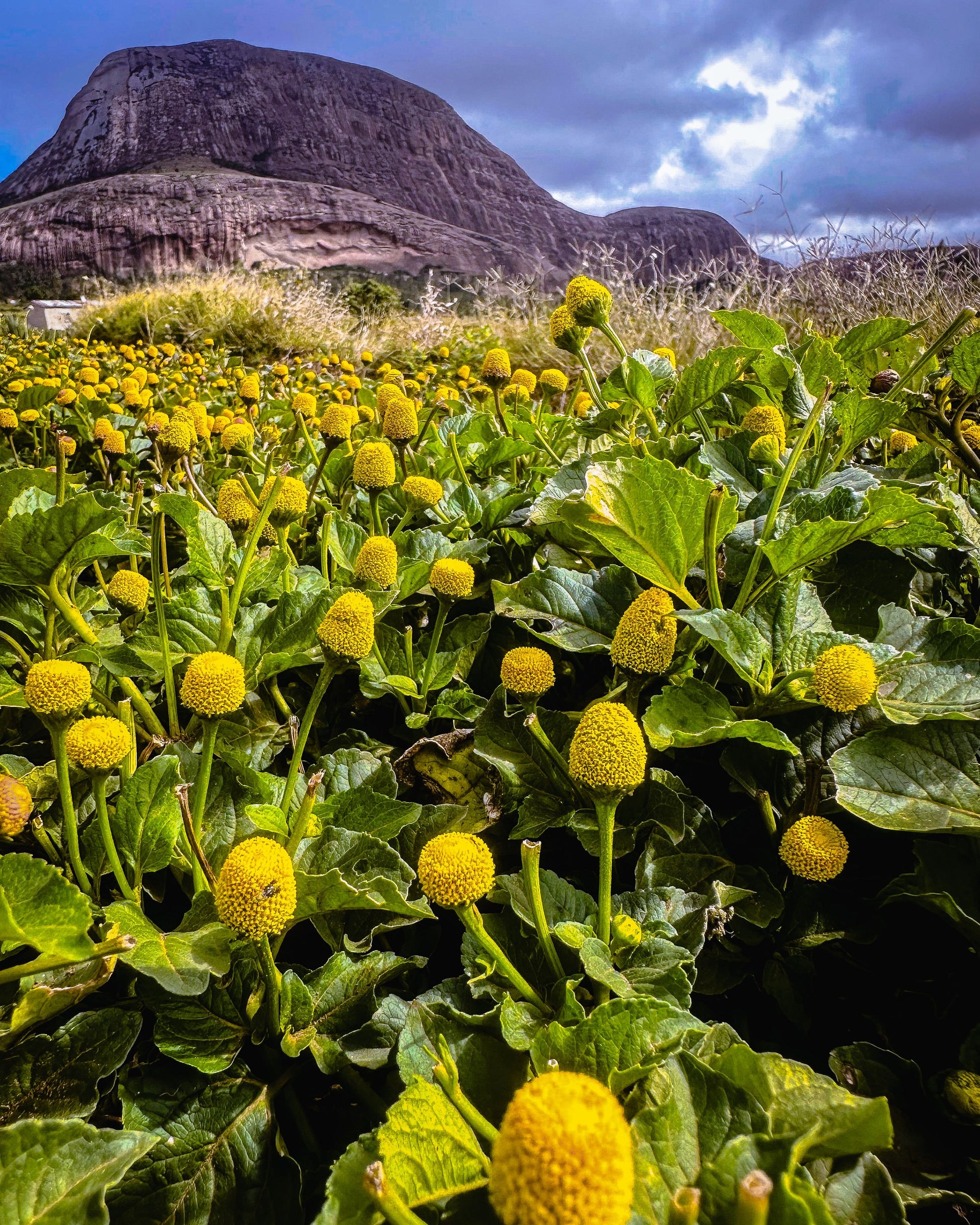
Our goal is to cultivate Acmella oleracea responsibly in environments where the plant naturally thrives.
Responsible cultivation allows us to:
- carefully monitor plant development
- harvest flower heads at the appropriate stage of maturity
- maintain consistent production practices
- support long-term traceability
- protect naturally growing populations from unnecessary harvesting pressure
Cultivation also enables long-term partnerships with farming communities who have developed extensive experience growing Acmella oleracea.
Madagascar: An Exceptional Growing Environment
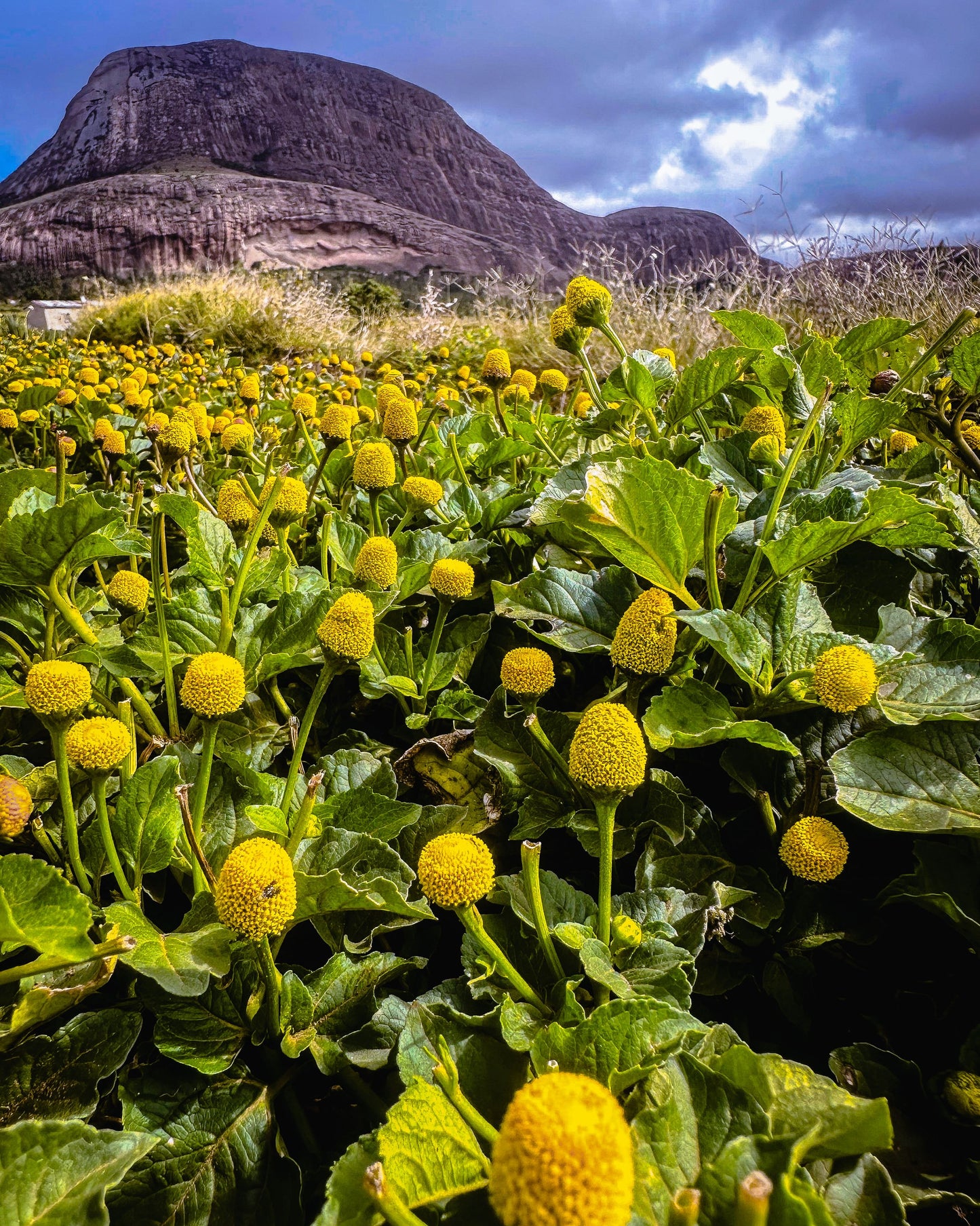
Madagascar offers remarkable natural conditions for cultivating Acmella oleracea.
Our growing regions combine:
- warm tropical temperatures
- fertile volcanic-derived soils
- abundant sunshine
- seasonal rainfall
- excellent natural drainage
- rich biodiversity
These conditions provide a favorable environment for healthy plant development throughout the growing season.
Rather than creating artificial conditions, cultivation works in harmony with Madagascar's natural climate.
The result is vigorous plants that develop under conditions similar to those preferred by the species.
Healthy Soils, Healthy Plants
Every healthy plant begins beneath the surface.
Soil is far more than a place for roots to grow.
It is a living ecosystem containing microorganisms, fungi, minerals, and organic matter that work together to support plant development.
Many of our cultivation areas benefit from volcanic-derived soils, which are naturally fertile and rich in minerals.
Combined with careful land management, these soils support healthy root development and long-term agricultural productivity.
Healthy soils do not guarantee a specific botanical composition, but they provide an excellent foundation for healthy plants.
Biodiversity Supports Resilient Agriculture
Madagascar is one of the world's most biodiverse countries.
Birds, insects, native plants, and soil organisms all contribute to balanced agricultural ecosystems.
These living systems help create resilient farming environments that support long-term cultivation.
Although plant chemistry depends on many interacting factors, including genetics, climate, soil, cultivation practices, and harvest timing, healthy ecosystems remain an important part of sustainable agriculture.
At Madabuzz, we believe biodiversity should be protected, not replaced.
Our cultivation philosophy seeks to work alongside nature rather than simplify it.
Natural Cultivation Without Routine Synthetic Agrochemicals
One of the principles that defines our cultivation model is simplicity.
We cultivate Acmella oleracea using natural farming practices and do not routinely use synthetic pesticides or herbicides in our production.
Instead, our farmers focus on:
- healthy living soils
- crop observation
- biodiversity
- responsible cultivation
- selective harvesting
- long-term environmental stewardship
Growing healthy plants begins with maintaining healthy agricultural systems.
Supporting Farmers, Not Just Crops
Responsible cultivation is about more than producing botanical ingredients.
It is also about supporting the people who grow them.
Madabuzz works directly with farming communities in Madagascar through long-term partnerships built on transparency, shared knowledge, and mutual respect.
By cultivating rather than relying on unpredictable wild collection, farmers gain:
- more stable production planning
- consistent seasonal work
- opportunities to develop specialized expertise
- stronger long-term relationships
This approach benefits both the farming communities and the botanical supply chain.
Sustainability Beyond the Field
Our commitment to sustainability continues beyond cultivation.
As part of the Madabuzz mission, 5% of every purchase supports educational projects for schools in Madagascar.
We believe sustainable botanical production should create lasting value for local communities while helping preserve traditional agricultural knowledge for future generations.
Supporting education is one way of investing in the people who make responsible cultivation possible.
Why Consistency Matters
Nature is wonderfully diverse.
No two plants are exactly alike.
Responsible cultivation does not eliminate natural variation, but it helps manage the factors that growers can reasonably influence.
This includes:
- planting healthy material
- monitoring plant health
- harvesting at maturity
- drying under controlled conditions
- maintaining traceability
- verifying quality through laboratory analysis
Consistency is particularly important for botanical ingredients used in cosmetic formulations, research, and premium botanical products.
Wild vs. Cultivated: Sustainability Comparison
| Wild Harvesting | Responsible Cultivation |
|---|---|
| Relies on naturally occurring populations | Grown under managed natural conditions |
| Harvest opportunities depend on natural populations | Harvest timing can be planned |
| Traceability may be limited | Complete field-to-laboratory traceability |
| Can support biodiversity when carefully managed | Helps reduce harvesting pressure on wild populations |
| Requires sustainable collection practices | Requires sustainable farming practices |
| Laboratory testing remains essential | Laboratory testing remains essential |
Key Takeaways
- Responsible cultivation helps protect wild plant populations while supporting long-term botanical production.
- Traceability allows every production batch to be followed from cultivation through laboratory verification.
- Madagascar provides favorable natural conditions for cultivating healthy Acmella oleracea, including tropical temperatures, fertile volcanic-derived soils, and rich biodiversity.
- Madabuzz cultivates Acmella oleracea using natural farming practices without the routine use of synthetic pesticides or herbicides.
- Sustainable cultivation benefits both the environment and the farming communities responsible for growing premium botanical ingredients.
Which Produces Better Botanical Quality?
After exploring the differences between wild and cultivated Acmella oleracea, one conclusion becomes clear:
Botanical quality cannot be determined simply by asking whether a plant is wild or cultivated.
The more meaningful questions are:
- Was the plant correctly identified?
- Was it harvested at the appropriate stage of maturity?
- Was the botanical material carefully dried and stored?
- Is the material fully traceable?
- Has it been independently laboratory tested?
These factors often have a far greater influence on the quality of a botanical ingredient than whether it grew naturally in the wild or on a responsibly managed farm.
Quality Is Built Through the Entire Journey
Every botanical ingredient follows a journey.
The journey begins with a seed.
It continues through cultivation or natural growth.
Then comes harvesting.
Drying.
Storage.
Extraction.
Laboratory analysis.
Finally, the ingredient reaches researchers, formulators, manufacturers, or consumers.
Every stage contributes to the final quality.
No single step determines the outcome.
This is why responsible botanical production looks at the entire lifecycle of the plant rather than focusing on only one characteristic.
Science in Everyday Life
A Great Vineyard Doesn't Produce Great Wine by Accident
Imagine two vineyards.
One grows naturally on a beautiful hillside.
The other is carefully managed by experienced wine growers.
Both produce grapes.
But the quality of the final wine depends on much more than where the vines grow.
It depends on:
- harvest timing
- weather
- soil
- grape selection
- processing
- storage
- quality control
Acmella oleracea follows exactly the same principle.
Whether the plant grows wild or is responsibly cultivated, botanical quality is shaped by every decision made throughout its journey.
Why Laboratory Verification Matters More Than Assumptions
One of the biggest mistakes in the botanical industry is relying on assumptions.
A plant may look healthy.
Its flowers may appear vibrant.
Its leaves may seem perfect.
But appearance alone cannot determine botanical composition.
This is why independent laboratory testing plays such an important role.
Scientific analysis allows producers to verify important quality parameters using objective analytical methods rather than visual inspection alone.
Depending on the application, laboratory evaluation may include:
- botanical identity
- chromatographic analysis
- naturally occurring Spilanthol content
- moisture determination
- microbiological quality
- documentation and traceability
Science replaces assumptions with measurable evidence.
Why Madabuzz Chose Responsible Cultivation
At Madabuzz, we believe cultivation offers the best opportunity to combine quality, sustainability, and transparency.
Our decision to cultivate Acmella oleracea in Madagascar was not made because cultivated plants are automatically better.
It was made because responsible cultivation allows us to:
- protect natural plant populations
- work directly with experienced farming communities
- harvest mature flower heads selectively
- maintain complete traceability
- preserve botanical quality through careful post-harvest handling
- independently verify every production batch
For us, cultivation is not about controlling nature.
It is about working alongside nature while respecting both the environment and the communities who care for the plants.
The Madagascar Advantage
Madagascar provides an exceptional natural environment for cultivating Acmella oleracea.
Our growing regions combine:
- tropical temperatures
- fertile volcanic-derived soils
- abundant sunshine
- seasonal rainfall
- remarkable biodiversity
- experienced local farmers
Rather than creating artificial growing conditions, we cultivate the plant in an environment where it naturally thrives.
This approach allows us to combine the benefits of natural ecosystems with the consistency and traceability of responsible cultivation.
Sustainability Is About the Future
The future of botanical ingredients depends on balancing human needs with environmental responsibility.
Wild harvesting can be valuable when carefully managed and when natural populations remain healthy.
Responsible cultivation, however, helps reduce harvesting pressure on wild ecosystems while creating long-term opportunities for farming communities.
At Madabuzz, sustainability means protecting both nature and people.
Our commitment includes:
- responsible cultivation
- biodiversity conservation
- natural farming practices
- long-term farmer partnerships
- independent quality verification
- investment in local education
Through our community program, 5% of every purchase supports schools in Madagascar, helping create opportunities for future generations while strengthening the communities that make premium botanical cultivation possible.
Wild vs. Cultivated: A Balanced Comparison
| Consideration | Wild Harvested | Responsibly Cultivated |
|---|---|---|
| Botanical species | Same species | Same species |
| Natural growth | Yes | Yes |
| Human management | Minimal | Planned cultivation |
| Harvest timing | Depends on natural conditions | Can be monitored and scheduled |
| Traceability | May vary | High |
| Batch consistency | More variable | More consistent |
| Sustainability | Depends on responsible collection | Depends on responsible farming |
| Laboratory testing | Essential | Essential |
Scientific Summary
Current botanical research supports several important conclusions.
Well Established
✔ Wild and cultivated Acmella oleracea belong to the same botanical species.
✔ Plant chemistry is influenced by genetics, climate, soil, cultivation practices, harvest timing, and post-harvest handling.
✔ Traceability and laboratory verification are essential components of modern botanical quality assurance.
✔ Responsible cultivation can improve production consistency while helping reduce pressure on wild plant populations.
✔ Sustainable harvesting and sustainable cultivation both require responsible management.
Areas of Ongoing Research
Scientists continue investigating:
- environmental influences on phytochemical composition
- sustainable cultivation systems
- climate effects on botanical chemistry
- analytical standardization
- biodiversity and plant resilience
- post-harvest preservation techniques
As research advances, producers continue improving cultivation and quality assurance practices.
Frequently Asked Questions
Is wild Acmella oleracea better than cultivated?
Not necessarily.
Current scientific evidence does not support the idea that wild plants are automatically superior. Botanical quality depends on multiple factors, including cultivation, harvest timing, post-harvest handling, and laboratory verification.
Why doesn't Madabuzz harvest wild populations?
We believe responsible cultivation helps protect natural ecosystems while allowing us to maintain traceability, consistent harvesting practices, and long-term partnerships with farming communities in Madagascar.
Does cultivation make the plant less natural?
No.
Cultivated Acmella oleracea still grows through natural biological processes using sunlight, water, soil, and seasonal growth cycles. Responsible cultivation simply manages the growing environment to support healthy development.
Why is traceability important?
Traceability allows producers to document the complete journey of each production batch, from cultivation and harvesting to drying, storage, and laboratory analysis, supporting transparency and quality assurance.
Can wild harvesting be sustainable?
Yes.
When carried out responsibly and in accordance with sustainable harvesting practices, wild collection can support biodiversity conservation and local livelihoods. However, it requires careful management to avoid damaging natural plant populations.
Why is laboratory testing important for both wild and cultivated plants?
Laboratory analysis provides objective information about botanical quality. It confirms measurable characteristics that cannot be determined reliably by appearance alone.
Why does Madabuzz cultivate Acmella oleracea in Madagascar?
Madagascar offers tropical growing conditions, fertile volcanic-derived soils, exceptional biodiversity, and experienced farming communities. Combined with natural cultivation practices and independent laboratory testing, these factors support the production of premium botanical ingredients.
Conclusion
The question is not whether Acmella oleracea grows wild or is cultivated.
The question is how responsibly it is produced.
Wild populations deserve protection.
Cultivated fields deserve thoughtful management.
Both play important roles in the future of botanical ingredients.
At Madabuzz, we have chosen responsible cultivation in Madagascar because it allows us to combine natural growing conditions with careful harvesting, complete traceability, independent laboratory verification, and long-term support for local farming communities.
For us, premium botanical quality is not defined by marketing terms.
It is defined by transparency.
By science.
By sustainability.
And by respect, for the plant, for nature, and for the people who cultivate it.