

Part 1: Compound vs Botanical Extract
The words spilanthol and Acmella extract are often used as though they describe the same ingredient.
They do not.
Spilanthol is a specific chemical compound associated with Acmella oleracea. An Acmella extract is a mixture obtained by extracting components from the plant into a suitable extraction medium.
That extract may contain spilanthol.
But it can also contain other plant constituents and, in a commercial ingredient, a carrier or solvent system.
This distinction matters when reading:
- cosmetic ingredient specifications
- Certificates of Analysis
- technical data sheets
- research papers
- extraction studies
- skincare formulas
- supplier claims
It also prevents one of the most common mistakes in botanical formulation:
A percentage of Acmella extract is not automatically the same percentage of spilanthol.
Understanding the difference begins with one simple question:
Are we talking about a molecule, or are we talking about a botanical mixture?
1. What Is Spilanthol?
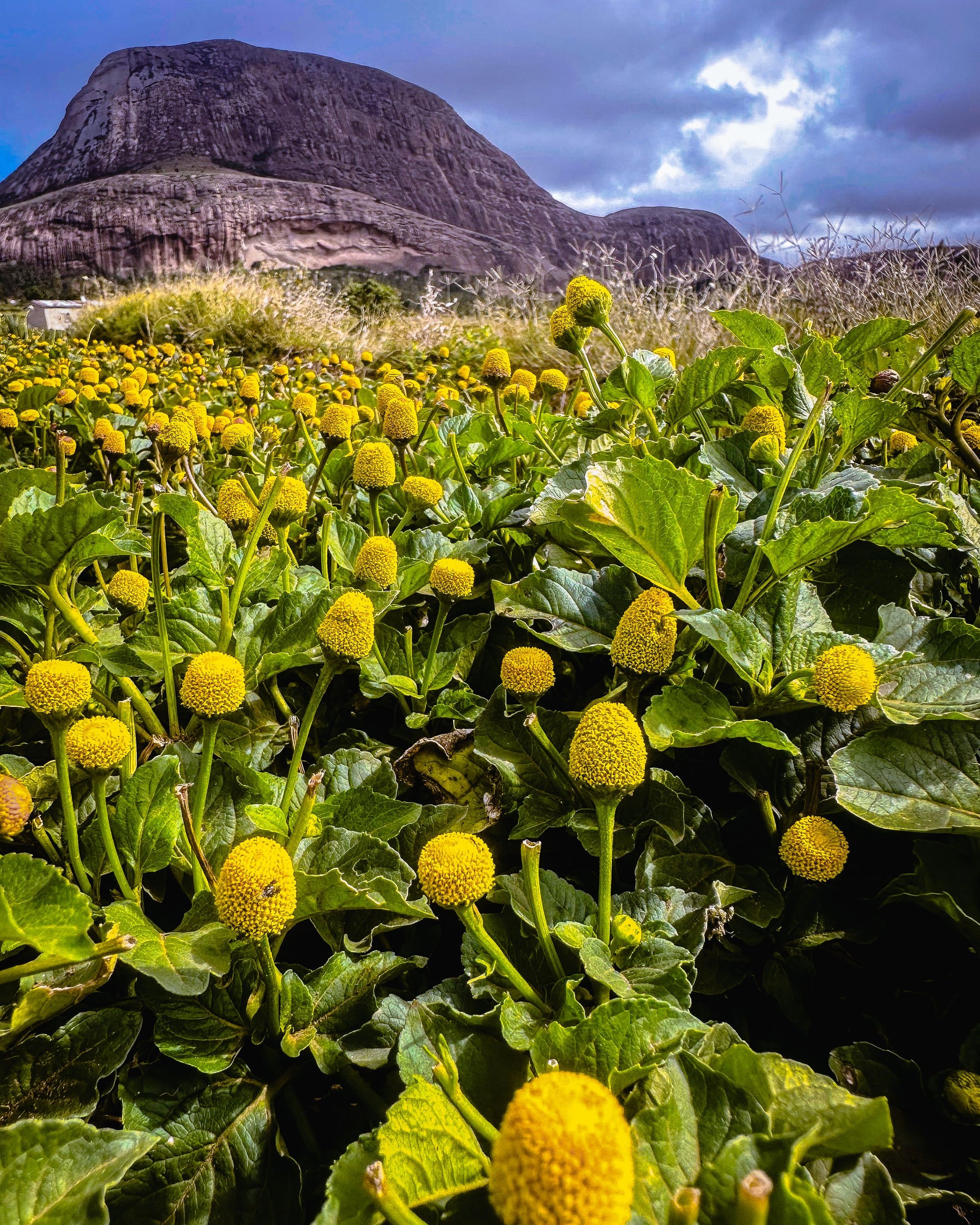
Spilanthol is a naturally occurring alkamide associated with Acmella oleracea and certain related plants.
Its molecular formula is:
C₁₄H₂₃NO
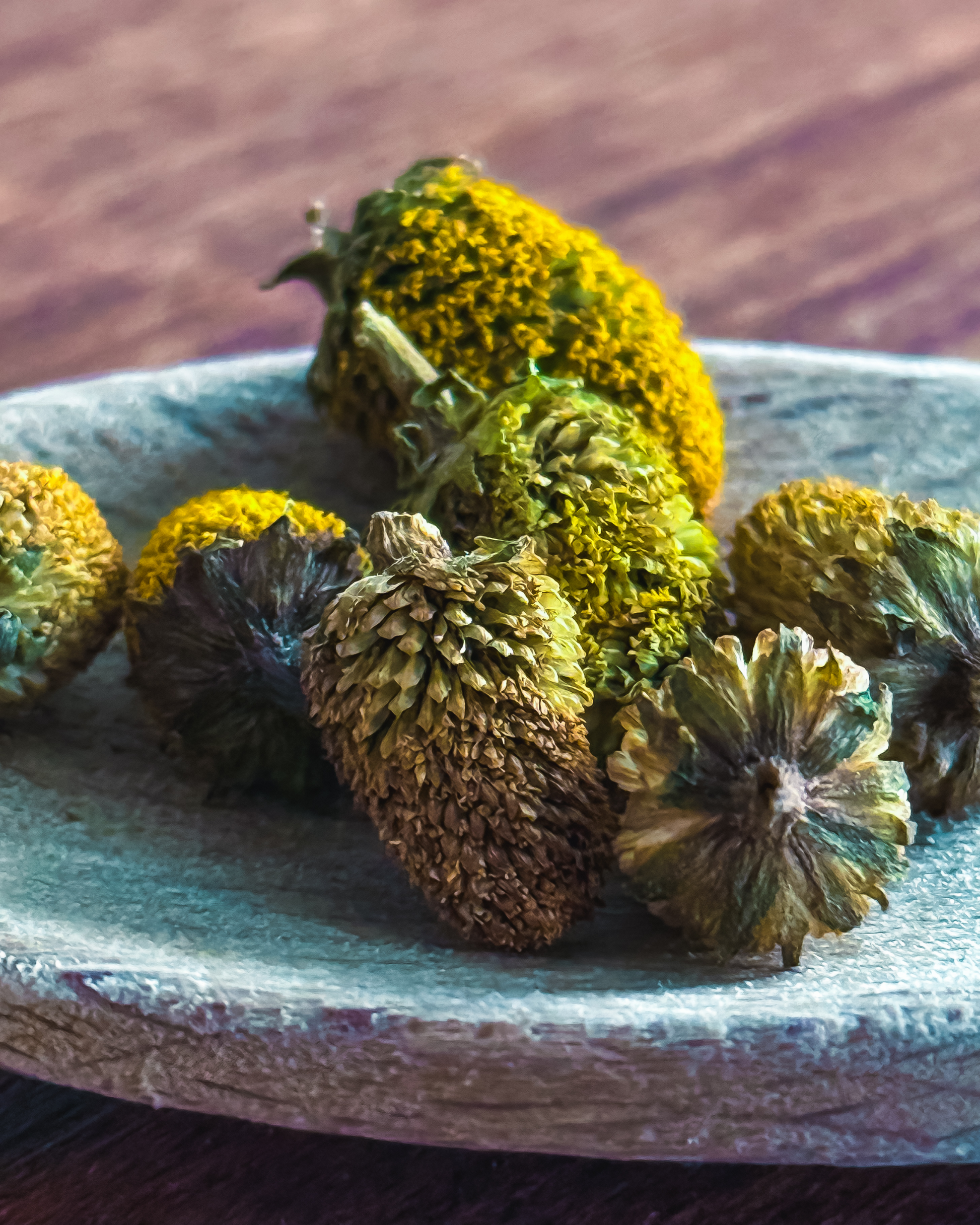
It is particularly well known because of its association with the distinctive oral sensation produced by Buzz Buttons.
That sensation may include:
- tingling
- buzzing
- prickling
- increased salivation
- numbing-like sensations
Spilanthol is therefore an important marker when studying the chemistry of Acmella oleracea.
2. Spilanthol Is a Defined Chemical Compound
This is the first major distinction.
A chemical compound has a defined molecular identity.
Spilanthol can therefore be investigated as an individual analyte using appropriate analytical techniques.
An Acmella extract is different.
It is normally a mixture.
3. What Is Acmella Extract?
An Acmella extract is produced by bringing plant material into contact with an extraction medium under defined conditions.
Depending on the process, that medium might involve:
- alcohol
- water
- water-alcohol mixtures
- glycerine-containing systems
- oils
- other technically suitable extraction systems
The purpose is to transfer selected soluble or dispersible constituents from the botanical material into the extract.
4. Extraction Does Not Transfer the Whole Plant
Imagine placing dried Acmella oleracea flower heads into an extraction medium.
The solvent does not simply turn the entire flower into liquid.
Instead, certain compounds transfer from the plant material according to factors such as:
- their chemistry
- solvent composition
- temperature
- extraction time
- particle size
- botanical-to-solvent ratio
- mixing
- extraction technique
Other material remains behind.
5. An Extract Is Selective
This is why two extracts made from the same plant can be chemically different.
For example:
Acmella oil extract
and:
Acmella hydroalcoholic extract
should not automatically be treated as equivalent ingredients.
They may differ in:
- carrier
- polarity
- extracted constituents
- concentration
- appearance
- formulation behaviour
- sensory properties
The botanical name alone does not describe the complete ingredient.
6. Spilanthol Can Be Part of the Extract
Because spilanthol occurs naturally in Acmella oleracea, suitable extraction processes can transfer it into an extract.
But saying:
Acmella extract contains spilanthol
is very different from saying:
Acmella extract is spilanthol.
The first can be correct.
The second generally confuses a botanical mixture with one of its constituents.
7. A Useful Analogy
Think about coffee.
A cup of coffee contains caffeine.
But:
coffee ≠ caffeine
Caffeine is one chemical constituent within a chemically complex preparation.
Similarly:
Acmella extract ≠ spilanthol
Spilanthol can be one important constituent of the extract.
8. Why This Distinction Matters
Suppose a cosmetic formula contains:
5% Acmella extract
A reader might incorrectly conclude:
"The product contains 5% spilanthol."
That conclusion would only make sense if the ingredient itself were effectively 100% spilanthol, which is not what the phrase "Acmella extract" normally means.
We need another number.
9. We Need the Spilanthol Concentration of the Extract
Suppose the Acmella extract is standardised to:
4% spilanthol
and the cosmetic contains:
5% of that extract.
The theoretical spilanthol contribution is:
5% × 4% = 0.20%
More formally:
5 × 4 ÷ 100 = 0.20%
So the formula theoretically receives:
0.20% spilanthol
from that raw material.
Not 5%.
10. Extract Percentage and Marker Percentage Are Different
This gives us two separate numbers:
Acmella extract in the finished formula
5%
Spilanthol concentration in that extract
4%
Theoretical spilanthol contribution to the formula
0.20%
These numbers describe different things.
11. Theoretical Does Not Mean Analytically Confirmed
Even this calculation requires careful language.
If 5% of a 4% spilanthol extract is added, 0.20% is the theoretical contribution based on the input values.
It does not automatically prove that laboratory analysis of the finished product would measure exactly 0.20%.
12. Why Might the Analytical Result Differ?
Potential factors include:
- raw-material variability
- analytical uncertainty
- manufacturing loss
- incomplete recovery during testing
- degradation
- sampling
- formulation matrix effects
Therefore:
calculation and finished-product analysis are different forms of evidence.
13. What Does "4% Spilanthol" Actually Mean?
Context matters.
If a supplier describes an Acmella extract as containing:
4% spilanthol
the important questions include:
- Is 4% a target?
- Is it a minimum specification?
- Is it a range?
- Is it a typical value?
- Was the actual batch tested?
- What analytical method was used?
- What does the Certificate of Analysis report?
A percentage without context can be misleading.
14. Specification vs Batch Result
Suppose a technical specification states:
Spilanthol: 3.5-4.5%
That describes an acceptable specification range.
A specific batch might then have an analytical result within that range.
The specification and the batch result are related but not identical.
15. Standardised Acmella Extract
A standardised botanical extract is generally an extract in which one or more selected markers are controlled to defined specifications.
For Acmella, spilanthol may be used as such a marker.
This can improve consistency between batches.
16. Standardised Does Not Mean Pure
This is an important misconception.
If an extract is standardised to:
4% spilanthol
the remaining material does not simply disappear.
The ingredient may still contain:
- other extracted plant constituents
- carrier or extraction medium
- processing-related components permitted by its specification
Standardisation does not convert a botanical extract into purified spilanthol.
17. What Is Purified Spilanthol?
At the other end of the spectrum, spilanthol can be considered as an isolated or highly enriched chemical material.
That is conceptually very different from a broad botanical extract.
The closer a material moves towards isolated spilanthol, the less appropriate it becomes to assume that evidence for the whole botanical extract applies unchanged.
18. Extract Evidence and Compound Evidence Are Not Automatically Interchangeable
Imagine a laboratory study testing purified spilanthol.
The researchers observe a particular biological effect.
Can we immediately conclude that every Acmella extract produces exactly the same effect?
No.
The extract may contain a different concentration of spilanthol plus many other constituents.
19. The Reverse Is Also True
Suppose a study uses a particular Acmella oleracea extract.
Can we conclude that every observed effect was caused entirely by spilanthol?
Not necessarily.
Other constituents could contribute.
The study design and chemical characterisation matter.
20. This Is a Common Botanical Research Problem
Research papers sometimes investigate:
- whole plant material
- crude extracts
- enriched extracts
- fractions
- isolated compounds
These are different test materials.
When interpreting research, always ask:
What exactly was tested?
21. "Acmella" Is Not a Chemical Specification
The word:
Acmella
identifies a botanical context.
It does not tell you:
- plant part
- extraction solvent
- extraction ratio
- carrier
- spilanthol concentration
- microbiological quality
- contaminant status
- standardisation
- batch result
Those details require additional documentation.
22. Botanical Identity Comes First
Before discussing spilanthol concentration, the plant itself should be correctly identified.
The currently accepted botanical name in major taxonomic references is:
Acmella oleracea (L.) R.K.Jansen
Older literature and commercial materials may also use historical or synonymous botanical names.
23. Why Botanical Naming Matters
Common names such as:
- Buzz Buttons
- Electric Daisy
- Toothache Plant
- Paracress
- Sichuan Buttons
can be useful in everyday communication.
But common names are not sufficient for precise botanical identification.
24. Spilanthes and Acmella
Older literature frequently uses names involving Spilanthes.
For example, Spilanthes oleracea appears historically in botanical literature and is treated as a synonym of Acmella oleracea in current taxonomic databases such as Kew's Plants of the World Online.
This history helps explain the name:
spilanthol.
25. A Chemical Name Does Not Define the Species
The presence of the word "spilanth" in spilanthol does not mean that a product labelled spilanthol must come from a botanical currently classified in the genus Spilanthes.
Chemical naming and modern botanical taxonomy operate differently.
26. Plant Part Matters
Even within correctly identified Acmella oleracea, different plant parts can contain different levels of spilanthol.
Flower heads are generally especially important.
Leaves can contain measurable amounts.
Stems tend to contain less.
Roots are generally much less relevant as a spilanthol-rich material.
27. "Whole Plant Extract" Is Not the Same as "Flower Extract"
Suppose one supplier extracts primarily flower heads.
Another uses broader aerial plant material.
Even if both labels contain the name:
Acmella oleracea
the starting botanical material differs.
That can affect the resulting chemical profile.
28. Starting Material Influences the Extract
The chemistry of the extract begins with the chemistry of the plant material.
Important variables include:
- species
- plant part
- maturity
- cultivation
- harvest timing
- drying
- storage
Extraction cannot be understood independently of these earlier steps.
29. Extraction Is a Chain
A useful model is:
Botanical identity
↓
Plant part
↓
Cultivation
↓
Harvest
↓
Post-harvest handling
↓
Drying
↓
Storage
↓
Extraction
↓
Standardisation
↓
Analysis
↓
Finished ingredient
Quality develops across the entire chain.
30. Extraction Solvent Matters
Different molecules have different affinities for different chemical environments.
Spilanthol is relatively lipophilic and has limited compatibility with plain water.
This influences extraction and formulation behaviour.
31. Water Extracts
Water is effective for extracting many water-compatible plant constituents.
However, an aqueous Acmella preparation should not automatically be assumed to recover spilanthol to the same extent as a more suitable mixed or lipophilic extraction system.
The actual result depends on the process.
32. Hydroalcoholic Extracts
Mixtures of water and alcohol can provide a different extraction environment.
They can recover a broader or simply different profile of plant constituents depending on solvent composition and process conditions.
The exact alcohol percentage matters.
33. Oil Extracts
Because spilanthol is relatively lipophilic, oil-based systems can be relevant carriers for Acmella preparations.
But:
oil extract ≠ pure spilanthol dissolved in oil
unless analytical and compositional evidence specifically establishes that.
An oil macerate remains a botanical preparation.
34. Glycerine-Containing Extracts
Some cosmetic botanical extracts use glycerine-containing carrier systems.
Glycerine can influence:
- polarity
- viscosity
- formulation behaviour
- water contribution
- preservation strategy
Knowing that an ingredient contains Acmella is therefore not enough to formulate with it correctly.
35. The Carrier Enters the Formula Too
Suppose a cosmetic ingredient consists primarily of:
- carrier system
- Acmella-derived constituents
- defined spilanthol level
When you add that ingredient to a cream, you are not adding spilanthol alone.
You are adding the complete raw material.
36. This Matters for Formulation
The carrier can affect:
- oil phase
- water phase
- solvent load
- emulsification
- viscosity
- sensory feel
- preservation
- pH
- packaging compatibility
Two Acmella extracts with identical spilanthol percentages may still behave differently in a formula.
37. Equal Spilanthol Does Not Mean Equal Ingredient
Imagine:
Extract A
4% spilanthol in an oil-based carrier.
Extract B
4% spilanthol in a hydroalcoholic carrier.
The marker concentration is the same.
But the ingredients are not functionally identical.
Their carriers and broader composition differ.
38. Equal Extract Percentage Does Not Mean Equal Spilanthol
Now imagine:
Extract A
4% spilanthol.
Extract B
1% spilanthol.
If a formulator adds 5% of each extract to separate products:
Product A theoretical spilanthol:
5 × 4 ÷ 100 = 0.20%
Product B theoretical spilanthol:
5 × 1 ÷ 100 = 0.05%
Both contain 5% Acmella extract.
Their theoretical spilanthol contributions differ fourfold.
39. This Is Why INCI Alone Cannot Tell You Potency
An ingredient list can identify the presence of an Acmella-derived ingredient.
But it generally does not tell a consumer the precise spilanthol concentration in the finished product.
Additional formulation and analytical information would be needed.
40. What Is an INCI Name?
INCI stands for:
International Nomenclature of Cosmetic Ingredients.
INCI naming provides standardised terminology for cosmetic ingredient declaration.
It is useful for identifying ingredient categories and botanical materials.
41. INCI Is Not a Certificate of Analysis
An INCI name does not normally tell you:
- exact spilanthol concentration
- actual batch result
- microbiological count
- extraction yield
- contaminant levels
- shelf life
- efficacy
These belong to other forms of documentation and testing.
42. What Is a Certificate of Analysis?
A Certificate of Analysis, or CoA, reports selected analytical or quality information for a particular material or batch.
Depending on the ingredient, it may include tests relating to:
- identity
- appearance
- marker concentration
- microbiology
- moisture
- other specifications
The exact scope varies.
43. A CoA Is Not a Universal Safety Certificate
A passing spilanthol result tells us something about that particular specification.
It does not automatically establish:
- complete toxicological safety
- finished-product safety
- cosmetic efficacy
- ethical sourcing
- sustainability
Each claim requires appropriate evidence.
44. What Does HPLC Do?
High-performance liquid chromatography, commonly abbreviated as HPLC, can separate and quantify selected compounds in suitable samples when an appropriate method is used.
For Acmella ingredients, HPLC can be used to investigate spilanthol.
45. HPLC Separates Chemistry from Sensation
This is particularly useful because sensory intensity is unreliable as a concentration measurement.
A person might say:
"This extract tingles much more."
HPLC asks a different question:
How much of the selected analyte is actually present in the tested sample?
46. Strong Tingle Does Not Equal a Specific Percentage
You cannot reliably conclude:
strong tingle = 4% spilanthol
or:
weak tingle = 1% spilanthol.
Sensory perception depends on:
- concentration
- carrier
- delivery
- exposure
- formulation
- individual sensitivity
- other botanical constituents
Chemical analysis is required for quantitative claims.
47. Standardisation Helps Control Variability
Botanical materials naturally vary.
Standardisation can help manufacturers define and control a selected marker within specified limits.
For an Acmella extract, spilanthol can provide a useful measurable reference.
48. But Standardisation Has Boundaries
A spilanthol specification does not describe every molecule in the extract.
Two batches that both meet the same spilanthol specification could still differ somewhat in other constituents.
Standardisation controls selected variables.
It does not make complex botanical mixtures chemically identical in every respect.
49. High Spilanthol Is Not a Complete Quality Definition
Suppose Extract A contains more spilanthol than Extract B.
That establishes a difference in one measured characteristic.
It does not automatically tell us which extract has better:
- botanical identity
- microbiological quality
- traceability
- contaminant control
- formulation suitability
- storage stability
"More" and "better" are not interchangeable.
50. Purity and Concentration Are Different Too
The words purity and concentration are sometimes used loosely.
They should be distinguished.
If a botanical extract contains 4% spilanthol, that is a concentration statement about spilanthol within the material.
Calling the extract:
4% pure spilanthol
could create confusion about what exactly is being described.
51. A 4% Spilanthol Extract Is Still Mostly Something Else
Mathematically, if an ingredient contains 4% spilanthol by the stated basis, approximately 96% of its composition is not spilanthol.
That remainder may include:
- carrier
- other botanical constituents
- other permitted components of the ingredient
This is why the complete specification matters.
52. What About 40% Spilanthol?
An ingredient containing 40% spilanthol is much more concentrated in that marker than one containing 4%.
But even 40% is not the same as:
100% pure spilanthol.
The remaining composition still matters.
53. Concentrated Extract vs Purified Compound
It is useful to imagine a continuum:
Whole flower
↓
Crude botanical extract
↓
Standardised extract
↓
Highly enriched extract
↓
Purified spilanthol
As we move along this continuum, the relationship between the ingredient and the whole plant changes.
54. Evidence Must Follow the Material
A study using whole flowers should not automatically be treated as a study of purified spilanthol.
A study using purified spilanthol should not automatically be treated as proof for every Acmella extract.
A study using one standardised extract should not automatically apply to every differently produced extract.
55. Ask What Was Actually Tested
Whenever you encounter a claim about Acmella or spilanthol, ask:
- What botanical species was used?
- Which plant part?
- Was it fresh or dried?
- What extraction method was used?
- What was the carrier or solvent?
- Was spilanthol quantified?
- What concentration was tested?
- Was the test in cells, animals, humans or a finished cosmetic?
These details determine how broadly the result can be interpreted.
56. Why This Matters for Skincare Claims
Suppose purified spilanthol produces a biological effect in an isolated laboratory system.
That can be scientifically interesting.
But it does not automatically prove that a cream containing a small amount of an Acmella extract produces a visible consumer benefit.
Several additional steps exist between those two situations.
57. The Finished Formula Matters
In a cosmetic, the Acmella ingredient interacts with:
- water
- oils
- emulsifiers
- solubilisers
- humectants
- preservatives
- antioxidants
- chelating agents
- thickeners
- packaging
The finished product is its own chemical and physical system.
58. Delivery Matters
A compound must be present in the right form and environment to behave as intended.
Its behaviour can depend on:
- solubility
- partitioning
- concentration
- formulation structure
- stability
- application amount
Therefore, raw-material potency alone cannot describe finished-product performance.
59. More Spilanthol Is Not Automatically More Effective
This is one of the most important principles for cosmetic formulation.
A higher marker concentration does not automatically produce a proportionally greater consumer-visible effect.
Efficacy can depend on:
- formulation
- exposure
- delivery
- concentration-response relationships
- study design
More is not a universal quality scale.
60. Part 1 Takeaway
Spilanthol and Acmella extract are related, but they are not interchangeable terms.
Spilanthol is a defined chemical compound with the molecular formula C₁₄H₂₃NO.
Acmella extract is a botanical preparation containing a mixture of substances extracted from Acmella oleracea, potentially including spilanthol, other plant constituents and a carrier or solvent system.
A standardised Acmella extract controls selected marker compounds within defined limits.
It does not become pure spilanthol.
Likewise:
5% Acmella extract ≠ 5% spilanthol
unless the raw material itself were actually 100% spilanthol.
If a formulation contains 5% of an extract standardised to 4% spilanthol, the theoretical spilanthol contribution is:
0.20%
And even that number is a formulation calculation rather than finished-product analytical proof.
The central principle is:
Spilanthol tells you about one molecule. Acmella extract describes a botanical ingredient system. To understand either properly, you need to know exactly what material was tested, how it was produced, what it contains and how its composition was measured.
Coming in Part 2
Part 2 will go deeper into crude extracts, standardised extracts, enriched spilanthol extracts and purified spilanthol, including extraction solvents, plant-to-extract ratios, carriers, marker standardisation, CoAs, HPLC results, purity versus concentration, how to calculate spilanthol in a finished cosmetic and why two Acmella extracts with the same percentage can behave very differently.
End of Part 1
Part 2: Crude Extracts, Standardised Extracts, Enriched Extracts and Purified Spilanthol
Part 1 established the central distinction:
Spilanthol is a molecule. Acmella extract is a botanical mixture.
That sounds straightforward, but commercial botanical ingredients can sit anywhere along a broad spectrum.
At one end, there may be a relatively simple extract made from Acmella oleracea flower heads. At the other, there may be a highly enriched material containing a much larger proportion of spilanthol.
Between those extremes are numerous possibilities involving different:
- plant parts
- solvents
- extraction processes
- carriers
- concentrations
- standardisation methods
- purification steps
Two ingredients can therefore both be called Acmella extract while being very different materials.
Understanding those differences is essential when comparing suppliers, reading a Certificate of Analysis, calculating a cosmetic formula or interpreting research.
61. Start with the Raw Botanical Material
Every Acmella extract begins with botanical material.
Before considering extraction, important questions include:
- Is the species correctly identified?
- Which plant part is used?
- Is the material fresh or dried?
- How mature was it at harvest?
- How was it dried?
- How was it stored?
- Is the lot traceable?
Extraction cannot correct every weakness in the starting botanical material.
62. Flower Heads Are Particularly Important
Spilanthol is not distributed equally throughout Acmella oleracea.
Flower heads are generally especially relevant as spilanthol-rich material.
Leaves can also contain measurable amounts, while stems tend to contain less and roots are generally much less relevant.
This means:
flower-head extract
and:
whole-plant extract
should not automatically be assumed to have the same composition.
63. Extraction Begins with Selectivity
An extraction medium interacts with plant tissue and transfers some constituents more effectively than others.
This depends partly on chemical compatibility.
A compound that transfers readily into one extraction system may transfer less efficiently into another.
64. Solvent Choice Changes the Extract
Consider three broad possibilities:
Water-based extraction
Hydroalcoholic extraction
Oil-based extraction
All can begin with the same plant.
They do not necessarily produce the same ingredient.
65. Why Polarity Matters
Molecules differ in how they interact with water-like and oil-like environments.
Spilanthol is relatively lipophilic.
This helps explain why solvent composition matters when designing an extraction process for it.
But extraction behaviour cannot be predicted from one simple label such as "oil-soluble" or "water-insoluble".
Real botanical extraction systems are more complex.
66. Plain Water Is Only One Extraction Environment
Water can extract many constituents from plants.
But because spilanthol has limited compatibility with plain water, a simple water infusion should not automatically be treated as equivalent to an extraction system designed specifically to recover spilanthol.
That does not mean a water preparation must contain zero spilanthol.
It means the actual concentration should be established rather than assumed.
67. Hydroalcoholic Systems
Mixtures of alcohol and water can provide a broader extraction environment than either component alone for some botanical systems.
Changing the alcohol-to-water ratio can change which constituents are extracted and in what proportions.
Therefore:
hydroalcoholic Acmella extract
is still an incomplete technical description.
68. Oil-Based Acmella Extracts
Oil-based extraction can be useful when the intended finished product is itself oil-rich or when the target compounds have suitable compatibility with the oil system.
But the identity of the oil matters.
An extract made using one carrier oil is not automatically formulation-equivalent to an extract made using another.
69. The Carrier Is Part of the Ingredient
This is one of the most important formulation concepts.
Suppose a raw material contains:
4% spilanthol
That tells you the concentration of one marker.
It does not tell you what the remaining approximately 96% consists of.
The complete ingredient composition matters.
70. Imagine Two 4% Spilanthol Extracts
Extract A
4% spilanthol in an oil-based Acmella ingredient.
Extract B
4% spilanthol in a different carrier system.
Both may legitimately contain the same stated concentration of spilanthol.
But they are not necessarily interchangeable in a formula.
71. Why Extract A and Extract B May Behave Differently
Their differences could affect:
- solubility
- emulsion structure
- viscosity
- clarity
- pH
- sensory feel
- preservation
- oxidation
- processing
- packaging compatibility
Marker concentration is only one property.
72. What Is a Crude Extract?
The term crude extract generally describes an extract before extensive purification or fractionation.
It can contain a broad mixture of compounds transferred from the botanical material.
"Crude" does not automatically mean:
- dirty
- unsafe
- poor quality
- untested
It describes the degree of chemical refinement more than overall quality.
73. A Crude Extract Can Still Be Well Controlled
A carefully produced botanical extract may have controls for:
- plant identity
- raw-material quality
- extraction process
- microbiological quality
- selected contaminants
- marker concentration
- storage
Broad chemical complexity and poor quality are not synonymous.
74. What Is a Standardised Extract?
A standardised extract has one or more selected characteristics controlled within defined limits.
For Acmella ingredients, spilanthol may be used as a marker.
For example, a supplier might define an acceptable spilanthol specification.
The exact specification must come from actual product documentation.
75. Why Standardise?
Plants vary naturally.
Differences can arise from:
- genetics
- environment
- plant maturity
- harvest timing
- drying
- storage
- extraction
Standardisation helps reduce variability in a selected characteristic.
76. Standardisation Does Not Remove Botanical Complexity
If an extract is standardised for spilanthol, it can still contain many other substances.
Therefore:
standardised extract ≠ isolated spilanthol
This distinction is fundamental.
77. Standardisation Is Targeted Control
A useful way to think about it is:
Standardisation controls selected markers. It does not make every molecule in every batch identical.
That is why a standardised botanical ingredient can remain chemically complex.
78. What Is an Enriched Extract?
An enriched extract contains a higher proportion of a selected constituent or group of constituents than might be present in a less concentrated preparation.
For Acmella, this could mean increasing the relative concentration of spilanthol.
79. Enrichment Can Require Additional Processing
Depending on the manufacturing process, enrichment might involve steps such as:
- selective extraction
- concentration
- fractionation
- separation
- purification
The exact process is ingredient-specific.
80. Enriched Does Not Mean Pure
Suppose an Acmella-derived material contains:
40% spilanthol.
That is highly enriched compared with a 4% extract.
But 40% is still not 100%.
Approximately 60% of the material, by that compositional basis, consists of something other than spilanthol.
81. The Remaining 60% Matters
Depending on the material, the remainder could include:
- other botanical constituents
- carrier
- processing-related components
- other specified ingredients
You need the supplier's technical documentation to understand the actual composition.
82. What Is Purified Spilanthol?
Purified spilanthol moves further away from the concept of a broad botanical extract.
The goal is to isolate spilanthol to a high degree rather than retain a broad spectrum of plant constituents.
At that point, the ingredient behaves conceptually more like an isolated chemical substance.
83. Purity Requires a Defined Basis
Statements such as:
high purity
are incomplete without context.
Useful questions include:
- What purity is specified?
- How was it measured?
- Which analytical method was used?
- Is the value a minimum specification or actual batch result?
- What impurities or related compounds are controlled?
"Pure" should not be used casually.
84. Purity and Concentration Are Not the Same Question
Imagine a highly purified spilanthol material dissolved into a carrier.
The spilanthol itself might have been highly purified before dilution.
But the final commercial ingredient could contain a much lower concentration of spilanthol because of the carrier.
Therefore:
purity of isolated compound
and:
concentration in commercial ingredient
can describe different stages or materials.
85. A Simple Example
Imagine purified spilanthol is incorporated into a carrier to create an ingredient containing:
10% spilanthol
The commercial ingredient is now 10% spilanthol by the stated basis.
Calling the complete ingredient "100% pure spilanthol" would be misleading.
86. Always Identify Which Material the Percentage Describes
When reading technical documents, ask:
Percentage of what, in what material, measured how?
That single question prevents many interpretation errors.
87. Plant-to-Extract Ratio
Botanical extracts may sometimes be described using a plant-to-extract relationship.
For example, documentation might describe how much starting botanical material was used relative to the resulting extract.
This can provide useful manufacturing context.
But it should not be confused with spilanthol concentration.
88. Plant-to-Extract Ratio Is Not Spilanthol Percentage
A concentrated botanical extract can have a high plant-to-extract relationship while still having a spilanthol concentration that must be measured separately.
You cannot calculate exact spilanthol solely from the plant-to-extract ratio unless the necessary analytical information is also available.
89. Extraction Yield Is Another Different Number
Extraction yield describes how much extract is recovered relative to the starting material under defined conditions.
Again:
extraction yield ≠ spilanthol concentration
A high extract yield does not automatically mean a high spilanthol yield.
90. More Extract Can Mean More Non-Target Material
Imagine an extraction method recovers a large amount of material from the plant.
That extract may contain many compounds.
Another method might recover less total material but a greater proportion of spilanthol.
Therefore, total extraction yield alone does not define selectivity.
91. Spilanthol Yield Needs Its Own Context
If the goal is to understand spilanthol recovery, useful information could include:
- starting botanical mass
- initial spilanthol content
- extract mass
- final spilanthol concentration
- analytical method
Without enough information, "high yield" can be ambiguous.
92. Concentration by Evaporation
An extract may sometimes become more concentrated when part of its solvent or carrier is removed.
This reduces total mass or volume while retaining some extracted compounds.
But concentration is not necessarily purification.
93. Concentrated and Purified Are Different
Imagine removing solvent from a botanical extract.
Spilanthol concentration may increase.
But many other non-volatile extracted compounds may also become more concentrated.
The result is:
more concentrated extract
not necessarily:
purified spilanthol.
94. Fractionation Is Different Again
Fractionation separates a mixture into portions based on selected chemical or physical properties.
A fraction may become enriched in spilanthol relative to the original extract.
But it can still contain multiple compounds.
95. Purification Goes Further
Purification aims to separate the target compound more extensively from other components.
How far purification proceeds depends on the intended product.
This creates the useful continuum:
Crude extract → Standardised extract → Enriched fraction → Highly purified compound
96. These Categories Can Overlap
Commercial terminology is not always perfectly uniform.
For example, an enriched extract may also be standardised.
A crude extract may also have a marker specification.
Therefore, the label alone is not enough.
Read the technical documentation.
97. What Should a Technical Data Sheet Tell You?
Depending on the ingredient, useful information can include:
- ingredient identity
- botanical species
- plant part
- carrier
- physical appearance
- solubility or dispersibility
- recommended storage
- marker specification
- processing guidance
- relevant quality parameters
The exact content varies between suppliers.
98. What Should a CoA Tell You?
A Certificate of Analysis should be interpreted as batch-specific evidence for the parameters it actually reports.
It may include:
- test
- specification
- result
- method or method reference
- batch identification
But the scope varies.
99. Read Test, Specification and Result Separately
Imagine a CoA states:
Test: Spilanthol
Specification: 3.5-4.5%
Result: 4.1%
The specification defines the acceptable range.
The result describes the analysed batch.
Those numbers have different roles.
100. "Pass" Is Not the Whole Story
A result may be marked:
Pass
because it falls within specification.
But understanding the actual numerical result can still be important for:
- formulation calculations
- batch comparisons
- research
- standardisation
101. CoA Numbers Need Units
A number without units can be meaningless.
Depending on the test, results might be expressed as:
- percentage
- mass per mass
- mass per volume
- parts per million
- microbiological units
Never assume the unit.
102. Percentages Need a Basis
Even the symbol:
%
can require interpretation.
Depending on context, percentages can refer to different bases.
The method and specification should make the basis clear.
103. HPLC Quantification
HPLC can be used to separate spilanthol from other sample components and quantify it when an appropriate analytical method is available.
A simplified workflow might involve:
Representative sample
↓
Sample preparation
↓
Chromatographic separation
↓
Detection
↓
Comparison with reference/calibration
↓
Calculation
↓
Reported result
Each stage matters.
104. The Instrument Does Not Work Alone
An impressive chromatogram does not guarantee a meaningful result.
Analytical reliability depends on:
- representative sampling
- appropriate sample preparation
- suitable standards
- chromatographic separation
- calibration
- method performance
- data interpretation
The whole analytical process matters.
105. Reference Standards Matter
Quantitative analysis requires an appropriate basis for relating instrument response to analyte amount.
A suitable reference standard can support this process.
This is different from simply observing a peak and assuming it represents an exact concentration.
106. Peak Area Is Not Automatically Percentage
A chromatogram may show a peak associated with spilanthol.
Its area can be used within a validated or otherwise appropriate quantitative method.
But:
peak area ≠ concentration by itself.
Calibration and method calculations are required.
107. Biggest Peak Does Not Automatically Mean Purest Ingredient
Chromatograms can be visually persuasive.
A large spilanthol peak does not by itself prove:
- high purity
- absence of contaminants
- safety
- efficacy
- botanical authenticity
Interpretation depends on the method and sample.
108. HPLC Is Targeted Evidence
If the method is designed to quantify spilanthol, it answers a spilanthol-related analytical question.
It does not automatically establish every other quality parameter.
Other tests may be needed for:
- microbiology
- elemental contaminants
- pesticides where relevant
- residual solvents where relevant
- identity
- moisture
- other specifications
109. One Test Cannot Replace a Quality System
This principle applies throughout botanical ingredient production.
Quality is better represented as:
Identity + Traceability + Processing Control + Analytical Testing + Storage + Documentation
rather than one impressive number.
110. Calculating Spilanthol in a Finished Formula
Now we can return to the practical formulation question.
The basic theoretical calculation is:
Finished theoretical spilanthol % = Extract use % × Extract spilanthol % ÷ 100
111. Example 1: 4% Extract at 4% Spilanthol
Suppose:
Acmella extract use level = 4%
Spilanthol in extract = 4%
Calculation:
4 × 4 ÷ 100
= 0.16%
The theoretical spilanthol contribution is:
0.16%
112. Example 2: 2% Extract at 10% Spilanthol
Suppose:
Extract = 2%
Spilanthol = 10%
Calculation:
2 × 10 ÷ 100
= 0.20%
The theoretical contribution is:
0.20%
113. A Lower Extract Percentage Can Deliver More Spilanthol
Compare:
Formula A
5% extract containing 1% spilanthol
5 × 1 ÷ 100 = 0.05%
Formula B
2% extract containing 5% spilanthol
2 × 5 ÷ 100 = 0.10%
Formula B uses less Acmella extract but has twice the theoretical spilanthol contribution.
114. This Is Why Extract Percentage Alone Is Misleading
Marketing language might highlight:
Contains 5% Acmella extract
That number can sound impressive.
But without knowing the extract's composition, it tells us little about the actual spilanthol contribution.
115. The Reverse Is Also Important
A product using a smaller amount of a more concentrated extract may contain a comparable or higher theoretical spilanthol level.
Therefore:
more extract ≠ automatically more spilanthol.
116. What If the Extract Has a Range?
Suppose an extract specification is:
3.5-4.5% spilanthol
and the formula contains:
5% extract.
Using the specification range, the theoretical contribution could range from:
5 × 3.5 ÷ 100 = 0.175%
to:
5 × 4.5 ÷ 100 = 0.225%
This illustrates why batch results can matter when precision is important.
117. A Batch Result Can Refine the Calculation
If the actual batch CoA reports:
4.1% spilanthol
then:
5 × 4.1 ÷ 100 = 0.205%
That gives a more batch-specific theoretical input calculation.
It still does not replace finished-product analysis.
118. Why Finished-Product Analysis May Differ
Once the extract enters a formulation, several things can happen.
Possible influences include:
- heat exposure
- oxygen
- light
- processing time
- formulation pH
- interactions with the matrix
- storage
Whether these significantly affect spilanthol must be established rather than assumed.
119. Manufacturing Losses Are Possible
Material can remain on:
- mixing vessels
- spatulas
- transfer equipment
- filters
- filling equipment
This is one reason theoretical input and actual recovered product are not always identical.
120. Sampling Matters Again
Even if the finished product is tested, the sample must represent the batch appropriately.
A perfect analytical method applied to a poor sample can still produce misleading conclusions.
121. What About a 40% Spilanthol Ingredient?
Highly concentrated ingredients make calculation especially important.
Suppose a formulation uses:
0.5% of an ingredient containing 40% spilanthol.
The theoretical contribution is:
0.5 × 40 ÷ 100
= 0.20% spilanthol
122. Compare That with a 4% Extract
To theoretically provide the same 0.20% spilanthol from a 4% extract:
5 × 4 ÷ 100
= 0.20%
So:
0.5% of a 40% ingredient
and:
5% of a 4% ingredient
can theoretically contribute the same amount of spilanthol.
123. But the Formulas Are Still Not Equivalent
This is crucial.
The first formula receives:
0.5% total raw material
while the second receives:
5% total raw material.
The amount of carrier and other constituents entering the formula can therefore differ greatly.
124. Equal Spilanthol Does Not Mean Equal Formulation
Even when theoretical spilanthol is identical, formulas may differ in:
- solvent load
- oil content
- botanical co-extractives
- viscosity
- colour
- odour
- sensory feel
- preservation demands
- emulsion behaviour
This is why formulators must work with the complete ingredient specification.
125. Carrier Contribution Can Be Calculated Too
Suppose an extract is mostly an oil carrier.
Adding 5% of that ingredient contributes a meaningful amount of that carrier to the oil phase.
A formulator should account for this when designing the emulsion.
126. Water-Based Extracts Add Water-Phase Material
Similarly, an aqueous or water/glycerine extract contributes material to the water phase.
That can affect:
- total water
- humectant content
- viscosity
- preservation
- water activity indirectly through the complete formulation
The botanical name alone does not reveal these effects.
127. Hydroalcoholic Extracts Add Solvent
A hydroalcoholic extract introduces alcohol as well as botanical constituents.
This may affect:
- solubility
- sensory feel
- processing
- preservation environment
- viscosity
Again, the complete ingredient matters.
128. Extract Carrier Can Matter More Than the Botanical Name During Formulation
From a marketing perspective, the label may emphasise:
Acmella.
From a formulation perspective, the chemist may need to think:
What exactly am I adding to the system?
That includes both the botanical constituents and their carrier.
129. Why Solubilisers May Be Relevant
If a relatively lipophilic Acmella-derived ingredient is added to a predominantly aqueous product, the formulator may need an appropriate strategy for incorporating it.
Depending on the amount and product architecture, this could involve:
- solubilisation
- emulsification
- another suitable delivery system
The correct approach depends on the complete formulation.
130. Why Emulsifiers May Be Relevant
If an Acmella ingredient contributes to a meaningful oil phase in a cream or lotion, it becomes part of the oil-water system.
An appropriate emulsifier system may therefore be required.
Spilanthol concentration alone does not determine emulsifier level.
131. The Same Spilanthol Percentage Can Enter Different Product Architectures
Spilanthol-containing Acmella ingredients might be used in products such as:
- oils
- balms
- creams
- lotions
- serums
Each product architecture creates different formulation challenges.
132. Preservation Is Separate
A botanical extract may itself contain a preservative system.
That does not automatically preserve the finished cosmetic after dilution.
This is especially important for water-containing products.
133. A Preserved Raw Material Is Not a Preserved Formula
Suppose an Acmella extract is microbiologically controlled in its original container.
Once only a small percentage is added to a large water-containing formulation, its preservative system may be heavily diluted.
The finished product needs its own preservation strategy.
134. Antioxidants Are Separate Too
An antioxidant may help manage oxidative deterioration.
It does not automatically provide broad-spectrum microbial preservation.
Likewise, a preservative is not automatically an antioxidant.
135. Chelating Agents Have Another Role
Chelating agents can bind certain metal ions and reduce their availability for unwanted formulation chemistry.
They may complement preservation or oxidation strategies.
But they do not replace:
- preservatives
- antioxidants
- emulsifiers
- solubilisers
These functions should remain conceptually separate.
136. Spilanthol Does Not Tell You Whether the Product Is Preserved
Knowing:
spilanthol = 0.20%
does not tell you:
- water activity
- microbial count
- preservative performance
- challenge-test result
- packaging hygiene
Spilanthol analysis and microbiological quality are different questions.
137. Spilanthol Does Not Tell You Whether the Emulsion Is Stable
Likewise, knowing the exact spilanthol concentration cannot establish:
- droplet stability
- phase separation
- viscosity stability
- freeze-thaw behaviour
- package compatibility
These require formulation and stability evaluation.
138. Spilanthol Does Not Tell You Whether the Product Works
A high analytical concentration is not automatically proof of cosmetic efficacy.
To establish a particular consumer-visible effect, relevant evidence is needed for that outcome.
139. Biological Activity Is Not Finished-Product Efficacy
A molecule can demonstrate biological activity in a laboratory experiment.
A finished cream containing an extract is a much more complex system.
Between the two are questions involving:
- concentration
- delivery
- exposure
- formulation
- stability
- study design
Mechanism alone does not answer all of them.
140. Why "Natural Botox" Can Cause Confusion
Spilanthol-containing Acmella ingredients are sometimes marketed using comparisons with botulinum toxin.
But an Acmella extract should not be treated as scientifically equivalent to botulinum toxin injections.
They differ in:
- chemistry
- delivery
- mechanism
- evidence
- regulatory context
Marketing shorthand can obscure these distinctions.
141. Tingling Does Not Solve the Problem
A formulator might apply an Acmella product and notice a sensation.
That sensory response does not reveal:
- exact spilanthol concentration
- skin penetration depth
- wrinkle reduction
- stability
- preservation
- safety
Sensation is not a universal assay.
142. Stronger Tingling Does Not Prove a Better Extract
Two extracts may differ in sensory effect because of:
- spilanthol concentration
- carrier
- other compounds
- delivery
- formulation
- exposure level
Therefore, sensory intensity should not replace analytical characterisation.
143. Comparing Suppliers Properly
If two suppliers offer Acmella extracts, comparing only the price per kilogram can be misleading.
The ingredients may have different:
- spilanthol concentrations
- carriers
- plant parts
- standardisation
- use levels
- documentation
- quality specifications
A technically meaningful comparison requires more context.
144. Compare Like with Like
Useful comparison questions include:
- What species is used?
- Which plant part?
- What is the carrier?
- What is the spilanthol specification?
- Is there a batch result?
- What analytical method is used?
- How should the ingredient be stored?
- What is its physical form?
- What quality documentation is available?
Only then can the materials be compared intelligently.
145. Cost per Kilogram vs Cost per Spilanthol Input
A more concentrated extract may cost more per kilogram while requiring a lower use level.
A less concentrated extract may cost less per kilogram but require more material for the same theoretical spilanthol contribution.
However, even this comparison remains incomplete because the extracts may provide different carriers and co-extractives.
146. Concentration Is Not a Universal Commercial Ranking
A 40% spilanthol ingredient is not automatically "better" than a 4% ingredient.
The right material depends on the intended formulation.
A lower-concentration extract might be technically preferable for one product architecture, while a more concentrated material may suit another.
147. More Concentrated Means Different, Not Automatically Better
Concentration affects:
- required use level
- formulation load
- carrier contribution
- dosing precision
- handling
It should be evaluated as a technical characteristic.
148. Small Use Levels Create Measurement Challenges
Highly concentrated materials may be used at lower percentages.
That means the required ingredient mass can become very small in laboratory-scale batches.
Scale resolution then matters.
149. Example
Suppose a 100 g prototype requires:
0.25% of a concentrated ingredient.
Required mass:
100 × 0.25 ÷ 100
= 0.25 g
The formulator needs equipment capable of weighing that quantity with appropriate confidence.
150. Display Resolution Is Not Accuracy
A scale showing two decimal places does not automatically guarantee accurate measurement at every small mass.
Formulators should distinguish:
- readability
- repeatability
- accuracy
- capacity
- practical minimum weighing needs
This becomes increasingly important with concentrated ingredients.
151. Dilution Can Sometimes Improve Practical Handling
In professional formulation work, concentrated ingredients may sometimes be supplied or handled through defined premixes or carrier systems to improve dosing.
But any dilution changes the concentration of the commercial material.
Calculations must use the concentration of the material actually being weighed.
152. Never Calculate from the Wrong Concentration
Suppose a premix contains:
10% of a 40% spilanthol ingredient.
The premix does not contain 40% spilanthol.
Its theoretical spilanthol concentration would be:
10 × 40 ÷ 100
= 4%
This illustrates why ingredient hierarchy matters.
153. The Calculation Can Have Multiple Layers
Imagine:
Raw concentrate: 40% spilanthol
↓
Used at 10% in a premix
↓
Premix therefore theoretically contains 4% spilanthol
↓
Premix used at 5% in a finished formula
↓
Finished theoretical spilanthol contribution:
5 × 4 ÷ 100
= 0.20%
Each dilution step matters.
154. Documentation Should Follow the Material
Once a concentrate becomes a premix, that premix should have a clearly defined composition and identity.
Otherwise, calculation errors become easy.
Good documentation reduces ambiguity.
155. Traceability Matters Too
A high spilanthol result tells you little about where the botanical material came from unless traceability information accompanies it.
Traceability asks questions such as:
- Which botanical lot?
- Which harvest?
- Which drying lot?
- Which extraction batch?
- Which finished ingredient batch?
This is different from chemical potency.
156. Madagascar Origin and Spilanthol Concentration
If Acmella oleracea is cultivated and processed in Madagascar, that origin can be important for supply-chain identity.
But:
Madagascar origin alone does not prove a specific spilanthol concentration.
That requires analysis.
157. Origin Does Not Replace a CoA
Likewise, a CoA does not replace origin documentation.
These evidence types complement each other.
One answers questions about analytical specifications.
The other helps establish supply-chain identity and traceability.
158. Sustainability Is Another Separate Question
A high-quality analytical result does not automatically prove sustainable cultivation.
Sustainability claims require relevant evidence about the agricultural and supply-chain practices being claimed.
Chemistry cannot establish every aspect of sourcing.
159. Ethical Sourcing Is Separate Too
An HPLC chromatogram cannot tell you:
- how farmers were treated
- how purchasing relationships were structured
- whether social-impact claims are accurate
These require different documentation.
One test should never be stretched beyond the question it can answer.
160. The Complete Ingredient Picture
To understand an Acmella ingredient properly, consider at least four layers:
Botanical layer
What plant and plant part were used?
Extraction layer
How were constituents transferred and what carrier remains?
Analytical layer
How much spilanthol and other specified characteristics are present?
Formulation layer
How does the complete ingredient behave in the finished product?
This is much more informative than asking only:
"What percentage Acmella is it?"
161. Part 2 Takeaway
Acmella ingredients exist along a continuum.
At one end are broad botanical extracts containing complex mixtures of plant constituents.
Further along are standardised extracts in which spilanthol or another selected marker is controlled within defined limits.
Additional processing can create enriched fractions with higher spilanthol concentrations.
At the far end is highly purified spilanthol, which should be understood as a substantially different material from a broad botanical extract.
These categories should never be treated as interchangeable.
A 4% spilanthol Acmella extract and a 40% spilanthol enriched ingredient can theoretically deliver the same amount of spilanthol when used at appropriately different percentages, but they may contribute very different amounts of:
- carrier
- botanical co-extractives
- oil
- water
- alcohol
- other formulation-relevant material
That means equal spilanthol does not automatically mean equal formulation behaviour.
Likewise:
extract percentage ≠ spilanthol percentage
plant-to-extract ratio ≠ spilanthol percentage
extraction yield ≠ spilanthol concentration
standardisation ≠ purification
concentration ≠ purity
sensory intensity ≠ analytical concentration
and:
high spilanthol ≠ complete quality
The central principle is:
To compare Acmella ingredients properly, follow the complete material from botanical starting material through extraction, carrier composition, standardisation and analytical testing to its actual use level in the finished formula. Spilanthol is one important number, but it is never the whole ingredient.
Coming in Part 3
Part 3 will complete the guide with a practical framework for choosing and comparing Acmella ingredients, including how to read supplier documentation, calculate equivalent use levels, compare 1%, 4%, 10% and highly enriched spilanthol materials, identify misleading percentage claims, interpret INCI and CoA information, understand research using extracts versus isolated spilanthol, avoid common formulation mistakes, and answer the most important FAQs about Acmella extract and spilanthol.
End of Part 2
Part 3: How to Compare Acmella Ingredients, Read the Numbers and Avoid Misleading Claims
Parts 1 and 2 established a distinction that sounds simple but has major consequences for botanical science and cosmetic formulation:
Spilanthol is a defined chemical compound.
Acmella extract is a botanical ingredient containing a mixture of substances.
An Acmella extract may contain spilanthol, but it may also contain other extracted plant constituents, solvents, carrier oils, glycerine, water or other components depending on how the ingredient was produced.
Part 2 also introduced the continuum:
Whole botanical material → Crude extract → Standardised extract → Enriched fraction → Highly purified spilanthol
The final part turns that chemistry into a practical framework.
How do you compare two Acmella extracts?
What does 1%, 4%, 10% or 40% spilanthol actually mean?
How much of each ingredient would theoretically provide the same amount of spilanthol?
What should you look for on a Certificate of Analysis?
And which common marketing claims confuse extract percentage with active concentration?
162. Start with the Right Question
When comparing Acmella ingredients, asking:
"Which one is strongest?"
is often too vague.
Strongest in what sense?
It could mean:
- highest spilanthol concentration
- strongest sensory effect
- highest botanical extract percentage
- most concentrated plant-to-extract ratio
- strongest colour
- strongest aroma
These are not equivalent.
163. Define What You Actually Want to Compare
If the question is specifically about spilanthol concentration, compare:
measured spilanthol concentration
If the question is about formulation suitability, you need additional information.
If the question is about botanical quality, even more variables become relevant.
The comparison must match the question.
164. A Practical Acmella Ingredient Checklist
Before comparing products, identify:
- Botanical species
- Plant part
- Extraction system
- Carrier
- Spilanthol specification
- Actual batch result, where available
- Analytical method
- Physical form
- Storage requirements
- Intended application
This provides a much clearer technical picture.
165. Step 1: Confirm Botanical Identity
The botanical material should be identified clearly.
For the species discussed throughout this guide:
Acmella oleracea (L.) R.K.Jansen
Botanical naming matters because common names can be ambiguous.
166. Common Names Are Not Enough
Labels may use names such as:
- Buzz Buttons
- Paracress
- Electric Daisy
- Toothache Plant
These can be useful commercially.
But they should not replace botanical identification in technical documentation.
167. Step 2: Identify the Plant Part
Ask whether the ingredient was produced from:
- flower heads
- leaves
- aerial parts
- whole plant
- another defined botanical fraction
This matters because spilanthol distribution differs among plant tissues.
168. Flower Extract and Whole-Plant Extract Are Not Automatically Equivalent
Even when both originate from Acmella oleracea, different starting tissues can create different chemical profiles.
Therefore, comparing only the species name is insufficient.
169. Step 3: Identify the Extraction System
Ask how the plant constituents were extracted.
Possible systems can involve:
- water
- alcohol
- water-alcohol mixtures
- glycerine-containing media
- oils
- other suitable extraction systems
The extraction system helps determine which compounds enter the ingredient.
170. Step 4: Identify the Carrier
This is particularly important for cosmetic formulation.
An ingredient containing spilanthol in oil behaves differently from one supplied in a hydroalcoholic or water/glycerine system.
The carrier enters the finished formula too.
171. The Carrier Is Not an Inactive Footnote
At a 5% ingredient use level, a substantial proportion of the formula may consist of the ingredient's carrier.
That can influence:
- oil phase
- water phase
- viscosity
- sensory feel
- solubility
- emulsification
- preservation
- processing
A formulator must account for it.
172. Step 5: Find the Spilanthol Specification
If the ingredient is marketed as standardised for spilanthol, look for the actual specification.
It might be expressed as:
- a minimum
- a maximum
- a range
- a target
These formats mean different things.
173. Minimum Specification
Imagine documentation states:
Spilanthol: minimum 4.0%
This means the defined requirement is at least 4.0%, assuming the documentation uses that interpretation.
It does not necessarily mean every batch contains exactly 4.0%.
174. Specification Range
Imagine instead:
Spilanthol: 3.5-4.5%
This defines a range.
A particular batch could fall anywhere within that range while meeting the specification.
175. Typical Value
A supplier might provide a typical value.
A typical value should not automatically be interpreted as a guaranteed minimum or exact batch result.
Always distinguish:
typical
from:
specified
from:
measured.
176. Step 6: Check the Batch Result
If a batch-specific CoA is available, check what was actually reported for that batch.
For example:
Specification: 3.5-4.5%
Result: 4.1%
The 4.1% result gives more batch-specific information than simply referring to the product as a "4% extract".
177. Step 7: Check the Analytical Method
Ask how spilanthol was quantified.
An appropriate HPLC method can be used for spilanthol analysis.
But the acronym HPLC alone does not establish method quality.
178. Good Analytical Evidence Requires More Than an Instrument
Reliable quantitative analysis depends on factors including:
- sampling
- sample preparation
- reference standards
- chromatographic separation
- calibration
- method performance
- calculation
- reporting
The instrument is only one part of the process.
179. Step 8: Understand the Physical Ingredient
Is the ingredient:
- a liquid extract
- an oil
- a viscous concentrate
- a dry extract
- a powder
- an enriched fraction
Physical form can affect handling and formulation.
180. Step 9: Check Storage Requirements
Botanical ingredients may be sensitive to conditions such as:
- light
- oxygen
- heat
- moisture
The actual supplier documentation should define storage conditions for the specific ingredient.
Do not invent universal storage requirements.
181. Step 10: Consider the Finished Product
The "best" Acmella ingredient cannot be selected without knowing the intended formulation.
A formulator designing an anhydrous facial oil has different requirements from one designing:
- a clear aqueous serum
- a lotion
- a cream
- a balm
- a hydroalcoholic product
Ingredient suitability depends on context.
182. Comparing 1%, 4%, 10% and 40% Spilanthol Ingredients
Now consider four hypothetical Acmella-derived materials.
Ingredient A
1% spilanthol
Ingredient B
4% spilanthol
Ingredient C
10% spilanthol
Ingredient D
40% spilanthol
These numbers describe marker concentration.
They do not, by themselves, establish overall quality.
183. Equal Raw-Material Use Levels Give Different Spilanthol Inputs
Suppose each ingredient is used at:
1% of the finished formula.
The theoretical spilanthol contributions are:
1% ingredient × 1% spilanthol = 0.01%
1% ingredient × 4% spilanthol = 0.04%
1% ingredient × 10% spilanthol = 0.10%
1% ingredient × 40% spilanthol = 0.40%
The same ingredient percentage can therefore deliver very different theoretical spilanthol amounts.
184. Equal Spilanthol Requires Different Use Levels
Now reverse the problem.
Suppose the theoretical target is:
0.20% spilanthol
How much of each hypothetical ingredient would mathematically provide that amount?
185. Using the 1% Ingredient
Required ingredient percentage:
0.20 ÷ 1 × 100
= 20% ingredient
This is simply a mathematical example.
It is not a recommended use level.
186. Using the 4% Ingredient
0.20 ÷ 4 × 100
= 5% ingredient
Again, this is a calculation, not formulation advice.
187. Using the 10% Ingredient
0.20 ÷ 10 × 100
= 2% ingredient
188. Using the 40% Ingredient
0.20 ÷ 40 × 100
= 0.5% ingredient
So the same theoretical spilanthol contribution could mathematically come from:
20% of a 1% ingredient
5% of a 4% ingredient
2% of a 10% ingredient
or:
0.5% of a 40% ingredient
189. These Formulas Would Not Be Equivalent
This is one of the most important lessons in the entire article.
They may have the same theoretical spilanthol contribution.
But they contain dramatically different amounts of the complete raw material.
190. Carrier Load Would Be Different
The 20% ingredient formula receives twenty times as much total raw material as the 1% ingredient formula would.
The 0.5% concentrated ingredient introduces far less total carrier than the 20% low-concentration ingredient.
That can completely change formulation behaviour.
191. Other Botanical Constituents May Differ Too
If the materials are true botanical extracts rather than simple dilutions of the same concentrate, they may also differ in:
- alkamide profile
- pigments
- aroma
- other extractives
- carrier composition
Matching spilanthol does not necessarily match the rest of the chemistry.
192. Never Substitute Concentrates One-for-One
Suppose a formula uses:
5% of a 4% spilanthol extract.
Replacing it with:
5% of a 40% spilanthol ingredient
would increase the theoretical spilanthol contribution from:
0.20%
to:
2.0%
That is a tenfold difference.
193. Concentrated Ingredients Require Recalculation
When switching suppliers or ingredient strengths, recalculate:
desired theoretical spilanthol contribution ÷ new raw-material spilanthol concentration
Then separately evaluate the technical consequences of changing the amount and carrier.
194. Mathematical Equivalence Is Only the First Step
Matching the theoretical marker concentration does not prove that the reformulated product will have the same:
- viscosity
- appearance
- sensory feel
- stability
- preservation
- performance
A reformulation should be treated as a new technical system requiring evaluation.
195. Why Percentage Claims Can Be Misleading
A product may advertise:
10% Acmella
while another advertises:
4% spilanthol extract.
These statements cannot be compared meaningfully without knowing exactly what each percentage describes.
196. "10% Acmella" Is Ambiguous
Does it mean:
- 10% Acmella extract in the formula?
- an extract made using a certain plant ratio?
- 10% of a premix?
- 10% spilanthol?
- 10% botanical solids?
Without context, the number is incomplete.
197. "4% Spilanthol Extract" Can Also Be Ambiguous
This phrase might mean:
an extract containing 4% spilanthol
or it might be misread as:
4% of a spilanthol extract is used in the finished product.
Those are different statements.
Clear technical writing should remove the ambiguity.
198. Better Ingredient Language
Instead of:
"Contains 4% spilanthol extract."
A clearer technical description might distinguish:
the raw-material use level
from:
the spilanthol concentration within that raw material.
This allows the reader to understand what the percentage actually represents.
199. Three Percentages Can Exist at Once
A formulation may involve:
Percentage 1
Spilanthol concentration in the raw extract.
Percentage 2
Raw extract percentage in the finished formula.
Percentage 3
Theoretical spilanthol concentration in the finished formula.
Confusing these three creates major errors.
200. Example
Suppose:
Extract contains 4% spilanthol.
Formula contains 3% extract.
The theoretical finished spilanthol contribution is:
3 × 4 ÷ 100
= 0.12%
So the three numbers are:
4% raw-material spilanthol
3% raw-material use level
0.12% theoretical finished-product spilanthol
201. Keep the Numbers Labelled
Whenever documenting a formulation, avoid writing simply:
Spilanthol: 4%
unless it is completely clear what material that percentage describes.
Better documentation reduces downstream mistakes.
202. Percentage by Weight Matters
Cosmetic formulation percentages are commonly expressed by weight.
When performing calculations, the basis must remain consistent.
Do not casually mix:
- weight
- volume
- drops
without appropriate conversion information.
203. One Millilitre Is Not Universally One Gram
Different liquids have different densities.
Therefore:
1 mL = 1 g
should not be treated as a universal formulation rule.
For accurate formulation, weight-based calculations are usually more reproducible.
204. Drops Are Even Less Reliable
Drop size can vary with:
- dropper geometry
- liquid viscosity
- temperature
- dispensing angle
Drops are therefore poor universal units for precise active calculations.
205. Concentrated Ingredients Increase the Importance of Accurate Weighing
If a highly enriched spilanthol ingredient is used at a small percentage, a small weighing error can represent a meaningful relative error.
This is especially relevant in small laboratory batches.
206. Example of Relative Error
Suppose the target is:
0.20 g
and the actual amount added differs by:
0.05 g
That difference represents 25% of the intended mass.
Small absolute errors can become large relative errors.
207. Batch Size Can Solve Some Measurement Problems
If the smallest ingredient quantity is too small for the available scale to measure reliably, increasing the prototype batch size may make the required mass easier to measure.
The formula percentages remain the same.
208. But Scale-Up Changes Processing
Increasing batch size does not guarantee identical manufacturing behaviour.
Larger batches can change:
- heating
- cooling
- mixing
- shear
- oxygen exposure
- transfer losses
Mathematical scaling and process scaling are related but different.
209. Reading an Acmella CoA
A useful CoA review begins with batch identity.
Check that the document corresponds to the actual batch being supplied or evaluated.
Then review each test separately.
210. Look for the Test Name
For example:
Spilanthol
This tells you which parameter is being reported.
211. Look for the Specification
The specification defines the acceptable criterion.
For example:
3.5-4.5%
This is not automatically the measured result.
212. Look for the Result
The result reports the outcome for the tested batch.
For example:
4.08%
This provides batch-specific information.
213. Look for the Method
Where available, method information helps establish how the result was generated.
For spilanthol, an appropriate chromatographic method such as HPLC may be used.
214. Check the Units
Never assume a number is percentage simply because it looks familiar.
Different quality parameters use different units.
215. Check Whether the CoA Covers More Than Spilanthol
Depending on the ingredient and specification, additional quality tests may address matters such as:
- appearance
- moisture
- microbiology
- selected contaminants
- other physical or chemical parameters
A spilanthol result is only one part of the quality picture.
216. A CoA Is Evidence, Not a Magic Certificate
A CoA provides evidence for the parameters reported.
It does not automatically establish:
- finished-product safety
- cosmetic efficacy
- sustainability
- ethical sourcing
- shelf life of your finished formula
- preservation of your finished formula
Those require separate evidence.
217. Reading Research Papers: First Identify the Test Material
When a paper mentions Acmella or spilanthol, ask:
What exactly did the researchers test?
This question is essential.
218. Research Using Whole Plant Material
If a study uses dried Acmella oleracea flower powder, the test material contains the broader chemistry of the plant.
It should not be described as a purified spilanthol study.
219. Research Using an Extract
If researchers use an extract, look for:
- plant part
- solvent
- extraction method
- concentration
- chemical characterisation
The word "extract" alone is not enough.
220. Research Using a Standardised Extract
If the extract's spilanthol concentration is measured or controlled, interpretation becomes more specific.
But the extract is still not necessarily pure spilanthol.
221. Research Using Isolated Spilanthol
A study using isolated spilanthol can provide information about the compound itself under the tested conditions.
That evidence should not automatically be applied to every Acmella extract at every concentration.
222. Concentration Matters in Research
Suppose a laboratory study observes an effect at a particular concentration of isolated spilanthol.
A finished cosmetic containing an Acmella extract cannot be assumed to recreate that exposure simply because Acmella appears in the ingredient list.
The actual concentration matters.
223. Experimental Model Matters Too
Research may use:
- biochemical assays
- isolated cells
- reconstructed tissues
- animal models
- human volunteers
Each model answers different questions.
Evidence should be interpreted at the level it actually supports.
224. Mechanism Is Not the Same as Consumer Benefit
A compound may influence a biological pathway in a laboratory experiment.
That does not automatically establish that a consumer applying a finished cream will see a specific visible result.
Relevant finished-product evidence remains important.
225. Skin Penetration Is Another Separate Question
Evidence that spilanthol can interact with or cross biological barriers under certain experimental conditions does not by itself establish:
- wrinkle reduction
- skin tightening
- duration of effect
- clinical efficacy
Penetration and efficacy are different endpoints.
226. Sensory Effect Is Separate Again
If a finished product produces tingling, that tells us about perceived sensation.
It does not establish exact:
- spilanthol concentration
- penetration
- efficacy
- stability
- safety
A sensation is not an analytical instrument.
227. Common Mistake 1: Acmella Extract Equals Spilanthol
Incorrect:
Acmella extract and spilanthol are the same ingredient.
Better:
Spilanthol is one chemical compound that may be present in an Acmella extract.
228. Common Mistake 2: 5% Extract Means 5% Spilanthol
Incorrect:
A cream with 5% Acmella extract contains 5% spilanthol.
Better:
The extract's spilanthol concentration must also be known.
229. Common Mistake 3: Standardised Means Pure
Incorrect:
A 4% standardised extract is purified spilanthol.
Better:
Standardisation controls a selected marker. The ingredient can remain a complex botanical mixture.
230. Common Mistake 4: Enriched Means 100% Pure
Incorrect:
An enriched spilanthol fraction contains only spilanthol.
Better:
Enrichment increases relative concentration but does not necessarily produce a pure compound.
231. Common Mistake 5: More Spilanthol Means Better Extract
Incorrect:
The highest spilanthol percentage always represents the highest-quality ingredient.
Better:
Spilanthol concentration is one characteristic. Quality includes many other dimensions.
232. Common Mistake 6: Higher Spilanthol Means Better Cosmetic Performance
Incorrect:
A 40% ingredient must outperform a 4% ingredient.
Better:
Finished-product performance depends on use level, formulation, delivery, stability and relevant efficacy evidence.
233. Common Mistake 7: Stronger Tingling Means Higher Spilanthol
Incorrect:
Sensory intensity can accurately rank extract concentration.
Better:
Sensory perception is variable and cannot replace analytical quantification.
234. Common Mistake 8: HPLC Proves the Extract Is Safe
Incorrect:
A passing spilanthol HPLC result proves complete safety.
Better:
It establishes information about the tested analyte under the method used. Safety is a broader question.
235. Common Mistake 9: HPLC Proves Efficacy
Incorrect:
High spilanthol concentration proves better wrinkle reduction.
Better:
Analytical concentration and cosmetic efficacy are different endpoints.
236. Common Mistake 10: A CoA Proves Everything
Incorrect:
If an ingredient has a CoA, every quality and sourcing claim is verified.
Better:
A CoA supports the parameters it actually reports.
237. Common Mistake 11: Origin Proves Potency
Incorrect:
Acmella from a particular country automatically has a specific spilanthol level.
Better:
Geographical origin does not replace chemical analysis.
238. Common Mistake 12: High Plant-to-Extract Ratio Means High Spilanthol
Incorrect:
A concentrated plant-to-extract ratio proves high marker concentration.
Better:
Spilanthol still needs to be measured or otherwise supported by appropriate analytical evidence.
239. Common Mistake 13: High Extraction Yield Means High Spilanthol
Incorrect:
Recovering more total extract means more concentrated spilanthol.
Better:
Total extraction yield and marker concentration are separate variables.
240. Common Mistake 14: Oil Extract and Hydroalcoholic Extract Are Equivalent
Incorrect:
If both come from Acmella, they can be substituted directly.
Better:
Their carriers and chemical profiles may differ significantly.
241. Common Mistake 15: Same Spilanthol Means Same Formula
Incorrect:
Two ingredients providing 0.20% theoretical spilanthol can be swapped without reformulation.
Better:
Carrier load and other constituents may differ, affecting the whole product.
242. Common Mistake 16: The Preservative in the Extract Preserves the Cream
Incorrect:
A preserved Acmella raw material automatically preserves the finished formula.
Better:
Dilution changes the system. The finished water-containing product requires an appropriate preservation strategy and evaluation.
243. Common Mistake 17: Spilanthol Preserves the Formula
Incorrect:
Because spilanthol has biological activity, its presence means the cosmetic does not need preservation.
Better:
Spilanthol concentration does not establish broad-spectrum preservative efficacy in the finished product.
244. Common Mistake 18: Vitamin E Preserves an Acmella Oil or Cream Against Microbes
Incorrect:
Vitamin E is a universal preservative.
Better:
Tocopherol is primarily used as an antioxidant. Oxidation control and microbial preservation are different functions.
245. Common Mistake 19: Clear Formula Means the Extract Is Fully Stable
Incorrect:
If a spilanthol-containing serum looks clear, it must be stable.
Better:
Visual clarity does not establish long-term physical, chemical or microbiological stability.
246. Common Mistake 20: No Tingling Means the Ingredient Is Inactive
Incorrect:
A product without noticeable tingling contains no meaningful spilanthol.
Better:
Sensory thresholds, concentration, carrier, formulation and individual response can all influence perception.
247. How to Compare Two Supplier Ingredients
Imagine Supplier A offers:
Acmella extract standardised to 4% spilanthol
and Supplier B offers:
Acmella extract standardised to 10% spilanthol.
Do not stop at the percentages.
248. Compare Botanical Starting Material
Ask:
- Same species?
- Same plant part?
- Similar botanical identity controls?
- Traceable source?
These questions establish the botanical foundation.
249. Compare Carriers
Supplier A might provide an oil-based ingredient.
Supplier B might provide a different carrier system.
That difference may be more important to the formulation than the concentration difference alone.
250. Compare Specifications
Look at:
- spilanthol range
- physical properties
- microbiological specifications where relevant
- storage
- other relevant quality parameters
The full specification matters.
251. Compare Actual Batch Data
Where available, review the actual CoA rather than relying solely on marketing descriptions.
A product advertised as "10% spilanthol" should have technical documentation that clarifies what that number represents.
252. Compare Intended Use Levels Carefully
A supplier's technical guidance may provide relevant information about use and processing.
Do not assume that because one ingredient is ten times more concentrated it should simply be used at one-tenth the level without considering the rest of the formulation.
253. Recalculate the Formula
If changing extract strength, first calculate the theoretical spilanthol contribution.
Then recalculate:
- carrier contribution
- oil phase
- water phase
- solvent load
where relevant.
254. Reassess Emulsification
If the previous Acmella extract contributed significantly to the oil phase and the new concentrated ingredient contributes much less carrier, the emulsion architecture may change.
The formula may require technical adjustment.
255. Reassess Preservation
If changing from an oil-based extract to a water/glycerine botanical extract, the new ingredient changes the water-containing system.
Preservation should be reconsidered as part of the finished formula.
256. Reassess pH
A new extract may influence finished-product pH differently.
The final pH should be measured rather than predicted solely from ingredient descriptions.
257. Reassess Stability
Any meaningful raw-material change can justify renewed stability evaluation.
The new ingredient may alter:
- viscosity
- colour
- odour
- separation behaviour
- chemical stability
- packaging interaction
258. Do Not Assume "Same Active" Means "Same Product"
This principle extends far beyond Acmella.
A finished cosmetic is a system.
Changing the form, concentration or carrier of one ingredient can change that system even when the target marker concentration remains constant.
259. A Better Development Workflow
For an Acmella skincare prototype:
1. Define the product architecture
Serum, cream, oil, balm or another format.
2. Select the Acmella ingredient
Based on complete technical properties.
3. Check the spilanthol specification
Understand what the number means.
4. Determine the ingredient use level
Using appropriate technical and safety information.
5. Calculate theoretical spilanthol contribution
Keep the calculation separate from analytical proof.
6. Account for the carrier
Include it in the formulation architecture.
7. Manufacture the prototype
Using a defined process.
8. Measure relevant finished-product parameters
Such as pH where appropriate.
9. Evaluate stability
Physical and chemical considerations as relevant.
10. Evaluate preservation separately
For water-containing products where relevant.
11. Perform analytical testing where needed
If an exact finished spilanthol claim is required, theoretical calculation alone may be insufficient.
260. Frequently Asked Question: Is Spilanthol the Same as Acmella?
No.
Acmella oleracea is a plant species.
Spilanthol is a chemical compound associated with that plant.
261. Is Spilanthol the Same as Acmella Extract?
No.
An Acmella extract is a mixture produced from the plant.
Spilanthol may be one component of that mixture.
262. Does Every Acmella Extract Contain the Same Amount of Spilanthol?
No.
Concentration can vary with:
- starting material
- plant part
- extraction process
- concentration
- standardisation
The actual ingredient specification should be checked.
263. Does Every Acmella Extract Contain Spilanthol?
Spilanthol is strongly associated with Acmella oleracea, but the amount recovered in a particular extract depends on the material and extraction process.
Do not assume a specific concentration without analytical or specification data.
264. What Does Standardised to 4% Spilanthol Mean?
It indicates that spilanthol is being controlled as a marker according to the supplier's defined specification.
The exact interpretation depends on whether 4% is presented as a target, minimum, range or another specification format.
265. Does 4% Spilanthol Mean the Extract Is 96% Acmella?
No.
The remaining composition may include:
- carrier
- other extracted botanical compounds
- other specified components
The technical documentation should describe the ingredient more fully.
266. Is 40% Spilanthol Ten Times Better Than 4%?
It is ten times the concentration numerically, assuming the percentages use the same basis.
That does not make it ten times "better".
Quality and suitability cannot be ranked from concentration alone.
267. Can I Use Ten Times Less of a 40% Ingredient Than a 4% Ingredient?
Mathematically, ten times less would provide the same theoretical spilanthol contribution.
But that does not establish that the substitution is technically appropriate.
Carrier contribution, supplier guidance, safety, processing and finished-product stability still matter.
268. Can I Calculate Spilanthol in My Formula?
You can calculate a theoretical contribution if you know:
- the percentage of extract used
- the spilanthol concentration in that extract
Formula:
Extract % × Spilanthol % ÷ 100
269. Does That Prove the Finished Concentration?
No.
It is a theoretical input calculation.
Finished-product analytical testing is a different form of evidence.
270. Can Tingling Confirm the Concentration?
No.
Tingling is a sensory response.
It cannot provide an exact quantitative spilanthol measurement.
271. Does Stronger Tingling Mean Better Quality?
No.
Sensory intensity is one characteristic and can be influenced by several variables.
Botanical quality is broader.
272. Does More Spilanthol Mean Better Skincare?
Not automatically.
Cosmetic performance depends on the finished formulation, exposure and relevant efficacy evidence.
Higher concentration alone is not proof of greater benefit.
273. Can HPLC Measure Spilanthol?
An appropriate HPLC method can be used to quantify spilanthol in suitable samples.
Method quality and sample preparation remain important.
274. Does HPLC Prove Botanical Identity?
Not necessarily by itself.
Detecting spilanthol can support chemical characterisation, but botanical identity may require additional evidence and appropriate identification controls.
275. Does a CoA Prove Safety?
A CoA provides evidence for the tests reported.
It should not be treated as a universal safety certificate.
276. Does a CoA Prove Efficacy?
No.
Analytical quality control and cosmetic efficacy are different questions.
277. Is Purified Spilanthol Better Than Acmella Extract?
"Better" depends on the intended purpose.
Purified spilanthol offers a more defined chemical material.
A botanical extract provides a broader ingredient system.
These are technically different materials rather than a universal better-versus-worse hierarchy.
278. Is Acmella Extract More Natural Than Spilanthol?
"Natural" can have different meanings depending on processing, standards and regulatory context.
It is more technically useful to describe:
- source
- extraction
- composition
- processing
- concentration
rather than assuming a single naturalness scale determines quality.
279. What Should Formulators Ask Suppliers?
Useful questions include:
- What is the botanical species?
- Which plant part is used?
- What is the carrier?
- What is the spilanthol specification?
- How is spilanthol measured?
- Is batch-specific analytical data available?
- What are the storage requirements?
- What technical processing guidance applies?
- What quality specifications accompany the ingredient?
These questions provide much more information than simply asking whether the ingredient contains Acmella.
280. The Evidence Chain
A robust Acmella ingredient story can be viewed as a chain:
Correct botanical identity
↓
Defined plant part
↓
Traceable raw material
↓
Controlled harvest and post-harvest handling
↓
Defined extraction process
↓
Known carrier
↓
Spilanthol standardisation where relevant
↓
Representative sampling
↓
Appropriate analytical testing
↓
Batch documentation
↓
Correct formulation
↓
Finished-product evaluation
Every stage answers a different question.
281. Why This Matters for Madabuzz
For Madabuzz and other businesses working with Acmella oleracea, communicating clearly about spilanthol helps separate botanical science from vague potency language.
Instead of treating every Acmella material as chemically identical, meaningful product information should distinguish between:
- the plant
- the plant part
- the extract
- the carrier
- the marker concentration
- the batch
- the finished formulation
This gives formulators, researchers and customers a clearer basis for understanding what they are actually working with.
282. Final Comparison
The simplest way to remember the difference is:
Acmella oleracea
The plant
A botanical species containing many naturally occurring compounds.
Acmella botanical material
The harvested plant material
This may consist of flower heads, leaves, aerial parts or other defined material.
Acmella extract
The mixture
A preparation created by extracting selected constituents from the botanical material into an appropriate system.
Standardised Acmella extract
The controlled mixture
An extract in which one or more selected markers, such as spilanthol, are controlled within defined specifications.
Enriched Acmella extract
The more concentrated mixture
A material processed to increase the relative amount of selected constituents such as spilanthol.
Spilanthol
The molecule
A defined alkamide with the molecular formula:
C₁₄H₂₃NO
Purified spilanthol
The isolated or highly purified compound
A substantially different material from a broad botanical extract.
283. Final Takeaway
The difference between spilanthol and Acmella extract is not just terminology.
It changes how we interpret:
- research
- supplier documentation
- Certificates of Analysis
- formulation percentages
- potency claims
- cosmetic ingredient lists
- analytical results
- sensory effects
An Acmella extract can contain spilanthol.
But:
Acmella extract ≠ spilanthol
A standardised extract can control spilanthol.
But:
standardised ≠ purified
An enriched extract can contain more spilanthol.
But:
more concentrated ≠ universally better
A formula can contain 5% Acmella extract.
But:
5% extract ≠ 5% spilanthol
And two formulas can theoretically contain the same amount of spilanthol while behaving very differently because their extracts, carriers and broader compositions are different.
The most useful calculation remains:
Theoretical finished spilanthol % = Acmella extract use % × spilanthol concentration in the extract % ÷ 100
But even this calculation has limits.
It describes a theoretical contribution based on the ingredient inputs.
It does not replace analytical testing of the finished product.
Most importantly, spilanthol concentration should never be asked to answer questions it cannot answer.
It does not by itself establish:
- botanical identity
- complete extract composition
- preservation
- stability
- safety
- sustainability
- ethical sourcing
- cosmetic efficacy
- overall ingredient quality
Those require their own evidence.
The central principle of the complete guide is:
Spilanthol is one defined molecule within the much broader chemistry of Acmella. To understand an Acmella ingredient properly, follow the whole chain from plant identity and plant part through extraction, carrier, standardisation and analytical testing to the finished formulation. The spilanthol percentage is important, but it is never the whole story.