

Intent Summary
This article helps cosmetic formulators, botanical processors, and informed home users understand how ethanol extraction differs from oil maceration when working with Acmella oleracea.
Scientific comparison guide with practical formulation context.
Part 1 Outline
| Level | Heading | Purpose | Target Question or Intent |
|---|---|---|---|
| H1 | Alcohol vs Oil Extraction for Spilanthol | Establish the comparison | Which method is better? |
| H2 | The Difference in One Sentence | Give a direct answer | How do alcohol and oil differ? |
| H2 | What Is Oil Extraction? | Define oil maceration | How does an oil infusion work? |
| H2 | What Is Alcohol Extraction? | Define ethanol extraction | How does alcohol extraction work? |
| H2 | Why the Solvents Behave Differently | Explain polarity | Why do they extract different compounds? |
| H2 | Understanding Spilanthol’s Chemistry | Connect structure with extraction | Is Spilanthol oil-soluble? |
| H2 | What Else Comes Out of the Plant? | Explain selectivity | Does the solvent affect the whole extract? |
| H2 | Flower Heads vs Leaves | Address raw-material differences | Does plant part change the result? |
| H2 | Is One Method More Powerful? | Prevent oversimplification | Which produces more Spilanthol? |
| H2 | Key Takeaways | Summarize Part 1 | What should the reader remember? |
Alcohol vs Oil Extraction for Spilanthol
Part 1: Understanding the Difference
Choosing between alcohol and oil extraction is not simply a choice between two liquids.
It is a decision about:
- which plant compounds enter the extract;
- how quickly extraction proceeds;
- what the finished ingredient can be used for;
- how it must be stored;
- and whether additional processing will be required.
Both ethanol and carrier oils can be useful when working with Acmella oleracea. However, they do not behave identically, and they do not necessarily produce chemically equivalent extracts.
The most important question is therefore not:
Which solvent is universally better?
It is:
Which solvent produces the type of extract needed for the intended formulation?
That distinction is the foundation of responsible botanical extraction.
The Difference in One Sentence
Oil maceration transfers oil-compatible constituents directly into a carrier oil, while ethanol extraction generally produces a broader botanical extract that may contain compounds spanning a wider range of polarities.
Spilanthol has a substantial hydrocarbon chain together with an amide group. This mixed structure helps explain why it can be recovered with several organic extraction systems rather than behaving like a strongly water-soluble compound. Researchers have extracted or analyzed Spilanthol using ethanol, methanol, hydrocarbons, dichloromethane, supercritical carbon dioxide, and newer solvent systems.
Oil and alcohol can therefore both have a place in extraction, but the finished products should not be assumed to have the same concentration, composition, stability, or formulation behavior.
What Is Oil Extraction?
Oil extraction is usually performed as a maceration.
Dried or otherwise appropriately prepared botanical material is submerged in a carrier oil and held for a defined period. During that time, oil-compatible compounds migrate from the plant tissues into the surrounding carrier.
Common carrier oils include:
- sunflower oil;
- medium-chain triglyceride oil;
- jojoba;
- olive oil;
- fractionated coconut oil;
- and other oils chosen for cosmetic or formulation purposes.
Oil maceration is especially attractive when the finished extract will be used directly in an anhydrous product, such as:
- a facial oil;
- body oil;
- balm;
- salve;
- oil serum;
- or the oil phase of an emulsion.
The carrier is not merely a temporary processing aid. It remains part of the finished ingredient.
This is one of the most important differences between oil and ethanol extraction.
With an oil macerate, the extractor is simultaneously choosing:
- the extraction medium;
- the final delivery vehicle;
- the sensory character of the ingredient;
- and part of its oxidation profile.
A heavy, aromatic olive oil macerate will behave differently from a light MCT-based macerate even when both begin with the same flower heads.
What Oil Maceration Does Well
Oil maceration offers several practical advantages:
- It requires relatively simple equipment.
- It is directly compatible with many oil-based cosmetics.
- It avoids the need to evaporate a volatile solvent.
- It can provide gentle extraction conditions.
- It allows the botanical extract and carrier phase to be created in one operation.
However, the oil also limits what the finished extract can become.
An oil macerate cannot be added freely to a water-based product without an emulsification or solubilization strategy. Its stability will also be affected by the oxidative stability of the chosen carrier oil.
What Is Alcohol Extraction?
Alcohol extraction usually refers to extraction with ethanol, either nearly pure or mixed with water.
The plant material is submerged in the ethanol-containing solvent, allowing soluble constituents to migrate into the liquid. The resulting extract may be:
- retained as an alcoholic extract;
- filtered and used at a controlled concentration;
- concentrated by removing some ethanol;
- dried into a more concentrated material;
- or processed further to enrich selected constituents.
Ethanol has been used extensively in published Acmella oleracea research. Studies have examined ethanolic and hydroethanolic flower extracts, and newer work continues to use ethanol as a comparison solvent when evaluating alternative extraction systems for Spilanthol.
Unlike a fixed oil, ethanol is volatile. This means it can potentially be removed after extraction under controlled processing conditions.
That creates additional options, but it also adds complexity.
What Alcohol Extraction Does Well
Ethanol is valued because it can extract a broad mixture of botanical constituents and can be adjusted by changing its water content.
For example:
- higher-ethanol systems generally favor less polar constituents;
- adding water changes the solvent environment and can increase recovery of more polar plant compounds;
- but added water may also draw out more sugars, acids, pigments, and other hydrophilic material.
This tunability is useful, but it means that “alcohol extract” is not one standardized category.
A 95% ethanol extract and a 50% hydroethanolic extract may differ substantially.
The alcohol concentration, plant ratio, extraction time, temperature, particle size, and plant part all matter.
Why Alcohol and Oil Behave Differently
The central concept is solvent compatibility, often explained through polarity.
A solvent works best when its chemical environment is compatible with the compound being extracted.
A simple rule is:
Substances tend to dissolve more readily in solvents with compatible chemical characteristics.
This is commonly summarized as “like dissolves like,” although real botanical extraction is more complex because plants contain hundreds of constituents at once.
A Simple Analogy
Consider three kitchen problems:
- Salt dissolves readily in water.
- Grease is better removed with an oil-compatible or surfactant-based cleaner.
- Vanilla compounds can be extracted efficiently into alcohol.
Each material interacts differently with the surrounding liquid.
Plants behave in the same general way.
Their tissues may contain:
- water-soluble sugars;
- organic acids;
- phenolic compounds;
- chlorophylls;
- waxes;
- triglycerides;
- volatile substances;
- and alkylamides such as Spilanthol.
One solvent cannot recover every constituent equally.
Understanding Spilanthol’s Chemistry
Spilanthol is an N-alkylamide with the molecular formula C₁₄H₂₃NO and a molecular weight of approximately 221.34 g/mol. Its structure contains a long unsaturated carbon chain and an amide group.
The long hydrocarbon portion contributes substantial nonpolar character, while the amide group contributes some polarity.
This helps explain why Spilanthol can interact with several organic solvent systems.
It should not be described as simply “oil only” or “alcohol only.”
Published research has recovered Spilanthol using:
- ethanol;
- hydroethanolic mixtures;
- methanol;
- hexane-containing systems;
- dichloromethane;
- supercritical carbon dioxide;
- and natural deep eutectic solvents.
Supercritical carbon dioxide research has also linked Spilanthol extraction to the nonpolar character of its unsaturated aliphatic chain, while noting that its amide functionality contributes additional molecular interactions.
Is Spilanthol Lipophilic?
Spilanthol is commonly treated as a relatively lipophilic alkylamide, but this should not be misinterpreted to mean that every carrier oil will extract it equally or that oil automatically produces the highest recovery.
Extraction performance depends on more than general lipophilicity.
It also depends on:
- viscosity;
- solvent penetration into plant tissues;
- temperature;
- time;
- particle size;
- moisture;
- solvent-to-plant ratio;
- and the initial concentration in the raw material.
This is why laboratory comparisons should be used before making exact yield claims.
What Else Comes Out of the Plant?
A botanical extract is rarely a solution of only one molecule.
When Acmella oleracea is placed into ethanol or oil, the solvent can recover Spilanthol alongside other compatible constituents.
The solvent therefore shapes the whole extract, not only its Spilanthol level.
General Solvent Tendencies
| Constituent Group | Oil Extraction | Ethanol Extraction | Important Qualification |
|---|---|---|---|
| Spilanthol | Potentially suitable | Well documented | Exact recovery depends on method |
| Plant oils and waxes | Favored | Variable | Strongly affected by ethanol concentration |
| Chlorophylls | May be extracted | Often extracted, especially at high ethanol strength | Plant part and processing matter |
| Polyphenols | Usually limited or selective | Often broader recovery | Water content strongly affects extraction |
| Sugars | Poorly extracted | More likely with hydroethanolic mixtures | Higher water content generally increases recovery |
| Organic acids | Limited | Variable to good in hydroethanolic systems | Depends on pH and solvent composition |
| Proteins | Generally poor | Generally limited in strong ethanol | Water-rich systems behave differently |
| Volatile compounds | Some may transfer into oil | Some may transfer into ethanol | Heat and evaporation can cause losses |
This table describes general extraction behavior, not a guaranteed composition for every Acmella preparation.
Actual results require analytical testing.
Oil Extracts Are Often More Selective Toward Lipid-Compatible Material
A carrier oil primarily creates a lipid-rich environment.
This tends to favor compounds compatible with that environment, including certain:
- alkylamides;
- pigments;
- waxes;
- lipophilic aroma constituents;
- and other nonpolar or moderately polar compounds.
However, carrier oils differ in viscosity, fatty-acid composition, oxidation resistance, aroma, color, and skin feel.
These characteristics affect both processing and the finished cosmetic.
Oil extraction is therefore partly a question of phytochemistry and partly a formulation choice.
Alcohol Extracts Are Usually Broader, but “Broader” Is Not Always Better
Ethanol can interact with both less polar and moderately polar substances. When combined with water, its extraction profile changes further.
This often produces a chemically broader extract than a fixed-oil macerate.
However, broad extraction can also mean recovering more:
- color;
- plant acids;
- tannin-like constituents;
- sugars;
- pigments;
- or substances that complicate filtration and formulation.
A wider chemical profile is not automatically superior.
The ideal extract depends on its purpose.
A concentrated research extract may benefit from broad recovery.
A clear facial oil may benefit from a narrower oil-compatible profile.
Flower Heads and Leaves Do Not Respond Identically
The difference between alcohol and oil cannot be separated from the choice of plant part.
Flower heads and leaves contain different balances of:
- Spilanthol and related alkylamides;
- chlorophyll;
- waxes;
- structural carbohydrates;
- phenolic compounds;
- moisture;
- and other plant metabolites.
Published work has extracted Spilanthol from flowers, leaves, stems, and other aerial material, but extraction yield and chemical composition depend strongly on the tissue and procedure used. Supercritical carbon dioxide research found especially selective Spilanthol recovery from flowers, while other studies have developed methods for aerial parts or compared aqueous and hydroethanolic extracts from different tissues.
Flower-Head Extraction
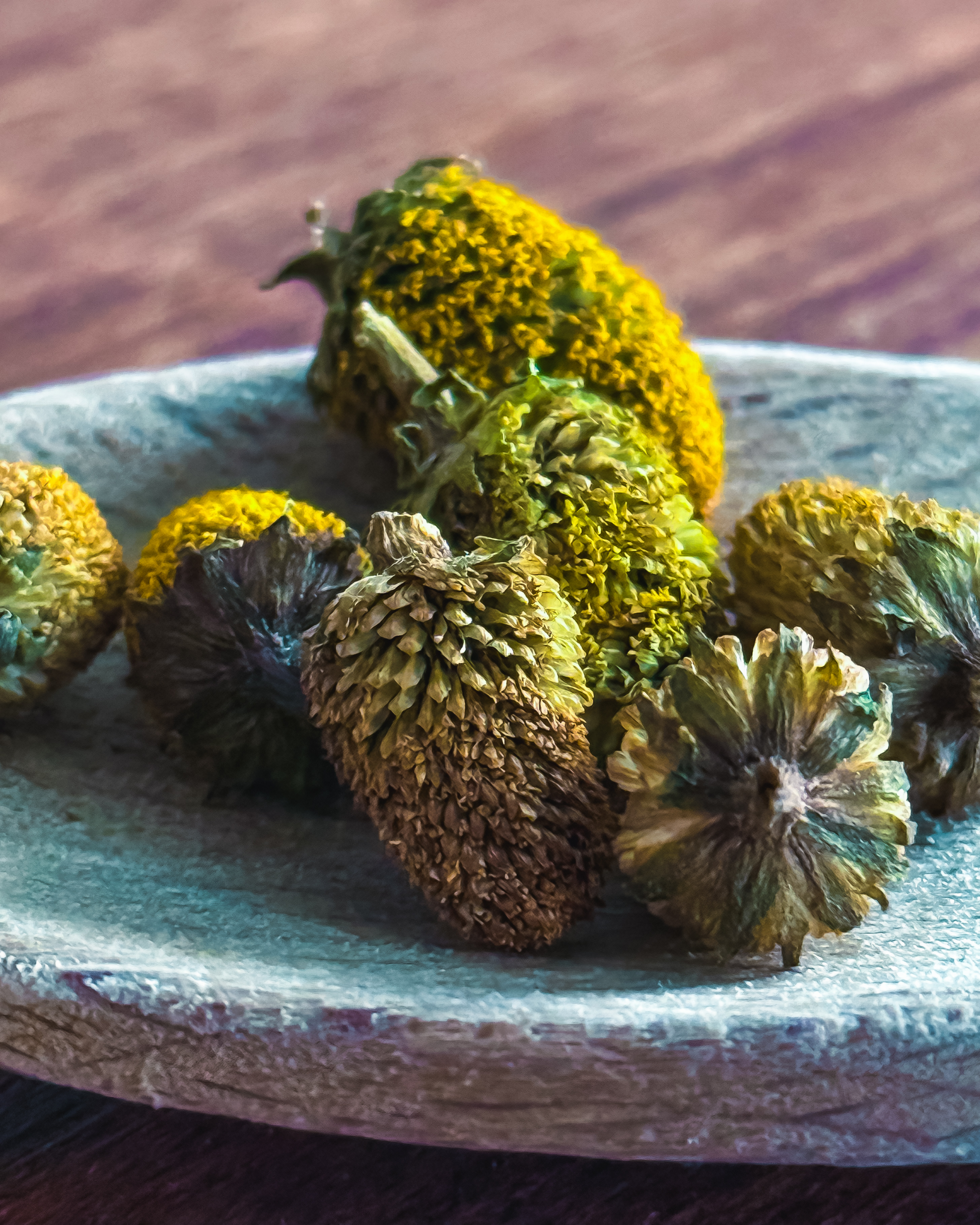
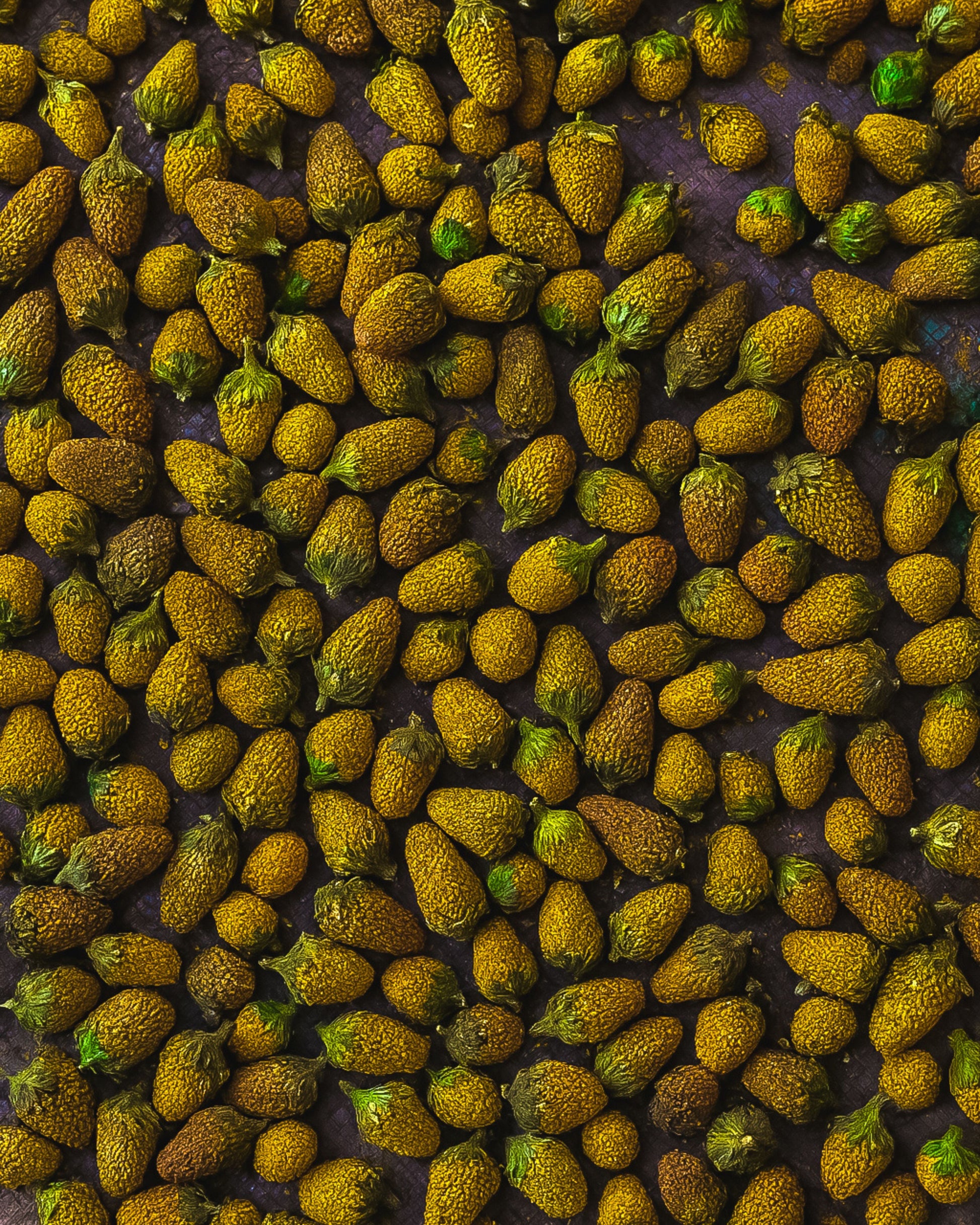
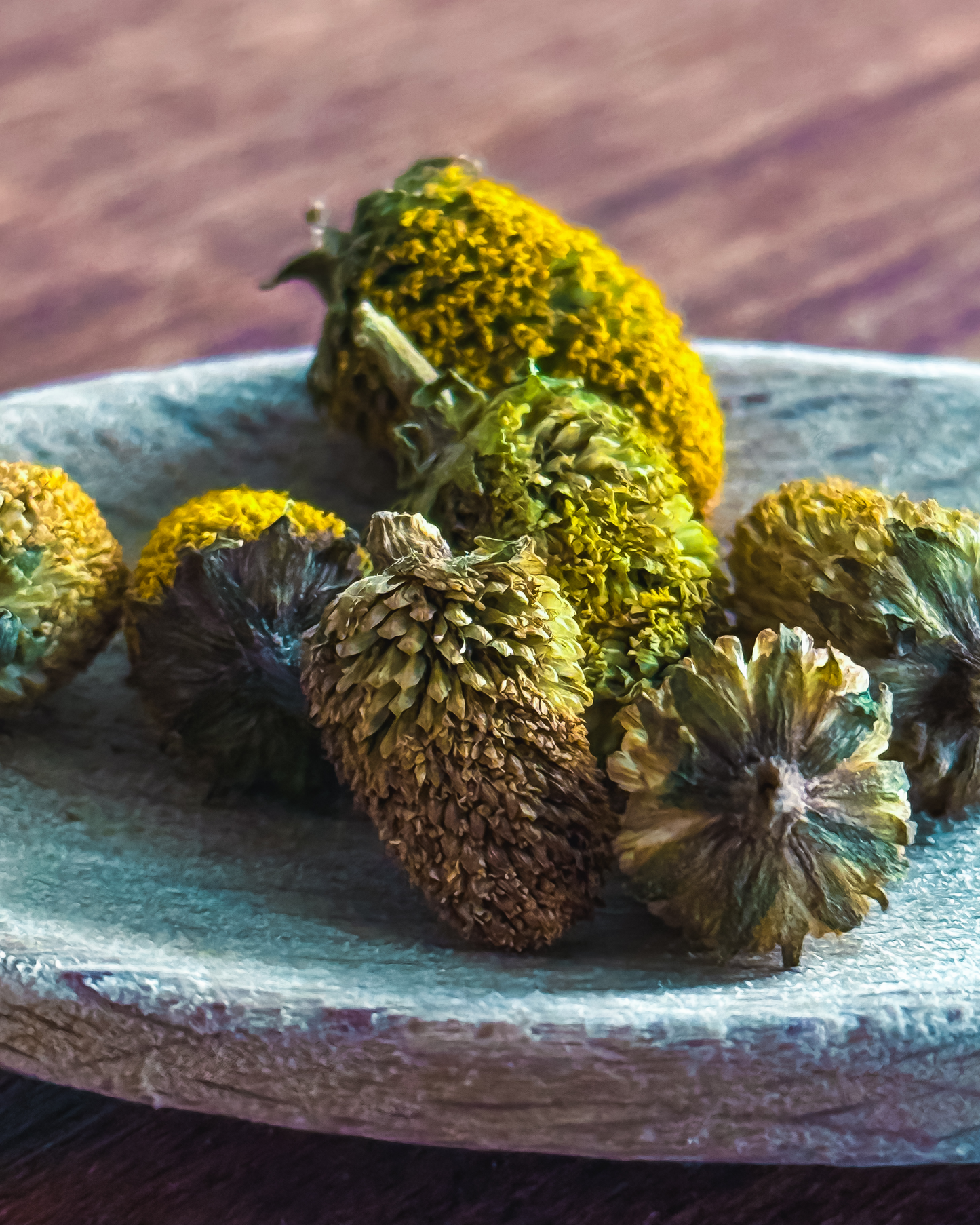
When mature flower heads are used, the process is more directly focused on the plant tissue generally associated with stronger Spilanthol abundance.
The resulting extract may also contain:
- flower pigments;
- waxes;
- aroma constituents;
- and other flower-specific metabolites.
For a Spilanthol-focused ingredient, flower heads are therefore the preferred starting point at Madabuzz.
Leaf Extraction
Leaves can produce valid botanical extracts, but their profile is different.
A leaf extract may recover proportionally more:
- chlorophyll;
- leaf waxes;
- polyphenolic material;
- and other constituents associated with photosynthetic tissue.
In alcohol, especially, leaf material can produce a dark green and chemically complex extract.
In oil, chlorophyll and lipid-compatible leaf constituents may also migrate into the carrier, influencing:
- color;
- aroma;
- oxidative behavior;
- and sensory character.
A leaf extract should therefore not be treated as a lower-cost equivalent of a flower-head extract. It is a different ingredient.
Does Alcohol Extract More Spilanthol Than Oil?
There is no responsible universal answer without specifying:
- the ethanol concentration;
- the carrier oil;
- the plant part;
- moisture content;
- extraction ratio;
- particle size;
- temperature;
- duration;
- number of extraction cycles;
- and the analytical method.
Published research strongly supports ethanol and other organic solvents as effective extraction media for Spilanthol, but that does not by itself prove that every ethanol maceration outperforms every carrier-oil maceration.
Similarly, the fact that Spilanthol has substantial lipophilic character supports the logic of oil maceration, but it does not establish a universal oil extraction yield.
A valid head-to-head comparison requires:
- the same homogenized botanical batch;
- the same dry-mass basis;
- controlled solvent-to-solid ratios;
- comparable extraction conditions;
- complete filtration;
- and quantitative analysis such as HPLC.
Without that experimental control, descriptions such as “stronger,” “better,” or “more concentrated” are impressions rather than verified conclusions.
Is Alcohol Extraction More Concentrated?
Not necessarily.
An alcohol extract may appear more concentrated because ethanol can later be evaporated, leaving a reduced-volume extract or dry residue.
An oil macerate usually remains diluted within its carrier oil unless further processing is used.
This makes the comparison misleading unless concentration is expressed clearly.
Useful measurements include:
- milligrams of Spilanthol per gram of finished extract;
- milligrams per millilitre;
- percentage by mass;
- and total recovery relative to the dried plant material.
Color and tingling intensity are not substitutes for quantitative analysis.
Neither Method Can Correct Weak Starting Material
The solvent matters, but it cannot manufacture Spilanthol.
If the starting plant material contains a lower concentration of the target compound, the extract will begin with that limitation.
This is why raw-material decisions remain essential:
- botanical identity;
- flower-head selection;
- maturity;
- harvest timing;
- drying;
- moisture control;
- storage;
- and batch traceability.
An advanced ethanol process using mixed leaves and stems may not deliver the same Spilanthol-focused profile as a carefully prepared extract made from mature flower heads.
Likewise, premium flowers cannot compensate for a poorly controlled extraction.
Quality depends on both sides of the process:
High-quality botanical material + suitable extraction conditions + analytical verification
Key Takeaways from Part 1
- Oil and ethanol can both serve as extraction media for Acmella oleracea, but they produce different ingredient systems.
- Oil maceration creates an extract that remains in a lipid carrier and is well suited to anhydrous formulations.
- Ethanol extraction can recover a broad range of constituents and may be concentrated or processed further.
- Spilanthol has mixed chemical character, with a substantial nonpolar chain and a polar amide group.
- Solvent composition affects the entire phytochemical profile, not only Spilanthol.
- Hydroethanolic extracts can recover more water-compatible plant material than nearly anhydrous ethanol.
- Leaves and flower heads produce chemically different extracts.
- Flower heads are the preferred starting material when the objective is a Spilanthol-focused extract.
- Neither alcohol nor oil can be declared universally superior without a controlled analytical comparison.
- HPLC or another validated quantitative method is needed to verify actual Spilanthol concentration.
Alcohol vs Oil Extraction: A Practical Head-to-Head Comparison
Part 1 established that alcohol and oil do not create identical Acmella oleracea extracts.
Both can recover Spilanthol, but they differ in extraction speed, selectivity, filtration, stability, sensory properties, formulation compatibility, and processing requirements.
In practice, the best choice depends less on which solvent appears “strongest” and more on what the finished ingredient must do.
An oil macerate may be ideal for a balm or facial oil because the extract is already carried in a cosmetic lipid. An ethanolic extract may be preferable when a formulator needs a broader extract, a more concentrated intermediate, or the ability to remove the solvent during further processing.
This chapter compares the two methods across the factors that matter most to formulators, processors, and ingredient buyers.
Alcohol vs Oil Extraction at a Glance
| Factor | Oil Maceration | Ethanol Extraction |
|---|---|---|
| Typical finished form | Botanical oil | Liquid alcoholic extract or concentrate |
| Extraction speed | Usually slower | Usually faster |
| Spilanthol suitability | Potentially suitable | Well documented in research |
| Broader polar compounds | Limited | Greater with water-containing ethanol |
| Direct use in anhydrous cosmetics | Excellent | Usually requires formulation planning |
| Use in water-based cosmetics | Requires emulsification | Requires compatibility assessment |
| Solvent removal | Usually not performed | Possible with suitable equipment |
| Main stability concern | Oil oxidation | Evaporation, water activity, and formulation compatibility |
| Filtration | Can be slow due to viscosity | Usually easier because ethanol is less viscous |
| Fire risk | Low under normal handling | Significant; ethanol is flammable |
| Home accessibility | High | Moderate |
| Concentration potential | Limited by carrier loading | Can be concentrated after extraction |
| Sensory effect | Determined partly by the carrier oil | Alcoholic, cooling, potentially drying |
| Scalability | Straightforward but storage-intensive | Efficient but requires solvent controls |
These are general tendencies rather than guaranteed outcomes. Plant material, solvent ratio, temperature, time, particle size, and analytical method can substantially change the result.
Which Method Extracts Faster?
In most comparable maceration systems, ethanol is expected to move through plant material faster than a viscous carrier oil.
This is partly because ethanol:
- has lower viscosity;
- wets dried botanical particles efficiently;
- penetrates small spaces within plant tissue;
- and supports relatively rapid molecular diffusion.
Oil is thicker and usually moves through plant structures more slowly. Its viscosity can also make agitation and filtration more difficult.
This does not mean that every ethanol extraction reaches its maximum useful recovery immediately. Extraction still depends on solvent strength, plant preparation, temperature, time, and mixing.
Research using Acmella oleracea flower heads has shown that extraction time, temperature, solvent composition, and added water can materially affect Spilanthol recovery. These variables were specifically investigated in a study comparing ethanol with natural deep eutectic solvents using HPLC-DAD quantification.
Practical Meaning
For a small oil maceration, time is often used to compensate for slower mass transfer.
For ethanol extraction, extending the process indefinitely may add little value once the system approaches equilibrium. It may instead recover more pigments, waxes, or unwanted background compounds.
The useful question is not:
How long can I leave it?
It is:
At what point does additional time stop producing a meaningful improvement?
Only controlled comparisons and analytical testing can answer that precisely for a particular method.
Which Method Can Produce a More Concentrated Ingredient?
Ethanol generally offers more options for concentration because it is volatile.
After filtration, some or all of the ethanol can be removed under controlled conditions to create:
- a reduced-volume liquid;
- a soft extract;
- a resin-like concentrate;
- or, with suitable processing, a dried extract.
That does not automatically make the original extraction more efficient. It means the finished volume can be reduced after extraction.
An oil macerate normally retains its carrier oil. Removing that carrier is not a routine step and would require additional separation or purification technology.
Consequently, an oil extract may contain useful Spilanthol while still being relatively dilute because the carrier remains part of the product.
Compare Concentrations Correctly
A fair comparison should use defined units, such as:
- milligrams of Spilanthol per gram of finished extract;
- milligrams per millilitre;
- percentage by mass;
- or total Spilanthol recovered per gram of dried plant material.
Comparing color, aroma, tingling intensity, or total dry residue does not prove which extract contains more Spilanthol.
Choosing a Carrier Oil
The carrier oil is not a neutral container. It influences extraction behavior, shelf stability, texture, aroma, color, cost, and the final formulation.
Sunflower Oil
Sunflower oil is widely available and has a relatively light cosmetic feel.
Its advantages include:
- broad familiarity;
- good compatibility with many balms and emulsions;
- mild aroma when refined;
- and accessible pricing.
Its oxidative stability depends strongly on its fatty-acid profile. High-oleic sunflower oil is generally more resistant to oxidation than conventional high-linoleic material.
For a commercial product, the exact grade should be documented rather than referring only to “sunflower oil.”
Medium-Chain Triglycerides
MCT oil, often sold in cosmetics as caprylic/capric triglyceride, has several practical advantages:
- low viscosity;
- light skin feel;
- neutral aroma;
- good oxidative stability;
- and easy filtration compared with heavier oils.
Its low viscosity may support better contact with prepared flower material than a thick oil, although actual Spilanthol recovery should still be verified rather than assumed.
MCT is especially suitable when the finished macerate will be used in:
- facial oils;
- light serums;
- roll-on products;
- or the oil phase of an emulsion.
Jojoba
Jojoba is technically a liquid wax rather than a conventional triglyceride oil.
It is valued for:
- strong oxidative stability;
- elegant skin feel;
- long-term sensory consistency;
- and premium cosmetic positioning.
Its main limitation is cost.
Jojoba may be an excellent finished carrier, but using it for the entire extraction can be unnecessarily expensive when the extract will later be diluted into a broader formulation.
A manufacturer may therefore compare direct jojoba maceration with extraction into a more economical stable lipid followed by formulation adjustments.
Olive Oil
Olive oil has a long history in traditional botanical preparations.
Its advantages include:
- availability;
- substantial monounsaturated fat content;
- familiar consumer perception;
- and compatibility with balms and body products.
Its disadvantages may include:
- distinct aroma;
- noticeable color;
- heavier skin feel;
- and greater influence on the sensory profile of the finished product.
Olive oil may be suitable for traditional preparations but less appropriate when a light, neutral, nearly colorless cosmetic ingredient is required.
Sweet Almond Oil
Sweet almond oil has an elegant cosmetic feel and is commonly used in body oils and massage products.
However, it is more oxidation-sensitive than highly stable carrier systems and introduces allergen-management considerations for some brands and markets.
Its suitability should therefore be judged within the full product-development and labeling context.
Fractionated Coconut Oil
Fractionated coconut oil is closely related to MCT-type carriers and generally offers:
- low viscosity;
- neutral aroma;
- clear appearance;
- and good oxidation resistance.
Terminology and composition vary between suppliers, so formulators should review the technical specification rather than relying only on the marketing name.
Carrier-Oil Comparison
| Carrier | Texture | Oxidative Stability | Aroma | Best Fit |
|---|---|---|---|---|
| High-oleic sunflower oil | Light to medium | Good | Mild | General cosmetic macerates |
| MCT/caprylic-capric triglyceride | Very light | Very good | Neutral | Facial oils and light serums |
| Jojoba | Light, silky | Excellent | Mild | Premium cosmetics |
| Olive oil | Rich | Moderate to good | Distinctive | Traditional balms and body oils |
| Sweet almond oil | Light to medium | Moderate | Mild | Massage and body care |
| Fractionated coconut oil | Very light | Very good | Neutral | Clear, lightweight products |
The table compares carrier properties, not confirmed Spilanthol yields.
A lighter or more stable oil is not automatically a more powerful extraction solvent.
Choosing the Alcohol Strength
“Ethanol extraction” can describe very different methods.
A nearly anhydrous ethanol system behaves differently from a mixture containing substantial water.
High-Strength Ethanol
High-strength ethanol generally favors less polar and moderately polar constituents.
Potential advantages include:
- good compatibility with Spilanthol extraction;
- relatively low water introduction;
- rapid wetting;
- easier solvent removal;
- and lower extraction of some highly water-soluble plant constituents.
Published studies have used ethanol as an effective extraction agent for Spilanthol from Acmella oleracea flower heads, with chromatographic methods used to quantify recovery.
However, high-strength ethanol is highly flammable and requires appropriate storage, ventilation, equipment, and operating procedures.
Hydroethanolic Mixtures
Adding water changes the polarity of the solvent.
A hydroethanolic mixture may recover more:
- sugars;
- certain phenolic compounds;
- organic acids;
- salts;
- and other polar constituents.
That may be desirable for a broad-spectrum botanical extract.
It may be undesirable when the objective is a cleaner, Spilanthol-focused intermediate.
Hydroethanolic flower extracts have been characterized in published Acmella oleracea research, confirming that these mixtures recover complex groups of plant constituents rather than Spilanthol alone.
More water also changes:
- drying requirements;
- microbial considerations;
- evaporation behavior;
- and compatibility with the final formulation.
Is 70% Ethanol Better Than 95%?
Neither concentration is universally better.
A water-containing system may penetrate dried plant tissues effectively and broaden the extraction spectrum. A higher-ethanol system may provide a more selective environment for less polar constituents and be easier to concentrate.
The correct choice depends on the target profile.
A useful development process would compare multiple solvent strengths using the same flower batch and then evaluate:
- Spilanthol concentration;
- total recovery;
- color;
- sediment;
- extractive solids;
- filtration time;
- and stability.
Without this controlled comparison, selecting an exact ethanol percentage is largely empirical.
Can Vodka Be Used?
Commercial vodka generally contains much more water than laboratory or high-strength food-grade ethanol.
It may create a botanical tincture, but it should not be assumed to be optimal for Spilanthol-focused extraction.
Possible limitations include:
- lower ethanol strength;
- broader extraction of water-compatible compounds;
- more water remaining in the finished extract;
- greater difficulty concentrating the product;
- and brand-to-brand variability.
Vodka is also not an appropriate substitute for controlled manufacturing-grade solvent when reproducibility, documentation, or regulatory compliance is required.
Food-Grade, Cosmetic-Grade, and Denatured Ethanol
The intended use determines the acceptable alcohol grade.
Food-Grade Ethanol
Food-grade ethanol may be required when the process or finished material is intended for food-compatible applications, subject to local regulation.
Cosmetic-Grade Ethanol
Cosmetic-grade ethanol may be suitable for external-use formulations, provided its specification and denaturants are compatible with the intended product and market.
Denatured Alcohol
Denatured alcohol contains additives intended to discourage consumption.
Not all denaturants are suitable for every cosmetic, and some may affect:
- odor;
- skin feel;
- toxicological assessment;
- labeling;
- or regulatory acceptance.
Never assume that any product labeled “denatured alcohol” is suitable for botanical extraction.
The complete composition and technical documentation must be reviewed.
Isopropyl Alcohol
Isopropyl alcohol should not be casually substituted for ethanol in botanical extracts intended for consumer formulations. Solvent selection must account for toxicology, residual-solvent limits, intended use, and applicable regulations.
Flower Heads and Leaves Require Different Strategies
The same solvent can behave differently when the plant material changes.
Oil Extraction of Flower Heads
A flower-head oil macerate is usually the most direct route to a lipid-compatible, Spilanthol-focused ingredient.
Potential benefits include:
- lower chlorophyll loading than a leaf-heavy extract;
- a cleaner color;
- fewer leaf-derived waxes;
- and a raw material naturally focused on the plant tissue generally richest in Spilanthol.
The flowers should still be evaluated for:
- maturity;
- dryness;
- cleanliness;
- particle size;
- and storage history.
Oil Extraction of Leaves
Leaf material may:
- absorb more oil;
- introduce stronger green color;
- contribute more chlorophyll and waxes;
- produce more sediment;
- and give a heavier botanical odor.
Because the relative Spilanthol content is generally lower than in mature flower heads, a leaf oil should not automatically use the same plant-to-solvent ratio or processing assumptions as a flower extract.
Adding more leaf material can also make filtration more difficult without guaranteeing a proportionate increase in Spilanthol.
Practical Insight
Trying to compensate for lower-value plant material by packing the vessel more tightly can backfire.
Overpacking may:
- trap air;
- reduce solvent movement;
- create dry pockets;
- complicate agitation;
- and retain a large amount of finished oil in the spent plant material.
Ethanol Extraction of Flower Heads
Ethanol typically penetrates prepared flower material efficiently and can produce a concentrated intermediate suitable for analysis or further processing.
Because the extract can be concentrated after filtration, it offers flexibility for professional manufacturing.
However, concentration can also enrich:
- pigments;
- waxes;
- off-odors;
- and other co-extracted constituents.
Purification may therefore be required when a cleaner Spilanthol-rich fraction is needed. Published work has described enrichment and purification approaches for Spilanthol-containing Acmella extracts, including removal of polar or acidic substances and solid-phase extraction.
Ethanol Extraction of Leaves
Leaf extraction with ethanol can produce a highly colored and chemically broad liquid.
The result may contain more:
- chlorophyll;
- phenolic material;
- leaf acids;
- and water-compatible compounds when hydroethanolic solvents are used.
This may be useful when the target is a broad leaf extract.
It is less desirable when the goal is a clean, lightly colored, Spilanthol-focused cosmetic ingredient.
Filtration Differences
Filtering Oil
Oil filtration can be slow because carrier oils are viscous.
Common challenges include:
- fine particles clogging filters;
- substantial extract remaining trapped in the plant material;
- prolonged dripping;
- and cloudy sediment after initial filtration.
Better Practice
Use a staged process:
- Remove coarse material with an appropriate mesh.
- Allow the extract to settle.
- Decant the clearer upper phase.
- Perform a finer final filtration only when needed.
Trying to pass a plant-heavy oil directly through a very fine paper filter often results in slow processing and unnecessary product loss.
Filtering Ethanol
Ethanol’s lower viscosity generally makes filtration faster.
However, finely milled plant material can still clog filters and pass into the finished extract.
Alcohol may also evaporate during prolonged open filtration, changing the extract volume and concentration.
Containers should therefore remain covered as much as the method safely permits, and the recovered volume should be recorded.
Stability: Oil Oxidation vs Alcohol Evaporation
Oil Extract Stability
The main risk for an oil macerate is oxidation.
Oxidation can lead to:
- rancid odor;
- color changes;
- increased peroxide formation;
- altered sensory properties;
- and reduced suitability for cosmetic use.
The oxidation rate depends on:
- carrier composition;
- light exposure;
- heat;
- oxygen;
- moisture;
- metals;
- botanical particles;
- and antioxidant content.
A flower macerate may be less stable than the unused carrier because plant material can introduce moisture, trace metals, enzymes, pigments, and reactive compounds.
Therefore, the published shelf life of the original carrier oil should not be copied automatically onto the finished macerate.
Ethanol Extract Stability
Ethanol is less vulnerable to rancidity, but ethanol extracts have other risks:
- solvent evaporation;
- changes in concentration;
- precipitation after dilution;
- light-sensitive constituents;
- and microbial concerns when substantial water is present.
A poorly sealed bottle may lose ethanol over time, changing the extract’s strength and solvent balance.
If ethanol is partly removed, the remaining concentrate may also become more viscous, less soluble, or more prone to precipitation.
Temperature and Agitation
Heat can accelerate both alcohol and oil extraction, but it also creates risks.
For oil:
- higher temperature lowers viscosity;
- diffusion may increase;
- but oxidation also accelerates.
For ethanol:
- warmth can improve extraction speed;
- but evaporation and flammability risks increase significantly.
Alcohol should never be heated near an open flame, domestic gas burner, unclassified electrical source, or poorly ventilated area.
Industrial solvent processing requires equipment designed for flammable liquids.
Gentle Agitation
Agitation improves solvent contact with the plant material.
Useful techniques include:
- slow inversion;
- gentle stirring;
- controlled mechanical mixing;
- or recirculation in professional systems.
Aggressive grinding or continuous high-shear mixing is not always beneficial. It may increase fine particles and complicate filtration without producing a proportionate increase in target-compound recovery.
Practical Recommendations by End Use
| Intended Product | Usually More Practical | Why |
|---|---|---|
| Facial oil | Oil macerate | Direct lipid compatibility |
| Balm or salve | Oil macerate | Easy incorporation into the oil phase |
| Massage oil | Oil macerate | Ready-to-use carrier system |
| Alcoholic tincture | Ethanol | The solvent remains part of the product |
| Concentrated manufacturing intermediate | Ethanol | Can be concentrated or processed further |
| Research extract | Ethanol or validated laboratory solvent | Easier quantitative control and processing |
| Cream or lotion | Depends | Oil extract enters the oil phase; ethanol extract needs compatibility assessment |
| Clear water-based serum | Neither without formulation work | Solubilization, emulsification, or encapsulation may be needed |
| Standardized Spilanthol ingredient | Validated method plus testing | Solvent choice alone cannot confirm potency |
Practical “Genius” Tips That Prevent Common Failures
1. Choose the Final Product Before Choosing the Solvent
Do not make an alcohol extract and later discover that your formula cannot tolerate ethanol.
Do not make an olive-oil macerate and later decide that you need a clear, weightless serum.
Start with the intended dosage form.
2. Compare Solvents Using One Botanical Batch
Never compare an oil made from one harvest with an alcohol extract made from another and assume that the solvent caused every difference.
Use a homogenized flower-head batch when testing extraction systems.
3. Weigh Everything
Record:
- dried plant mass;
- initial solvent mass;
- recovered extract mass;
- retained solvent;
- filtration losses;
- and final volume.
Without mass balance, it is difficult to understand whether a process is genuinely efficient.
4. Do Not Judge Strength by Color
A dark green extract may simply contain more chlorophyll.
A pale extract may still contain substantial Spilanthol.
Color is a process observation, not a potency measurement.
5. Avoid Ultra-Fine Powder Unless You Have Suitable Filtration
Fine powder increases surface area, but it also creates:
- clogged filters;
- high sediment;
- larger processing losses;
- and cloudy finished extracts.
Coarsely prepared flower heads often provide a better practical balance.
6. Keep Dried Material Fully Submerged
Exposed plant material can oxidize and may introduce stability concerns, especially when residual moisture is present.
Use a vessel size and solvent amount that maintain complete contact.
7. Do Not Add Antioxidants to Hide Poor Processing
An antioxidant may help protect a suitable oil system, but it cannot reverse:
- rancidity;
- microbial contamination;
- excessive moisture;
- or damaged starting material.
Good process control comes first.
8. Retain a Reference Sample
Keep a small sealed sample of:
- the dried flower batch;
- the fresh carrier or ethanol;
- and the finished extract.
Reference samples are valuable when investigating changes in aroma, color, sediment, or laboratory results.
Which Method Wins Part 2?
Neither method wins every category.
Oil extraction is usually the simpler choice when the intended product is already oil-based.
Ethanol extraction is usually the more flexible choice when the extract must be concentrated, analyzed, fractionated, or processed into different ingredient forms.
But solvent choice alone cannot establish quality.
A meaningful evaluation must also consider:
- plant part;
- flower maturity;
- drying;
- moisture;
- solvent specification;
- extraction ratio;
- processing conditions;
- filtration;
- final concentration;
- stability;
- and laboratory verification.
The best extract is not the darkest, strongest-smelling, most tingling, or most expensive.
It is the extract whose composition, purpose, and quality are clearly understood.
Key Takeaways from Part 2
- Ethanol usually extracts more quickly than viscous carrier oils.
- Oil macerates are directly compatible with balms, oils, and other anhydrous products.
- Ethanol extracts can be concentrated or purified after filtration.
- Carrier oils differ in viscosity, oxidation resistance, aroma, color, and cosmetic feel.
- High-strength ethanol and hydroethanolic mixtures do not produce the same extract.
- Vodka is not equivalent to controlled high-strength ethanol.
- Flower-head and leaf extracts require different expectations and processing decisions.
- Leaf-heavy extracts may contain more chlorophyll, sediment, and plant waxes.
- Oil stability is strongly influenced by oxidation.
- Alcohol extracts must be protected from evaporation and solvent-composition changes.
- Color and sensory intensity cannot verify Spilanthol concentration.
- Controlled batch comparisons and quantitative analysis are required to determine which method recovers more Spilanthol.
Which Extraction Method Should You Choose?
The comparison between alcohol and oil extraction becomes useful only when it leads to a practical decision.
Neither method is universally superior.
The right choice depends on:
- the intended finished product;
- the required concentration;
- the available processing equipment;
- the acceptable solvent system;
- the desired sensory profile;
- and the level of analytical control required.
An oil macerate may be the most efficient solution for a balm because it can enter the formula directly.
An ethanol extract may be more appropriate for a manufacturer that needs to quantify, concentrate, purify, or reformulate the extract.
The deciding question is therefore:
What must the finished extract do?
This final chapter provides a decision framework for home formulators, cosmetic developers, laboratories, and commercial buyers.
The Practical Decision in One Table
| Intended Use | Usually More Practical | Main Reason |
|---|---|---|
| Facial oil | Oil macerate | Direct compatibility with an anhydrous formula |
| Balm or salve | Oil macerate | Can be added directly to the lipid phase |
| Massage oil | Oil macerate | Carrier oil is already part of the product |
| Oil serum | Oil macerate | Simple formulation and favorable skin feel |
| Alcoholic botanical extract | Ethanol | Solvent remains part of the preparation |
| Concentrated intermediate | Ethanol | Solvent can be removed under controlled conditions |
| Standardized manufacturing ingredient | Validated ethanol or other professional process | Easier enrichment and quantitative control |
| Cream or lotion | Either, with formulation planning | Oil and ethanol enter the system differently |
| Water-based serum | Neither without additional technology | Dispersion or solubilization is required |
| Laboratory research | Validated analytical extraction method | Reproducibility matters more than convenience |
These recommendations are starting points, not fixed rules. The actual choice should be supported by compatibility testing, stability evaluation, and, when Spilanthol concentration matters, quantitative analysis.
Choose Oil Extraction for Anhydrous Products
Oil maceration is usually the most direct option when the final product contains little or no water.
Examples include:
- facial oils;
- body oils;
- beard oils;
- massage oils;
- balms;
- salves;
- oil serums;
- and solid cosmetic sticks.
The carrier oil performs two functions at once:
- It extracts oil-compatible plant constituents.
- It becomes part of the finished formulation.
This can reduce processing steps because there is no need to remove the extraction solvent before use.
Example: A Facial Oil
Suppose a formulator wants to create a lightweight facial oil containing an Acmella oleracea flower-head macerate.
A relatively light and oxidation-resistant carrier, such as MCT or a suitable high-oleic oil, may provide a more elegant sensory profile than a strongly aromatic, heavier oil.
The formulator still needs to consider:
- the concentration of the macerate in the finished product;
- carrier-oil stability;
- packaging;
- antioxidant strategy;
- skin feel;
- color;
- odor;
- and microbial risk introduced by residual plant moisture.
Oil extraction is convenient, but convenience does not eliminate the need for product testing.
Choose Ethanol When You Need Processing Flexibility
Ethanol extraction is generally more flexible when the extract will undergo further manufacturing.
After filtration, an ethanol extract may be:
- retained as a liquid;
- diluted to a defined concentration;
- concentrated;
- fractionated;
- purified;
- or converted into another ingredient format.
Published research has demonstrated ethanol-based extraction of Spilanthol from Acmella oleracea flower heads and has used chromatographic methods to quantify how processing variables affect recovery.
Research has also described methods for enriching Spilanthol-containing extracts by removing more polar or acidic constituents from crude material. This illustrates why ethanol extraction often serves as a manufacturing intermediate rather than the final consumer-ready ingredient.
Example: A Standardized Cosmetic Ingredient
A manufacturer may begin with a filtered ethanolic flower-head extract, quantify the Spilanthol concentration, and then concentrate or reformulate it into a carrier suitable for cosmetic use.
This offers greater control than a simple oil maceration, but it also requires:
- equipment suitable for flammable solvents;
- controlled solvent removal;
- residual-solvent evaluation where applicable;
- mass-balance records;
- and stability testing after concentration.
Ethanol creates options. It also creates responsibilities.
Can an Alcohol Extract Be Added Directly to a Cream?
Sometimes, but not automatically.
A cream is an emulsion containing both oil and water phases. Adding an alcoholic botanical extract changes that balance.
Depending on the amount and composition, ethanol may affect:
- emulsion viscosity;
- preservative performance;
- emulsifier behavior;
- fragrance;
- skin feel;
- evaporation rate;
- and packaging compatibility.
An ethanol extract containing substantial dissolved plant material may also cause:
- precipitation;
- color changes;
- graininess;
- instability;
- or separation after dilution.
The formulator must consider not only the ethanol but also everything dissolved in it.
Better Development Approach
Instead of pouring an alcoholic extract into a finished cream, a professional formulator would normally:
- Define the target amount of Spilanthol or extract.
- Review the extract’s solvent composition.
- Add it at an appropriate stage of manufacturing.
- Reassess the emulsifier and preservative system.
- Conduct centrifuge, heat, freeze–thaw, and real-time stability testing as appropriate.
- Confirm that no precipitation or phase separation occurs.
The exact program depends on the product, market, and applicable quality system.
Can an Oil Macerate Be Added to a Cream?
Yes, but it becomes part of the cream’s oil phase.
That means the amount of macerate must be included when calculating:
- total oil-phase percentage;
- emulsifier demand;
- viscosity;
- sensory profile;
- and oxidation risk.
Replacing part of an existing carrier oil with an Acmella macerate is usually more rational than adding it on top of an already balanced formula.
For example, a formulator might replace part of the planned MCT or sunflower oil with a flower-head macerate made in the same or a compatible carrier.
The revised product must still be tested as a new formulation.
Even a seemingly small oil substitution can alter:
- spreadability;
- absorption;
- emulsion structure;
- color;
- odor;
- and long-term stability.
What About Water-Based Serums?
Spilanthol’s structure includes a substantial lipophilic region, and PubChem lists a calculated XLogP value consistent with meaningful affinity for less polar environments. It should not be expected to disperse uniformly in plain water without an appropriate delivery system.
A water-based serum may therefore require:
- a solubilizer;
- an emulsifier;
- a nanoemulsion;
- a liposomal system;
- an encapsulation technology;
- or a pre-formulated water-dispersible ingredient.
Recent formulation research has investigated Acmella oleracea extracts in nanoemulsions and hydrogels, showing that delivery-system design can strongly influence dispersion and release behavior.
This does not mean every nanoemulsion will work.
The formulation still needs to be designed around:
- extract composition;
- droplet size;
- surfactant system;
- pH;
- viscosity;
- preservation;
- and packaging.
Can Alcohol and Oil Extracts Be Mixed?
They can be combined only within a properly designed formulation.
Oil and ethanol are not automatically incompatible, but their behavior depends on:
- ethanol concentration;
- water content;
- oil type;
- emulsifier or solubilizer;
- total botanical load;
- temperature;
- and the rest of the formulation.
A small amount of ethanol may remain compatible with an emulsion.
A larger amount may thin, destabilize, or alter it.
Simply shaking an alcohol extract into oil may create temporary cloudiness or separation rather than a stable product.
Important Distinction
A temporarily mixed liquid is not necessarily a stable formulation.
A product should remain acceptably uniform during:
- storage;
- transport;
- temperature changes;
- repeated opening;
- and normal consumer use.
That requires formulation science, not just vigorous shaking.
What Is Solvent Exchange?
Solvent exchange is a professional process in which an extract is transferred from one solvent system into another.
For example, a manufacturer may:
- Extract flower heads with ethanol.
- Filter the extract.
- Remove ethanol under controlled conditions.
- Redisperse the concentrated material into an oil or another suitable carrier.
This can combine the extraction efficiency and flexibility of ethanol with the final-use advantages of an oil-compatible ingredient.
However, solvent exchange is not as simple as evaporating alcohol and adding oil.
During concentration:
- some compounds may precipitate;
- volatile constituents may be lost;
- oxidation may increase;
- the concentrate may become difficult to redisperse;
- and Spilanthol stability may depend on processing conditions.
The final oil-dispersed ingredient should be tested to confirm:
- uniformity;
- Spilanthol concentration;
- residual solvent;
- sediment formation;
- and stability.
Do Not Evaporate Ethanol Casually
Ethanol is highly flammable.
Attempting to evaporate it over a domestic flame, stove, hot plate not designed for flammable solvents, or in a poorly ventilated room can create a serious fire hazard.
Professional solvent removal may use:
- a rotary evaporator;
- a closed vacuum system;
- explosion-rated equipment;
- controlled ventilation;
- and documented operating procedures.
Reduced-pressure processing allows solvent removal at lower temperatures, but it still requires suitable equipment and trained operators.
For home users, an oil macerate is often the more practical option when the final product is oil-based because it avoids solvent-removal hazards altogether.
Which Method Is Better for Flower Heads?
Both can be appropriate.
The choice depends on the objective.
Oil Is Usually Better When:
- the extract will remain in a cosmetic oil;
- simplicity is important;
- no solvent-removal equipment is available;
- a mild, direct-use ingredient is desired;
- and a moderate botanical concentration is acceptable.
Ethanol Is Usually Better When:
- the extract must be analyzed as an intermediate;
- concentration or enrichment is required;
- multiple finished formats are planned;
- the processor has appropriate solvent-handling equipment;
- or a broader chemical extract is desired.
The fact that flower heads generally provide the strongest starting point for Spilanthol-focused extraction does not determine the final solvent. It simply improves the raw-material foundation.
Which Method Is Better for Leaves?
Leaves can be extracted with either solvent, but the resulting ingredient should not be treated as equivalent to a flower-head extract.
Leaf Oil Macerates
These may be:
- greener;
- more strongly aromatic;
- richer in leaf pigments and waxes;
- more difficult to filter;
- and lower in relative Spilanthol concentration.
Leaf Alcohol Extracts
These may become especially dark and chemically broad because ethanol, and particularly ethanol-water mixtures, can recover numerous leaf-associated constituents.
A leaf extract may be valid when the desired ingredient is specifically a broad Acmella leaf extract.
It is less suitable when the goal is to create a clean, Spilanthol-focused flower-head ingredient.
The right approach is not to label leaves as useless.
It is to identify them honestly as a different raw material with a different chemical outcome.
How Should Commercial Buyers Evaluate an Extract?
A supplier’s description should not be the only evidence.
Serious buyers should request documentation appropriate to the material and intended use.
1. Botanical Identity
The documentation should identify the species clearly as Acmella oleracea and specify the plant part used.
“Paracress extract” is not sufficiently precise on its own.
Ask whether the ingredient is made from:
- flower heads;
- leaves;
- aerial parts;
- whole plants;
- or a mixture.
2. Extraction Solvent
The supplier should disclose the extraction system.
Examples include:
- sunflower oil;
- MCT;
- ethanol;
- ethanol-water;
- glycerin;
- propylene glycol;
- or another validated solvent.
For an oil extract, request the exact carrier identity.
For an alcohol extract, request the alcohol concentration or relevant solvent specification.
3. Plant-to-Solvent Ratio
A ratio provides useful processing context, but it does not prove potency.
A nominal 1:5 extract is not automatically stronger than a 1:10 extract because the result also depends on:
- plant quality;
- plant part;
- moisture;
- extraction efficiency;
- losses;
- and final concentration.
Ratios should support, not replace, analytical data.
4. Spilanthol Analysis
When Spilanthol concentration is commercially important, request a quantitative result produced by a suitable analytical method.
Published studies have used methods including HPLC-DAD, UHPLC-based analysis, mass spectrometry, and quantitative NMR to identify or measure Spilanthol in Acmella materials.
The documentation should state:
- the result;
- the unit;
- the test method;
- the sample or batch number;
- and the testing laboratory.
5. Certificate of Analysis
A certificate of analysis may include:
- appearance;
- botanical identity;
- Spilanthol content;
- moisture or water content;
- microbiological limits;
- heavy metals;
- pesticide residues;
- residual solvents;
- and other specifications relevant to the ingredient.
Not every test is necessary for every product, but the testing plan should reflect the intended use and risk profile.
6. Traceability
The supplier should be able to connect the finished ingredient to:
- its raw-material batch;
- cultivation or collection records;
- harvest period;
- drying process;
- extraction batch;
- and analytical report.
Traceability makes it possible to investigate variation rather than simply guessing at its cause.
7. Stability and Storage Information
Request information about:
- recommended storage temperature;
- light protection;
- expected shelf life;
- packaging;
- and whether the stated shelf life belongs to the tested extract or only to its carrier.
An oil’s standard supplier shelf life should not automatically be transferred to a botanical macerate.
Questions Every Buyer Should Ask
| Question | Why It Matters |
|---|---|
| Which species was used? | Common names may cover different plants |
| Which plant part was extracted? | Flowers and leaves produce different profiles |
| Was the material fresh or dried? | Moisture changes extraction and stability |
| What solvent or carrier was used? | Determines compatibility and extract composition |
| What was the extraction ratio? | Provides process context |
| Was Spilanthol quantified? | Confirms concentration objectively |
| Which method was used? | Results depend on analytical methodology |
| Is the result batch-specific? | Natural materials vary |
| Was residual solvent tested? | Relevant after solvent-based processing |
| What are the storage requirements? | Protects quality after purchase |
| Is there a batch-specific COA? | Links claims to the supplied material |
| Can the supplier provide traceability? | Supports quality assurance |
How Madabuzz Approaches the Decision
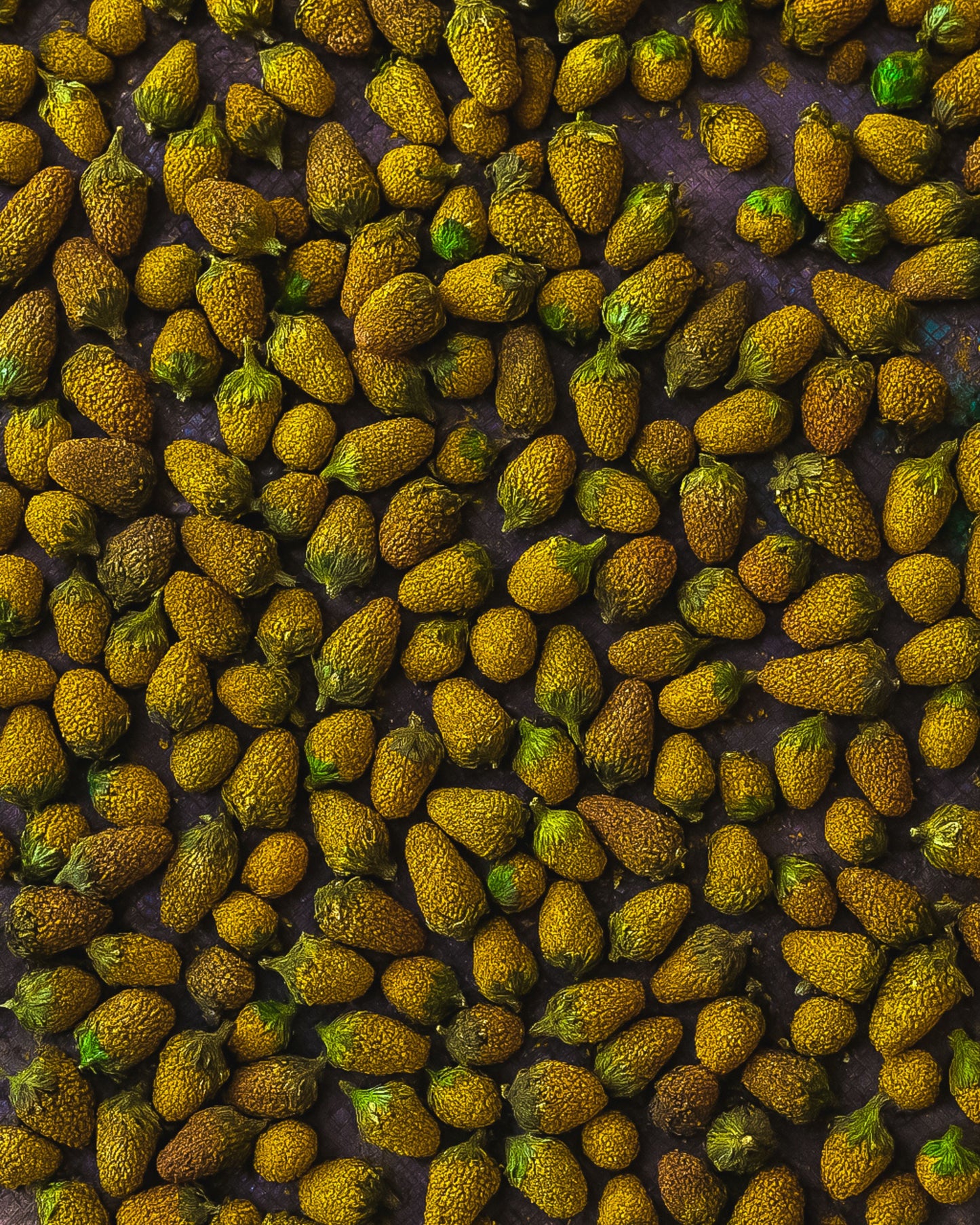
Madabuzz focuses on supplying carefully cultivated and prepared Acmella oleracea flower heads rather than declaring that one universal extraction method is best.
This gives formulators the flexibility to select a process suited to their finished product.
Our approach centers on:
- mature flower heads only;
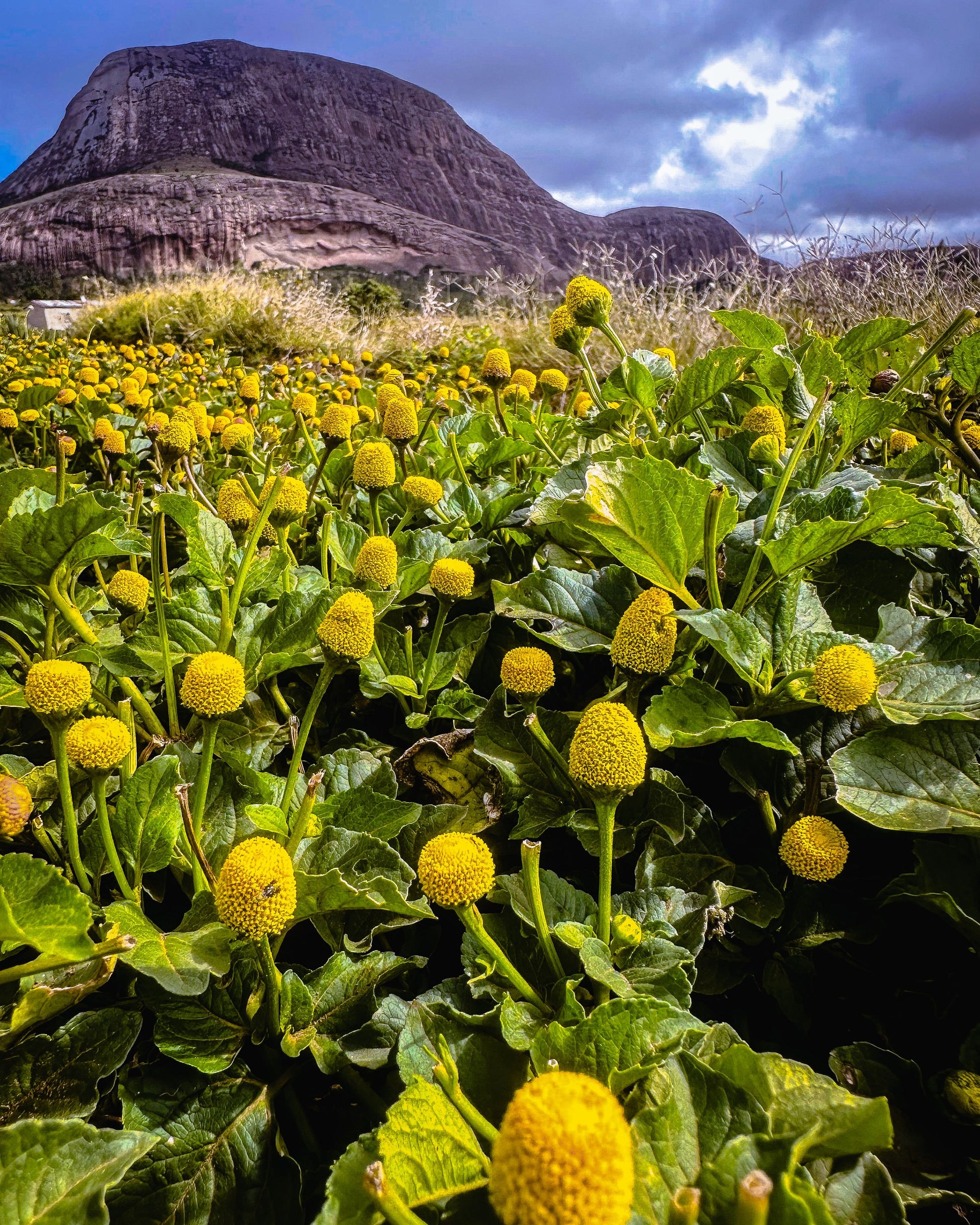
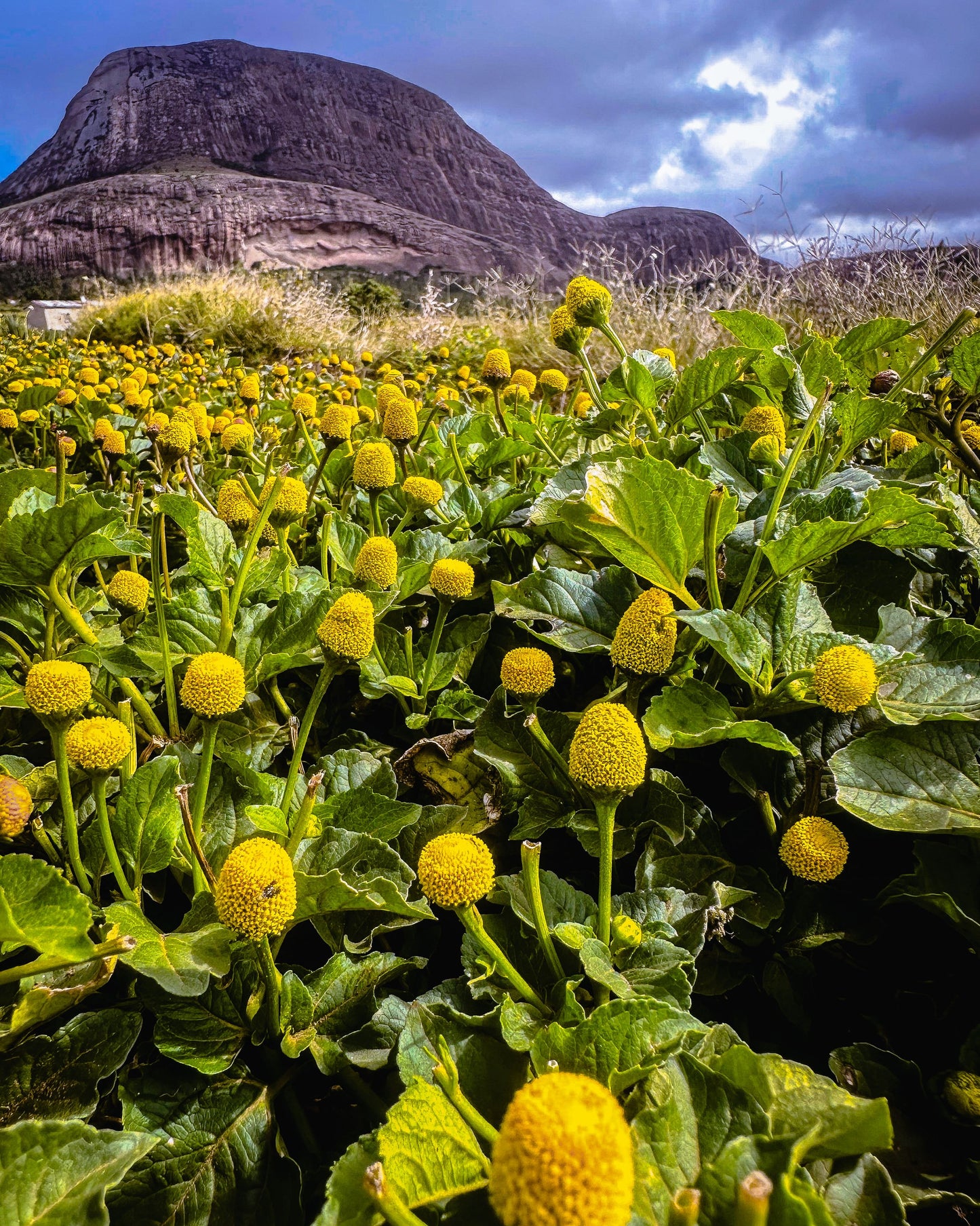
- natural cultivation in Madagascar;
- careful post-harvest handling;
- controlled drying;
- traceable production;
- and independent laboratory analysis.
One independently analyzed reference batch measured 4.01% naturally occurring Spilanthol.
That value belongs to the tested reference batch. It is not presented as a guaranteed concentration for every future harvest.
This distinction matters because the best extraction method still depends on the verified composition of the starting botanical.
A Decision Tree for Formulators
Do you want an anhydrous finished product?
Yes
Use an oil macerate or an oil-compatible standardized extract.
Consider:
- MCT for a light sensory profile;
- jojoba for premium oxidative stability;
- high-oleic sunflower for versatility;
- or another documented cosmetic carrier.
No
Continue to the next question.
Do you need to concentrate or purify the extract?
Yes
A controlled ethanol-based process may offer more flexibility.
Plan for:
- safe solvent handling;
- concentration;
- residual-solvent control;
- and re-dispersion or formulation.
No
Continue to the next question.
Is the product a cream or lotion?
Yes
Either extract type may work, but it must be incorporated into the correct phase and the complete emulsion must be revalidated.
No
Continue to the next question.
Is the product water-based?
Yes
Use a properly designed dispersible delivery system rather than adding raw oil or concentrated extract directly.
Possible approaches include an emulsion, solubilized system, nanoemulsion, or encapsulated ingredient. Research on Acmella nanoemulsions and hydrogels demonstrates the relevance of delivery-system design for dispersing hydrophobic constituents and controlling release.
Do you need a verified Spilanthol concentration?
Yes
Choose a supplier or process that provides batch-specific quantitative analysis.
The solvent name alone cannot confirm potency.
Common Decision-Making Mistakes
Choosing Alcohol Because It Sounds Stronger
Alcohol often provides faster and broader extraction, but broader is not always better.
A highly colored alcohol extract may contain more co-extracted plant material without necessarily providing the best cosmetic ingredient.
Choosing Oil Because It Sounds More Natural
Ethanol can also be derived from fermentation, while carrier oils undergo varying degrees of refining and processing.
“Natural” does not describe extraction performance, purity, stability, or suitability.
Choose according to function and documentation.
Assuming Tingling Equals Concentration
The sensory response to Spilanthol may indicate its presence, but it does not provide a validated concentration.
Perception can be influenced by:
- other compounds;
- solvent;
- dosage;
- contact time;
- individual sensitivity;
- and formulation.
Quantitative claims require analytical measurement.
Ignoring the Carrier in an Oil Extract
Two extracts containing the same botanical material may behave very differently when one uses olive oil and the other uses MCT.
The carrier affects:
- texture;
- aroma;
- oxidation;
- formulation limits;
- and consumer experience.
Ignoring Water in an Alcohol Extract
An ethanol-water extract is not interchangeable with a high-strength ethanol extract.
Water changes:
- polarity;
- co-extraction;
- microbial considerations;
- evaporation;
- and formulation behavior.
Concentrating Without Retesting
Removing solvent changes the ingredient.
After concentration, the manufacturer should not assume that all compounds remain dissolved or that the original analytical result still describes the new material.
Retesting may be required to confirm:
- Spilanthol concentration;
- uniformity;
- precipitation;
- residual solvent;
- and stability.
Frequently Asked Questions
Is alcohol or oil better for extracting Spilanthol?
Neither is universally better. Oil is usually more practical for anhydrous cosmetics, while ethanol offers more flexibility for concentration, purification, analysis, and further manufacturing.
Which method extracts more Spilanthol?
That cannot be answered reliably without a controlled comparison using the same plant batch, defined extraction conditions, and quantitative analysis. Published research supports ethanol as an effective extraction solvent, but this does not prove that every alcohol process outperforms every oil maceration.
Can I put an oil macerate into a cream?
Yes. It should be calculated as part of the oil phase, and the revised cream must be tested for stability, viscosity, preservation, sensory properties, and compatibility.
Can I add an ethanol extract to a serum?
It depends on the serum. A hydroalcoholic serum may tolerate it more easily than a purely water-based gel, but the extract can still cause precipitation, thinning, or preservation changes. Compatibility testing is essential.
Can I mix oil and alcohol extracts together?
They may be combined in a designed emulsion or solubilized system. Simply shaking them together does not ensure long-term stability.
Can I evaporate ethanol at home?
Casual evaporation is unsafe because ethanol vapor is highly flammable. Solvent removal should use appropriate ventilation, equipment, and procedures. For a home-scale oil product, direct oil maceration is usually the safer practical route.
Are leaves suitable for alcohol extraction?
Yes, but they produce a different extract that may contain more chlorophyll and other leaf-derived constituents. A leaf extract should not be presented as equivalent to a flower-head extract.
Why are flower heads preferred for Spilanthol-focused extraction?
Flower heads are generally regarded as the most suitable starting tissue when the objective is a Spilanthol-focused ingredient. Using flower heads also avoids dilution with large amounts of stem and leaf material.
Does a dark extract contain more Spilanthol?
Not necessarily. Dark color may reflect chlorophyll, pigments, oxidation, or broad co-extraction. Spilanthol concentration must be measured analytically.
What documents should I request from a supplier?
Request the species and plant part, extraction solvent, batch number, certificate of analysis, Spilanthol test result when relevant, storage guidance, traceability information, and safety or contaminant testing appropriate to the ingredient.
Scientific Summary
Several conclusions emerge from the alcohol-versus-oil comparison:
Well Supported
- Spilanthol can be recovered using ethanol and several other organic extraction systems.
- Solvent composition, temperature, time, and water content can influence extraction performance.
- Oil and alcohol extracts are not chemically or functionally interchangeable.
- Ethanol can serve as a removable processing solvent.
- A fixed oil normally remains part of the finished macerate.
- Water-based delivery generally requires formulation technology for hydrophobic extract components.
- Nanoemulsion and hydrogel systems have been studied for incorporating Acmella oleracea extracts into dispersed topical systems.
- Quantitative methods are needed to verify actual Spilanthol concentration.
Method-Dependent
- Which solvent produces the highest Spilanthol yield.
- The ideal extraction time.
- The ideal ethanol-water ratio.
- The best carrier oil.
- The useful shelf life of an extract.
- The concentration suitable for a particular cosmetic.
- Whether concentration or solvent exchange improves the final ingredient.
These questions require defined materials, controlled procedures, and appropriate testing.
Conclusion
Alcohol and oil extraction are not competing versions of the same process.
They are different tools.
Oil maceration is usually the simplest path when the finished product is already oil-based. It combines extraction and delivery in one step, making it practical for facial oils, balms, massage products, and other anhydrous formulations.
Ethanol extraction offers greater manufacturing flexibility. It can support faster extraction, analytical testing, concentration, enrichment, purification, and conversion into other ingredient formats. Those advantages come with greater processing complexity and stricter safety requirements.
The starting botanical remains equally important in both systems.
An advanced solvent cannot create Spilanthol that was not present in the plant. Mature flower heads, careful drying, moisture control, traceability, and batch verification provide the foundation from which either extraction method must work.
The best choice is therefore not the method that sounds strongest or most natural.
It is the method that:
- matches the intended formulation;
- uses suitable flower-head material;
- controls relevant variables;
- produces a stable ingredient;
- and verifies important claims with analytical evidence.
That is the difference between simply soaking a plant and developing a dependable botanical extract.
Continue Exploring
Madagascar Collection
- Wild vs. Cultivated Acmella oleracea
- How to Grow Acmella oleracea
- When to Harvest Acmella oleracea
- Flower Heads vs. Leaves
- Complete Botanical Guide to Acmella oleracea
Spilanthol Science
- What Is Spilanthol?
- How Does Spilanthol Work?
- How Is Spilanthol Extracted?
- How Stable Is Spilanthol?
- How Is Spilanthol Measured?
- What Does 4.01% Spilanthol Mean?
Quality Assurance
- How to Read a Certificate of Analysis (COA)
- Why Independent Laboratory Testing Matters
- Understanding Botanical Quality